Somerset Flooding 2026

Somerset had the second wettest January on record with more than double the average rainfall. A third of this rain fell during Storm Chandra, which saw around 1.2 million cubic metres of water per hour moving though the Parrett and Tone catchments. Most of this water spilled into the floodplain of the Levels and Moors. 

Wet weather continued into February, which had almost double the average rainfall by mid-month. Across the county, there have been widespread impacts from flooding.

Somerset Council declared a major incident on 27 January, with the support of the Environment Agency and Local Resilience Partners. You can read more via this link: Somerset Council Newsroom. Although the major incident has since been stepped down, the Environment Agency continues to respond.

While there are Flood Warnings in force across Somerset, pumping operations are active on the Somerset Levels and Moors, and while we are undertaking flood recovery activities, we will have this page live for updates, additional information and guidance. The latest updates can be found in the newsfeed at the bottom of this page.
How is the Environment Agency responding to the flooding?

We’ve brought people and equipment from around the country to Somerset to help with the flood response. We have:

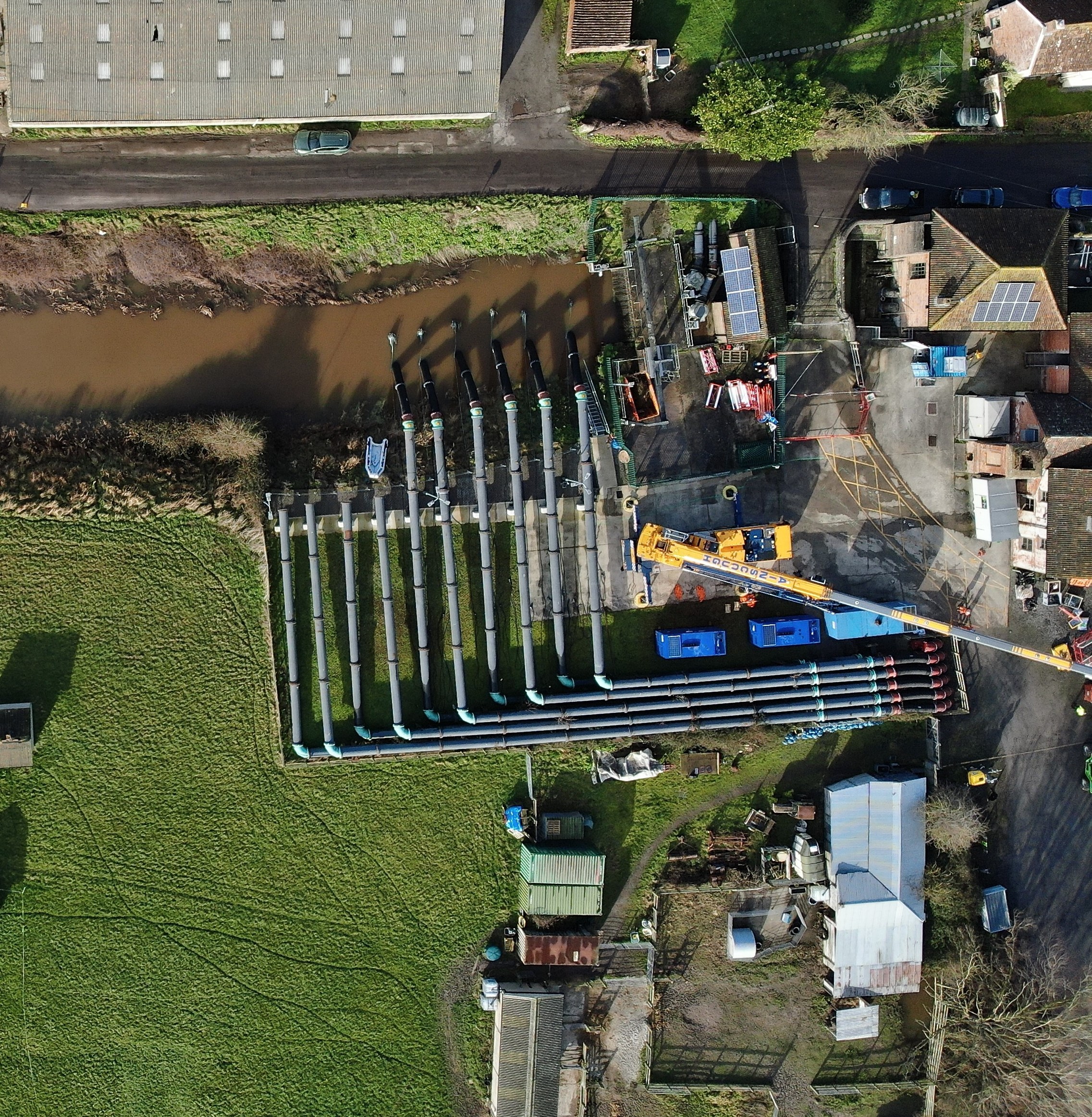
Aerial photo showing temporary pumps installed next to Northmoor Pumping StationAdditional temporary pumps installed alongside Northmoor Pumping Station
  • Deployed additional pumps to 19 locations. This includes 28 ultra-high volume pumps as well as a large number of smaller pumps.
  • Reprofiled banks to allow more water to flow into the rivers.  
  • Removed channel restrictions and constructed temporary bypass channels.  
  • Operated the Parrett Flood Relief Channel (Sowy/King's Sedgemoor Drain) with greater flows than in previous floods.
  • Had extra staff on the ground 24 hours a day checking the flood assets and maximising the use of pumps.
  • Run community drop-ins, sent out regular briefings, and responded to a huge volume of enquiries.

2860 properties have been protected by flood defences maintained and operated by risk management authorities, and the deployment of pumps has prevented many homes and businesses from flooding. As of mid-February, we have received reports of 91 properties flooded across the whole of Somerset, 23 of which are located in the low-lying Levels and Moors.

Find out more

You can read more about how we manage flood risk on the Somerset Levels and Moors on these pages:

The Somerset Levels and Moors

Our response to Storm Chandra

Investment & Maintenance

You can also see this guide for more information: How the Somerset Moors work.

What can you do?

To ensure your safety, do not walk or drive through flood water. Flood water may be deeper than it looks and contain sewage and hidden hazards.

It is essential that you know what to do in the event of flooding occurring. All our guidance can be found on our Government website pages linked here: What to do before or during a flood - GOV.UK.

You can check the latest river and rainfall levels here: Find river, sea and rainfall levels - GOV.UK

Sign up for flood warnings via this link: Get flood warnings by text, phone or email - GOV.UK or by calling Floodline on 0345 988 1188 (Textphone 0345 602 6340). This is a free service and information is updated regularly, so you can check conditions near you.

You can view historic records online at this link: Hydrology Data Explorer. You can view our webcams and community gauges online via the Community Flood Hub at this link: Wessex Webcams.

If you have been affected by flooding

Find guidance about recovery on the Gov.uk webpages: What to do after a flood - GOV.UK.

We encourage you to report any property flooding as soon as you can. Reporting helps organisations coordinate support and prioritise response. You can do this by calling the Environment Agency Incident Hotline 0800 80 70 60 or by contacting Somerset Council: Contact us.

For non-emergency reporting, submit a full report on the Flood Online Reporting Tool via this link: FORT. This information is shared with risk management authorities to ensure it goes to the correct organisation.

Somerset had the second wettest January on record with more than double the average rainfall. A third of this rain fell during Storm Chandra, which saw around 1.2 million cubic metres of water per hour moving though the Parrett and Tone catchments. Most of this water spilled into the floodplain of the Levels and Moors. 

Wet weather continued into February, which had almost double the average rainfall by mid-month. Across the county, there have been widespread impacts from flooding.

Somerset Council declared a major incident on 27 January, with the support of the Environment Agency and Local Resilience Partners. You can read more via this link: Somerset Council Newsroom. Although the major incident has since been stepped down, the Environment Agency continues to respond.

While there are Flood Warnings in force across Somerset, pumping operations are active on the Somerset Levels and Moors, and while we are undertaking flood recovery activities, we will have this page live for updates, additional information and guidance. The latest updates can be found in the newsfeed at the bottom of this page.

How is the Environment Agency responding to the flooding?

We’ve brought people and equipment from around the country to Somerset to help with the flood response. We have:

Aerial photo showing temporary pumps installed next to Northmoor Pumping StationAdditional temporary pumps installed alongside Northmoor Pumping Station
  • Deployed additional pumps to 19 locations. This includes 28 ultra-high volume pumps as well as a large number of smaller pumps.
  • Reprofiled banks to allow more water to flow into the rivers.  
  • Removed channel restrictions and constructed temporary bypass channels.  
  • Operated the Parrett Flood Relief Channel (Sowy/King's Sedgemoor Drain) with greater flows than in previous floods.
  • Had extra staff on the ground 24 hours a day checking the flood assets and maximising the use of pumps.
  • Run community drop-ins, sent out regular briefings, and responded to a huge volume of enquiries.

2860 properties have been protected by flood defences maintained and operated by risk management authorities, and the deployment of pumps has prevented many homes and businesses from flooding. As of mid-February, we have received reports of 91 properties flooded across the whole of Somerset, 23 of which are located in the low-lying Levels and Moors.

Find out more

You can read more about how we manage flood risk on the Somerset Levels and Moors on these pages:

The Somerset Levels and Moors

Our response to Storm Chandra

Investment & Maintenance

You can also see this guide for more information: How the Somerset Moors work.

What can you do?

To ensure your safety, do not walk or drive through flood water. Flood water may be deeper than it looks and contain sewage and hidden hazards.

It is essential that you know what to do in the event of flooding occurring. All our guidance can be found on our Government website pages linked here: What to do before or during a flood - GOV.UK.

You can check the latest river and rainfall levels here: Find river, sea and rainfall levels - GOV.UK

Sign up for flood warnings via this link: Get flood warnings by text, phone or email - GOV.UK or by calling Floodline on 0345 988 1188 (Textphone 0345 602 6340). This is a free service and information is updated regularly, so you can check conditions near you.

You can view historic records online at this link: Hydrology Data Explorer. You can view our webcams and community gauges online via the Community Flood Hub at this link: Wessex Webcams.

If you have been affected by flooding

Find guidance about recovery on the Gov.uk webpages: What to do after a flood - GOV.UK.

We encourage you to report any property flooding as soon as you can. Reporting helps organisations coordinate support and prioritise response. You can do this by calling the Environment Agency Incident Hotline 0800 80 70 60 or by contacting Somerset Council: Contact us.

For non-emergency reporting, submit a full report on the Flood Online Reporting Tool via this link: FORT. This information is shared with risk management authorities to ensure it goes to the correct organisation.

  • Environment Agency Briefing 27th February

    Current situation

    2 Flood Warnings remain in place at Currymoor and Haymoor; and Yeo and Parrett Moors, low lying properties around Muchelney. We have removed the A361 East Lyng to Burrowbridge Flood Warning today.

    There are also 4 Flood Alerts in place across the Levels and Moors.

    Cutts Road and New Road remain closed. Athelney spillway has stopped running and the A361 is open.

    Drain levels in Currymoor, the Muchelney and Thorney moors upstream of Langport, and moors adjacent to the Parrett and Sowy (e.g. West Sedgemoor, Aller Moor) remain high but are reducing.

    Friday will remain largely dry before a further spell of localised heavy rain moves into the southwest overnight. The longer-term forecast remains unsettled, and our flood warning duty officers continue to monitor the situation, closely linked in with the Flood Forecasting Centre at the Met Office.

    Water levels across the Levels and Moors are falling. Station pumps continue to operate supported by temporary pump installations. Temporary pumps at Hook bridge are pumping directly from Haymoor into the River Tone to reduce levels in Haymoor and Currymoor. Oath lock sluice has been raised to allow free flow of the Parrett. Monksleaze Clyce remains open, diverting the River Parrett flow into the Parrett Flood Relief Channel (Sowy) before discharging through the King’s Sedgemoor Drain. Temporary pumps remain in place at Dunball to operate during high tide when water cannot gravitate into the River Parrett through Dunball Sluice. Pumping at all stations continues. Some temporary pumps have been switched off due to insufficient water to operate

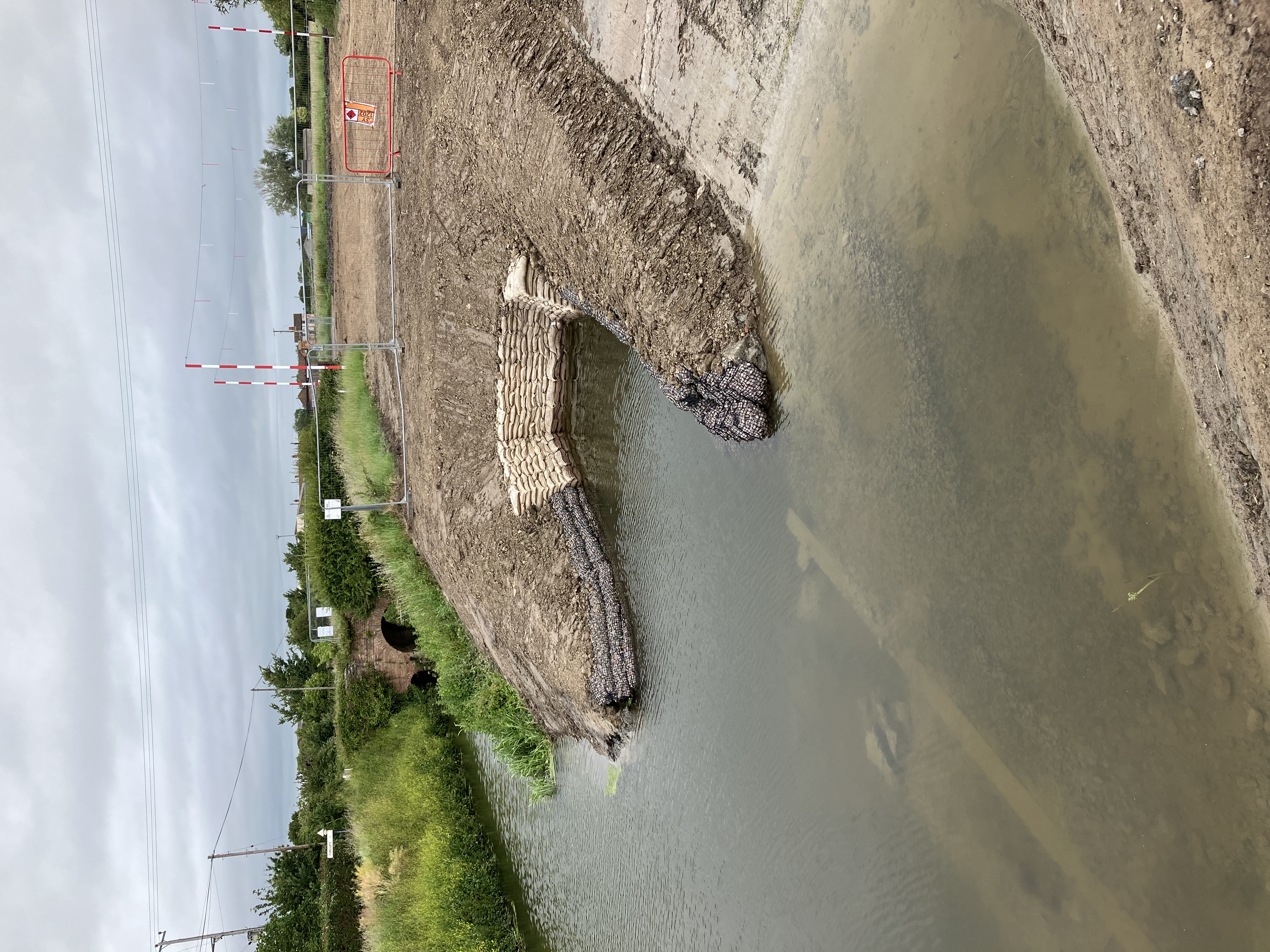
    We will begin demobilising temporary pumps from the Bridgwater Docks and at Fordgate over the next few days as the overall situation continues to improve.

    Keeping you informed

    To broaden our engagement, we have set up a webpage dedicated to the Somerset 2026 flooding. The latest situation updates will be posted here along with previous multi agency briefings, practical information and useful contacts. The page also provides links to more general information about flooding on the Levels and Moors, our response to Storm Chandra and details on investment since 2014.

    We continue to provide updates via our local Facebook Page find us at 'Environment Agency - South and South West

  • Multi-agency briefing 20 February 2026

    Local Resilience Forum partners including the Environment Agency and Somerset Council have been publishing regular briefings since the flooding began. These are hosted on the Somerset Council website. For the latest briefing follow this link:
    Major incident and flood response update: 20 February 2026

Page last updated: 03 Mar 2026, 02:40 AM