
Investment & Maintenance
Investment since the 2014 Floods
Somerset has received a huge amount of investment since 2014, with work delivered by the Environment Agency and other Risk Management Authorities.
Our funding is nationally prioritised according to how it will benefit the most people. Typically, these are areas with the highest concentration of properties, businesses, and infrastructure. Even though the Somerset moors are sparsely populated and mostly farmland, this landscape has received significant funding from local and national government, and from local taxpayers through the Somerset Rivers Authority.
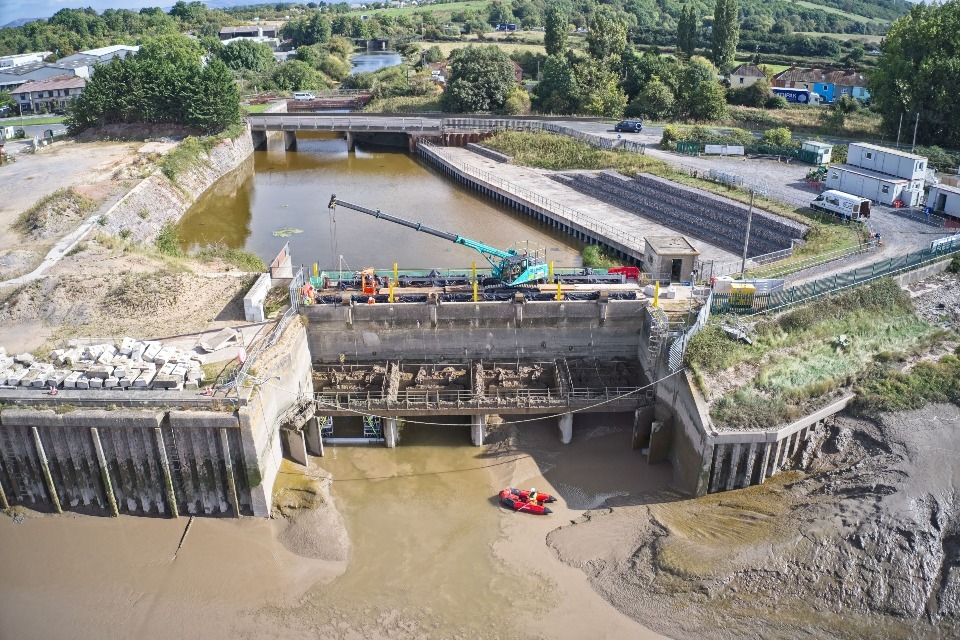 Dunball Sluice refurbishment
Since the floods in 2014, around £250 million has been spent in Somerset on reducing the impacts of flooding. Key projects include floodwater storage reservoir resilience, dredging, water injection silt agitation, water injection dredging, road raising and improvements to the Parrett flood relief channel, plus upgrading pumping stations, natural flood management interventions in the upper catchments, and refurbishing key assets such as Dunball Sluice.
In 2026, we have been able to deploy temporary pumps faster and get water away more quickly because of these improvements.
Any flood mitigation scheme must demonstrate a cost benefit to the taxpayer. So, any scheme that is put forward for additional funding, including extra permanent pumps, has to undergo financial scrutiny. Because the Somerset Levels and Moors are sparsely populated, attracting funding for large projects such as this can be difficult. We operate 21 pumping stations in Somerset, all of which require regular maintenance and upkeep.
All the Somerset Levels and Moors pumping stations were built based on land drainage and agricultural benefits, mainly in the period following the second world war. Some of the pumping stations predate this, and were originally driven by steam engines. Since then, pumping has become more important to reduce the likelihood and impact of flooding, but as the cost benefit assessment doesn’t support the high cost of creating larger permanent pumping stations, we are only able to provide temporary pumps on an incident activated basis.
After the floods of 2014, a great deal of work was done to understand what the most cost-effective response to future floods would be. It was clear that pumping reduces the duration of flooding and is instrumental to our response.
Management of water levels on the low-lying parts of Somerset is well established, and so is our response to flooding. But no two floods are the same. We scale up as needed, drawing upon national resources to do so. After significant flood events, we review to find ways to be more efficient and effective while operating within our available resources.
Following the floods in 2026, Somerset Council was awarded £50 million to bolster flood resilience. Find out more on the Somerset Council website: Council outlines next steps in allocating £50 million of flood resilience funding
Watercourse Maintenance
The Environment Agency has permissive powers to maintain and improve main rivers for the efficient passage of flood flows and the management of water levels. As these powers are permissive only, the Environment Agency is not obliged to carry out either maintenance or new works on main rivers.
We use our permissive powers to do weedcutting and vegetation management as part of a programme of watercourse maintenance. We do 120km of machine channel clearance every year across Somerset using these permissive powers, and we inspect and operate several hundred assets around the clock.
 This guide can be found on gov.uk here: Your Watercourse: Rights and Roles
However, the legal duty for maintaining watercourses, even main rivers, sits with the riparian landowner. See the gov.uk website for more information: Owning a watercourse - GOV.UK
The funding we receive for our watercourse maintenance is nationally allocated, and it can’t do everything – we prioritise work that will have the greatest impact on reducing flood risk to people and property.
There are some locations in Somerset where we are no longer able to fund routine maintenance such as weedcutting. These are places such as where only agricultural land is at risk, or where flood risk to property is low, which means these locations have the very lowest cost-benefit ratio. We are currently consulting with partner organisations and riparian owners to help us build a strong case for securing funding to carry out maintenance on these low risk watercourses. However, as with all watercourses, the legal duty for looking after them sits with the riparian landowner.
We have produced a local guide to support riparian landowners undertaking maintenance work. You can find it via this link: A guide to successfully maintaining rivers to reduce flood risk.
Targeted dredging and desilting is undertaken annually on main rivers in Somerset. Since the floods of 2014, 95km of main river and main drains have been dredged, a significant investment of taxpayers’ money. New techniques such as water injection dredging have been used, improving safety, reducing environmental impacts, and improving the cost effectiveness of dredging. Somerset's Internal Drainage Board uses this method annually to maintain the profiles on the River Parrett, funded by Somerset taxpayers through Somerset Rivers Authority. The Environment Agency transfer their permissive powers through a ‘public sector cooperation agreement’ which enables the Internal Drainage Board to undertake this work on an annual basis on the main river.
Dredging can be part of a solution, but it can be costly and the benefits can be short lived. It can also increase flood risk elsewhere - for example, on the A378 at Langport, there is only so much water than can pass under the historic Highways bridge on Bow Street, so dredging upstream could increase flood risk to the town.