
The Somerset Levels and Moors
Water Management at Landscape Scale
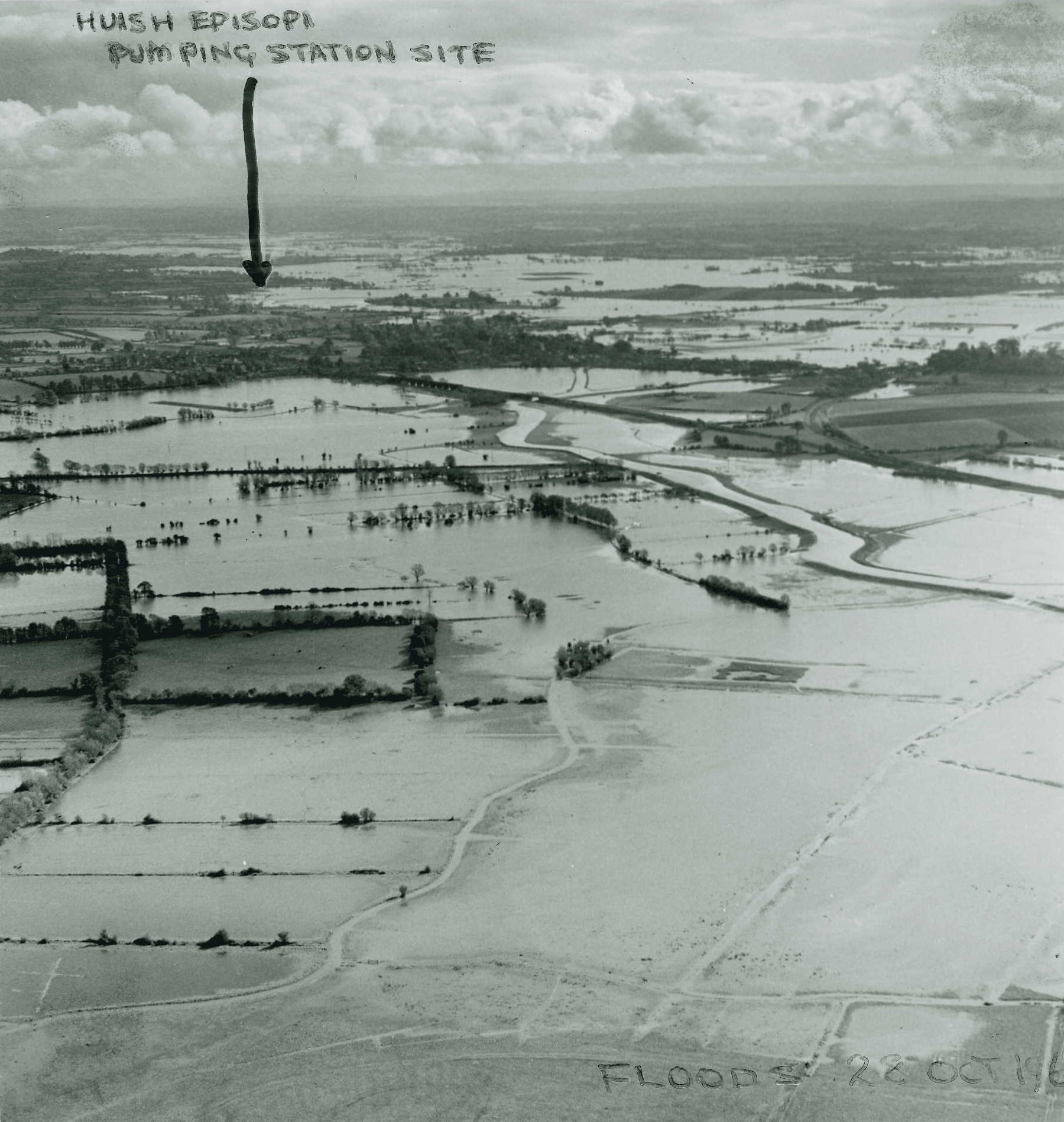 1960 Floods
The Levels and Moors are one of the lowest areas in the UK, with 18% of Somerset lying below average tide level. This area extends to around 250 square miles and is extremely flat, which makes it prone to regular flooding. Historically Somerset was known as ‘the land of the summer people’, and it was flooded during winter months, with communities moving down from the hills during the summer to graze livestock.
Records of flooding in this region go back as far as the 1600s. Significant floods in recent years occurred in 2026, 2023, 2014, 2012, 2000, and 1997, and notable events occurred in 1960 and 1929.
Today, 21 pumping stations and a complex network of embanked rivers, flood storage moors, spillways, sluice gates and pumping stations are used to manage water levels and reduce flood risk to properties. Many of these structures are operated by the Environment Agency, but the Internal Drainage Board (IDB) also operates and maintains a network of water control structures across the lowland area: Watercourses & Water Levels | Somerset Drainage Management
We pump all year round, with desired water levels set out in Water Level Management Plans. These plans have been agreed by organisations interested in the water level management on the Somerset Levels, and they set out different criteria for the summer and winter. In summer, farmers and land managers need higher water levels for agriculture and nature, and in winter, levels are lower to reduce flood risk.
All year round, our operations are focussed on keeping water at the levels agreed in these plans. However, there are times when there is too much or too little water in the catchment to be able to hold these levels. For example, during the drought in the summer of 2026, many watercourses were exceptionally low, as there was not enough rainfall to maintain desired levels.
When it’s very wet, it is normal for water to flow onto the floodplain of the moors, where it is stored until river levels go down. We pump whenever we are able to, aiming to evacuate water and bring levels back down to those agreed in the Water Level Management Plans. However, we cannot control the river levels, which creates some limitations to when pumps can run.
When the receiving river is full at the location of the pumps or downstream, from either high flows or tide locking, we cannot add more water to the river. Pumping into a full river would cause overtopping and may increase flood risk elsewhere. When spillways are operating or riverbanks are overflowing, this means the river is full and we cannot pump.
During severe flood events, we sometimes use additional temporary pumps. Their deployment is guided by a trigger point plan, which sets out the conditions under which deployment of additional pumps may be considered. Once the thresholds are met and the decision is made to bring in more pumps, it takes around ten days for them to be fully installed and operational. You can see the trigger point plan online here: Somerset Levels and Moors: reducing the risk of flooding - GOV.UK
The criteria for the trigger points were set after the 2014 floods, were revised following the 2023 floods, and are being reviewed again following the 2026 floods. Pump deployment is a significant investment, so it’s important to have clear criteria that help us act at the right moment. While additional pumping triggered by the plan doesn’t guarantee flood prevention, it does ensure we can begin removing floodwater as soon as conditions allow.
While pumping operations reduce flood risk on the Somerset Levels and Moors throughout the year, this area remains vulnerable to flooding. Flooding is a natural phenomenon and we cannot stop it altogether when extreme events occur.
Understanding the Watercourse Network
The Somerset Levels and Moors are a complex system that only works when operated as a whole. There is no single measure that can prevent flooding on the moors.
Many of the rivers in Somerset sit in 'perched' embankments, and are often higher than the land around them. To safeguard these banks from overflow damage, there are spillways – engineered low spots in the banks where floodwater spills into the floodplain of the moors. After a flood, many of the moors have to be pumped in order to get the water back over the embankments into the river channel. This can only be done once the river level has dropped and the spillways have stopped flowing.
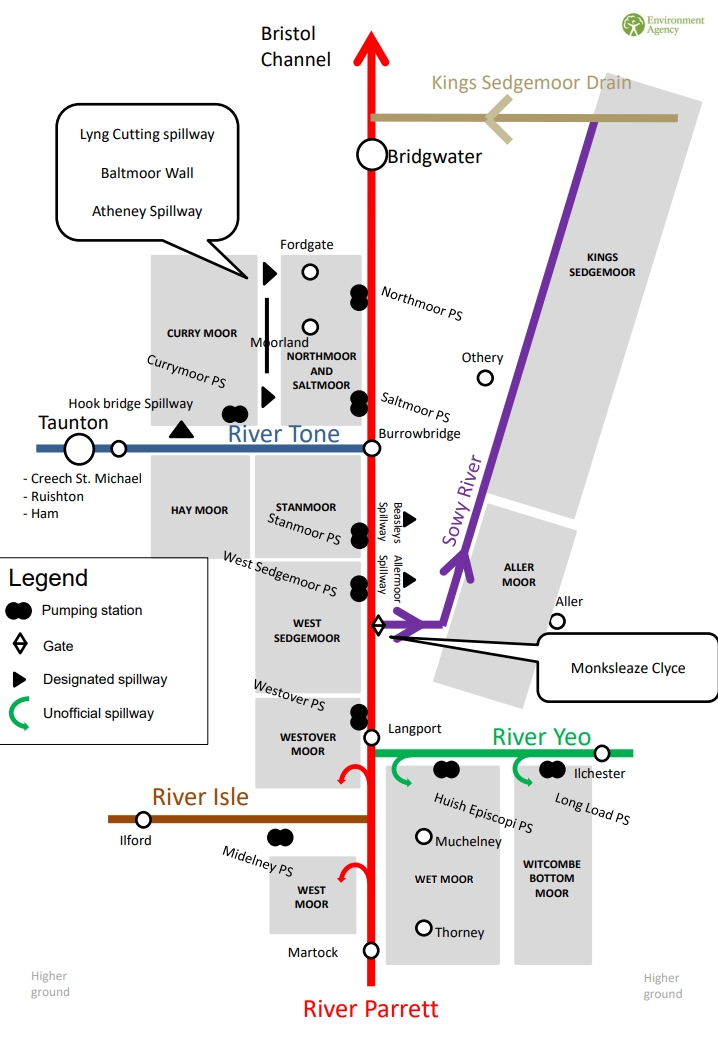 This diagram sets out how the Parrett and Tone moors work. When the rivers get high enough, water flows over the spillways, and the moors fill up.
When the Rivers Parrett, Yeo or Isle flood, water flows into the moors around Muchelney and Langport. In some places, constrictions limit the amount of water that can pass through the main channels, such as the historic Bow Bridge at Langport.
When the river Tone floods, water fills Currymoor and Haymoor. If Currymoor fills up, water starts flowing over Athelney spillway, which then crosses the A361 into Northmoor and Saltmoor. This puts properties in Moorland and Fordgate at risk of flooding.
More pumping wouldn’t stop the A361 from flooding, because the pumps at Currymoor cannot run when the River Tone is high.
The Parrett Flood Relief Channel is an artificial river created in the early 1970s, which diverts water from the River Parrett downstream of Langport. Water flows through a sluice called Monksleaze Clyse, into the Sowy river and then into the King’s Sedgemoor Drain, before rejoining the Parrett at Dunball 22km downstream. In flood conditions, the Sowy fills up naturally by water flowing into it from the River Parrett, over Allermoor and Beazeleys spillways. We can also divert water into the Sowy by opening Monksleaze Clyce, which is usually only done when the spillways aren't running.
The Axe and Brue catchments are also dependent on pumping. Gold Corner, North Drain, and Clewer Pumping Stations all pump water into adjacent rivers, but as with the Parrett and Tone, the pumps can only run when the river has capacity to receive the floodwater.
River levels in all the Somerset Levels and Moors catchments can be impacted by high tides, as well as water coming down from upstream.
Climate change is increasing extreme weather events, bringing wetter winters and drier summers. The winter of 2013/14 in the Parrett and Tone catchment remains the wettest on record, but weather records are being broken regularly. For example, in the Axe and Brue catchment, 2023/24 was the wettest winter on record. These records go back to 1871.
Many communities across Somerset - not just on the Somerset Levels and Moors - have experienced flooding in the past few years. Flooding is a natural phenomenon, and we can never eliminate the risk entirely. But there is a lot that has been done, and more that can be done, to reduce the risk and the impact.
See this guide for more information: How the Somerset Moors work.