We use cookies to ensure our site functions properly and to store limited information about your usage. You may give or withdraw consent at any time. To find out more, read our privacy policy and cookie policy.
Manage Cookies
A cookie is information stored on your computer by a website you visit. Cookies often store your settings for a website, such as your preferred language or location. This allows the site to present you with information customized to fit your needs. As per the GDPR law, companies need to get your explicit approval to collect your data. Some of these cookies are ‘strictly necessary’ to provide the basic functions of the website and can not be turned off, while others if present, have the option of being turned off. Learn more about our Privacy and Cookie policies. These can be managed also from our cookie policy page.
Strictly necessary cookies(always on):
Necessary for enabling core functionality. The website cannot function properly without these cookies. This cannot be turned off. e.g. Sign in, Language
Analytics cookies:
Analytical cookies help us to analyse user behaviour, mainly to see if the users are able to find and act on things that they are looking for. They allow us to recognise and count the number of visitors and to see how visitors move around our website when they are using it. Tools used: Google Analytics
It is recognised it will take time to agree on and put in place a more long-term and resilient approach to managing flood risk in the project area. In the meantime, it’s important we’re ready for any flooding that might happen.
Last year, we started work on the Sustainable Recovery Pilot Contingency Plan, a short-term approach while we work on the bigger picture. Partners came together to share their plans, procedures and information on how they operate assets like pumps and penstocks.
We used this local knowledge to work out which actions work best, which ones to avoid, and whereContinue reading
It is recognised it will take time to agree on and put in place a more long-term and resilient approach to managing flood risk in the project area. In the meantime, it’s important we’re ready for any flooding that might happen.
Last year, we started work on the Sustainable Recovery Pilot Contingency Plan, a short-term approach while we work on the bigger picture. Partners came together to share their plans, procedures and information on how they operate assets like pumps and penstocks.
We used this local knowledge to work out which actions work best, which ones to avoid, and where we need to think carefully. The aim is to make sure we’re all working together in the most effective way to support the community if flooding happens.
Recently teams from the Environment Agency and Witham Third District Internal Drainage Board have been trialling this plan ahead of the winter, running through a simulation as well as getting out on site to visit and learn about key locations.
The Sustainable Recovery Pilot project is a Fens 2100+ pilot project. Fens 2100+ is developing a Fens-wide approach to managing flood risk in a way that balances the needs of people, the environment and agriculture, both now and in the future.
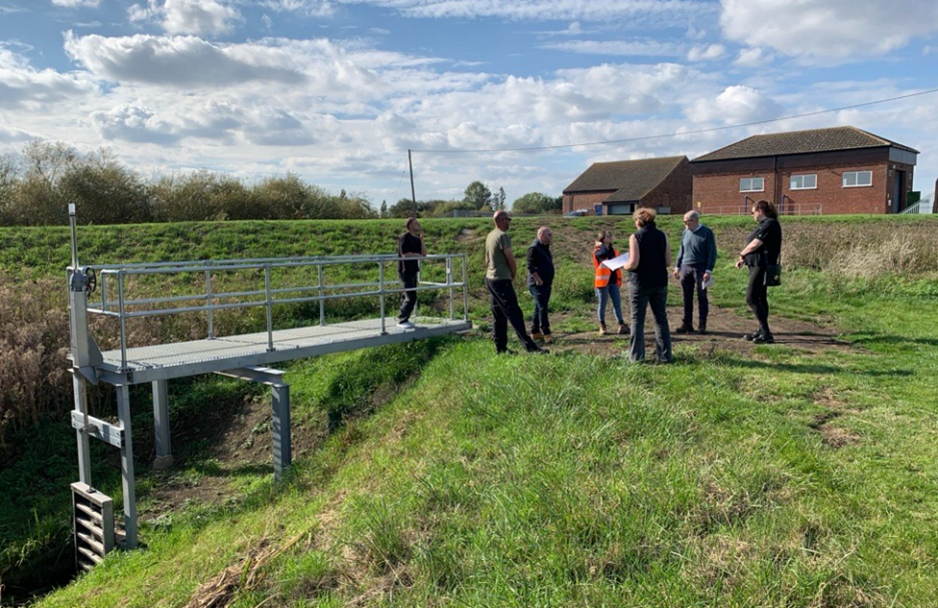
Witham Third District Internal Drainage Board and Environment Agency staff at New Cut Drain penstock.
Throughout May the project team have been continuing face-to-face farm and landowner meetings within the project area with contractors, Arup. These meetings have helped to deepen the team's understanding of past flooding impacts, people's aspirations for the area, and how some of the proposed measures could work within the landscape.
After gaining first hand insights into the area, Arup have been assessing the short list of potential measures against specific criteria. Their analysis aims to help us understand which measures may be technically viable, determine how well these could work together to form a master plan for the area, andContinue reading
Throughout May the project team have been continuing face-to-face farm and landowner meetings within the project area with contractors, Arup. These meetings have helped to deepen the team's understanding of past flooding impacts, people's aspirations for the area, and how some of the proposed measures could work within the landscape.
After gaining first hand insights into the area, Arup have been assessing the short list of potential measures against specific criteria. Their analysis aims to help us understand which measures may be technically viable, determine how well these could work together to form a master plan for the area, and if they contribute towards achieving the project's goals.
We have recently sent a draft of this report to our project partners to gain their feedback. Next, we will share this information with our Stakeholder Steering Group, which includes farmers and landowners for further discussion.
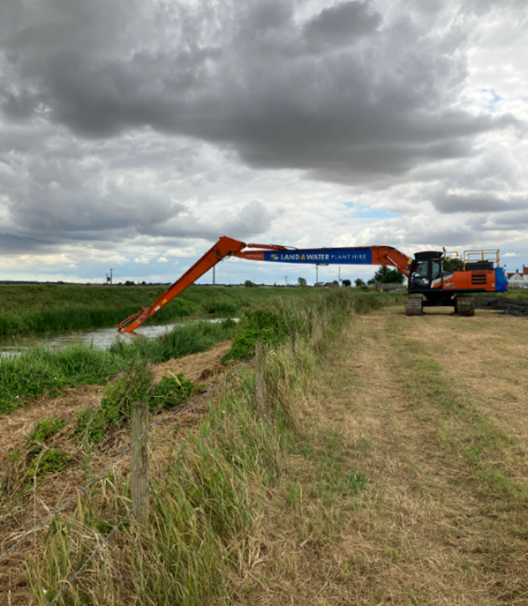
Channel desilting work has taken place on the Lower Barlings Eau, between Short Ferry Bridge and the pumping station inlet. This is to allow water pumped from the River Trent and into the River Witham to move up the channel to the Short Ferry Pumping Station. From there it is pumped via a pipe into the River Ancholme to alleviate low water levels.
The Sustainable Recovery Pilot project is a Fens 2100+ pilot project. Fens 2100+ is developing a Fens-wide approach to managing flood risk in a way that balances the needs of people, the environment and agriculture, both now and in the future.