
Explainers
- Historic expert judgement classifications that could not be verified have largely been removed to improve transparency. This has reduced the number of classified lakes and means some apparent changes simply reflect differences in available evidence.
- Heavily Modified Water Body (HMWB) assessments are now automated, improving consistency. However, gaps in supporting data have temporarily increased the number of water bodies reported as moderate rather than good ecological potential.
- Water bodies without supporting biological or water quality evidence are now classified as moderate ecological potential where assessments rely only on mitigation measures. This avoids overstating confidence in the result.
- Updated hydrological assessments, including longer flow records and improved local data, have identified more water bodies affected by flow pressures. Increasing abstraction has also contributed to some deteriorations and may require regulatory action.
- River diatom DNA data has been used for classification for the first time. While national results are broadly comparable with previous methods, some local classifications may differ and require further review.
- Monitoring network changes, including new monitoring locations and the introduction of new assessment elements, can also affect results.
- A small increase in the number of river water bodies achieving good status or potential.
- A decrease in the number of lakes, estuaries and coastal waters achieving good status or potential.
- Increase confidence in classification results and what is causing failures.
- Prioritise where classifications may need updating or actions are required.
Good Ecological Potential where all appropriate mitigation measures are in place.
Moderate Ecological Potential where some or all required mitigation measures are missing
Why do classifications matter?
Explainer #1: Why classification matters
Healthy rivers, lakes, estuaries and coastal waters are essential for people, communities and wildlife. They provide clean water, support nature, reduce flood risk and create places people can enjoy. To protect and improve these waters, we need strong evidence about their condition and the pressures affecting them.
The Environment Agency uses classification data as part of river basin planning to identify environmental problems, target action and measure progress. Classifications help us understand whether waters are meeting their legal objectives, the pressures they face and whether actions are delivering the improvements we expect.
Water body classifications are built from assessments of individual elements, such as fish, plants, invertebrates and water quality. These element results are combined using the "one out, all out" rule, which means the overall status is determined by the lowest-scoring element. As a result, a water body may be classified as less than good status even when many individual elements are performing well.
Monitoring under the Water Environment Regulations focuses on understanding the impacts of human activities on the water environment. We use a range of information to produce classification and prioritise monitoring where pressures are expected to affect water bodies.
Classification data is only one part of the evidence we use. We combine it with a wide range of environmental information and local knowledge to understand pressures in a catchment, identify future risks, decide where action is needed and evaluate whether interventions are working.
We also publish information on the reasons waters are not achieving good status, the causes of deterioration and the measures needed to improve them through the Catchment Data Explorer. This helps communities and partners understand local challenges and the actions being taken to address them. The next update is planned for December 2026 to support the consultation on the draft updated river basin management plans.
While wider evidence can sometimes identify environmental changes more quickly than formal classifications, classifications remain important because they are based on consistent scientific methods. This allows us to assess status fairly and make robust decisions.
The Water Environment Regulations were designed to evolve as science and environmental challenges change. Monitoring networks, standards and assessment methods are periodically updated to ensure river basin planning remains effective and focused on protecting and improving the water environment.
How do we use classification results?
Explainer #2: Using classification results
Healthy rivers, lakes, estuaries and coastal waters matter to people, communities and wildlife. They provide clean water, support nature and help create resilient places to live and work. To protect and improve them, we need reliable evidence about their condition and the pressures they face.
The Updated classifications provide that evidence. They measure the health of our waters and help us understand the effects of pressures such as sewage, agricultural pollution and physical changes to rivers. Classifications underpin River Basin Management Plans and help guide investment, regulation, and action to improve the water environment.
Classifications are an important source of evidence, but they are not used in isolation. We consider them alongside monitoring data, modelling, permit compliance information, local knowledge, citizen science, third-party data, and investigation findings. Together, these sources help us understand environmental problems, target action where it will have the greatest impact, and assess whether improvements are working.
Where no new monitoring data is available, the most recent valid classification remains in place. To improve transparency, the Catchment Data Explorer will show from December 2026 when classifications were last updated and where confidence may be lower because information is no longer current. Investigation findings are already published to help users better understand local environmental conditions.
Classification results do not always show environmental improvements immediately. Action may address one pressure while others remain, and wildlife often takes time to respond to improvements in water quality and habitat. For this reason, we use a wide range of evidence to track progress, not classifications alone.
What do the results mean?
Explainer #3: What do the results mean?
Healthy rivers, lakes, estuaries and coastal waters are vital for people, wildlife and local economies. Classification results help us identify where waters are under pressure and where action is needed most. However, classifications are a snapshot of environmental condition and should not be used on their own to assess long-term trends.
Understanding trends requires consistent monitoring over time. We sometimes need to change monitoring locations, sampling frequency, assessment methods or the elements we assess which can affect classification results. This means that differences between classification cycles do not always reflect genuine environmental improvement or deterioration.
When a water body's status changes, we investigate the causes using a wide range of evidence. These investigations help determine whether changes are driven by environmental pressures or by improvements to monitoring, data quality or assessment methods.
Key changes affecting 2025 classifications
Several changes have influenced the 2025 results:
What the 2025 results show
The latest assessment indicates:
Initial analysis suggests many of the apparent deteriorations in lakes, estuaries and coastal waters are linked to changes in monitoring, evidence and assessment methods rather than confirmed environmental decline. Water body investigations will provide a clearer understanding of the causes.
It is also important to remember that classifications apply the "one out, all out" principle. A deterioration in a single element can reduce the overall classification of a water body, while overall improvement often requires several elements to improve.
Key message
The 2025 classifications remain a robust tool for protecting and improving the water environment. They help us identify pressures, target action and support catchment planning.
However, classification results should always be considered alongside investigations and supporting evidence. Changes between classification cycles often reflect improvements in monitoring, data and assessment methods as well as genuine environmental change. Understanding the difference ensures we focus action where it can make the greatest benefit for people and the environment.
What does the "one out, all out" rule mean?
Explainer #4: Understanding the "one out, all out" rule
Healthy waters depend on many parts of the ecosystem working together. That's why we assess rivers, lakes, estuaries, coastal waters and groundwater using a range of measures, including wildlife, water quality and water flows.
To achieve good status or good potential, every assessed element must meet the standard for good or better. If one element falls below that standard, the overall classification is reduced. This is known as the "one out, all out" rule.
For example, a water body may perform well in most areas, but a failure in a single element can lower the overall classification.
This approach helps us identify the pressures that matter most and focus action where it will have the greatest impact. It also means that while one failing element can reduce overall status, improving overall status often requires improvements across several elements.
For Heavily Modified Water Bodies (HMWBs), some biological elements are not expected to achieve good status because of the modifications needed for uses such as flood management, navigation or water supply. These elements are excluded from ecological potential assessments to ensure classifications remain realistic while still driving environmental improvement.
Key message: The "one out, all out" approach provides a consistent and precautionary way to assess water body health, helping us target action to protect and improve the environment.
How do we use wider evidence?
Explainer #5: Using wider evidence
Protecting and improving rivers, lakes, estuaries and coastal waters depends on making decisions based on reliable evidence. Our classifications are built from monitoring data collected to agreed standards, ensuring results are transparent, consistent and trusted.
As science evolves, our methods will continue to improve. Alongside Environment Agency monitoring, we use quality-assured information from trusted partners, including other government organisations, to strengthen our understanding of water quality and environmental health.
We also use wider evidence throughout catchment planning to:
Citizen science plays an important role. Local communities and environmental groups provide valuable information that complements regulatory monitoring. For example, citizen science evidence has supported eutrophication assessments by helping us understand the environmental impacts of phosphate enrichment, such as excessive plant growth and algal blooms. In the River Wensum catchment, citizen science data also aligned closely with monitoring and modelled results, improving our understanding of local conditions.
Water quality models help us identify pollution sources, understand the likely impact of improvement programmes and predict future water quality. This enables us to target investment and understand where environmental improvements are most likely to lead to classification changes.
Riverfly monitoring provides an early warning of pollution. Thousands of trained volunteers regularly monitor river health and alert us when results suggest a problem. This allows us to investigate sooner and take action to protect rivers and the wildlife that depends on them.
By combining monitoring data, scientific modelling and local knowledge, we build a stronger evidence base, make better decisions and deliver more effective action.
What do the classification results tell us?
Explainer #6: What the classification results tell us
Healthy rivers, lakes, estuaries, coastal waters and groundwater are vital for people, nature and local economies. Classification results help us identify where waters are under pressure and where action is needed most.
These results are designed to support catchment planning and the management of individual water bodies. They provide a snapshot of environmental condition, not a measure of long-term trends. Changes in monitoring, evidence or assessment methods can affect results, so investigations are needed to understand the causes of any status changes.
The statistics on this page show how many assessed elements achieve good status or better and highlight where pressures on water quality, ecology and water resources remain.
Key message: Classification results are a vital tool for protecting and improving England's waters. They help us target action where it is needed most, but they should always be considered alongside investigations and supporting evidence.
Click here for a more detailed version of this explainer
What are Artificial and Heavily Modified Waterbodies (AHMWB) and Good Ecological Potential (GEP)?
Explainer #7: What are AHMWBs and Good Ecological Potential?
Introduction
Healthy rivers, lakes, estuaries and coastal waters support wildlife, communities and businesses. To protect them effectively, we need classification results that everyone can trust. That includes recognising the many benefits that we all get from the way we use the water environment.
A water body in England may be designated as artificial if it was created entirely by human activity, such as a canal, or as a heavily modified if it was originally natural but has been substantially altered by physical modifications such as dams, reservoirs, flood defences, navigation channels, ports, or heavily engineered river channels.
Our approach to classifying Artificial and Heavily Modified Waterbodies
Artificial and Heavily Modified Water Bodies (AHMWBs) provide important benefits to people and communities. They support activities such as flood management, navigation and public water supply. Because these water bodies have been created or significantly altered for these purposes, it is not realistic to remove those changes without losing the benefits they provide.
For this reason, we do not assess AHMWBs against the standards expected of a natural river, lake or coastal water. Instead, we designate them for their protected ‘use’ and classify them according to their ecological potential. This measures the best ecological condition that can be achieved while maintaining the benefits that justified their modification. Our aim is to achieve Good Ecological Potential (GEP) by improving habitat, water quality and ecological health wherever it is practical to do so.
To ensure AHMWBs are assessed fairly, we apply additional classification rules before using the standard one-out-all-out approach.
In most cases, ecological potential is based on an assessment of mitigation measures – the measures that can reasonably be put in place without impacting on the protected use. Water bodies where all appropriate mitigation measures are in place can achieve Good Ecological Potential. Where some or all relevant mitigation measures are missing, the water body is classified as Moderate Ecological Potential.
Use of biological indicators in assessing Ecological Potential
Mitigation measures alone will not always provide a complete picture. A water body may have all appropriate mitigation in place but still be affected by other pressures, such as nutrient pollution or toxic substances. To avoid overstating ecological condition, our classification method also considers biological indicators where they are not affected by the modified nature of the water body.
The method helps us decide which biological indicators should be used in the assessment, and which should be excluded. Some biological indicators are particularly sensitive to physical modification, including fish, invertebrates and aquatic plants (macrophytes).
The results
Artificial and heavily modified surface water bodies are normally classified as:
There are some exceptions to this approach that enable us to balance the needs to protect and enhance wildlife with the important benefits that we all get from the modifications that have been made to the water environment.
Reviewing AHMWB Designations
We periodically review heavily modified water body designations. If the biology is achieving good status and there is evidence that populations are stable, we will consider whether a heavily modified designation is still appropriate. Artificial water bodies remain designated as artificial regardless of biological condition.
Where can we see environmental improvement?
Explainer #8: Showing the impact of improvement projects
Environmental improvement does not always appear immediately in classification results.
Sometimes a project addresses one source of pressure while other problems remain. In other cases, there is a delay between environmental improvements taking place and the evidence of improvement feeding through to an update classification. Nature's recovery can also take time - fish, plants and other wildlife may take years to fully recover even after the water environment itself has improved.
For example, most measures delivered through Water Company Asset Management Plan 7 were completed by March 2025, and ambitious water industry investment plans have been agreed for the next five years, The environmental benefits of those investments and the work of others will be reflected in future monitoring and classification results.
This is why we look at a wide range of evidence when assessing environmental progress, not classifications alone.
River Roch: evidence of improvement
The River Roch (Spodden to Irwell) shows how sustained investment and targeted action can improve water quality.
Since the start of Cycle 2, the river has improved from poor to good phosphate status. Earlier improvements followed upgrades at Rochdale Wastewater Treatment Works under the Urban Wastewater Treatment Directive and were reflected in Cycle 1 classifications.
More recent improvements, confirmed in the 2025 classification results, are linked to a catchment-wide permit introduced to tackle phosphate deterioration in the Manchester Ship Canal and improve water quality in upstream rivers, including the River Roch.
The permit improved phosphate treatment at several wastewater treatment works and introduced phosphorus removal at others. An Environment Agency investigation helped identify this catchment-wide approach as the most effective solution.
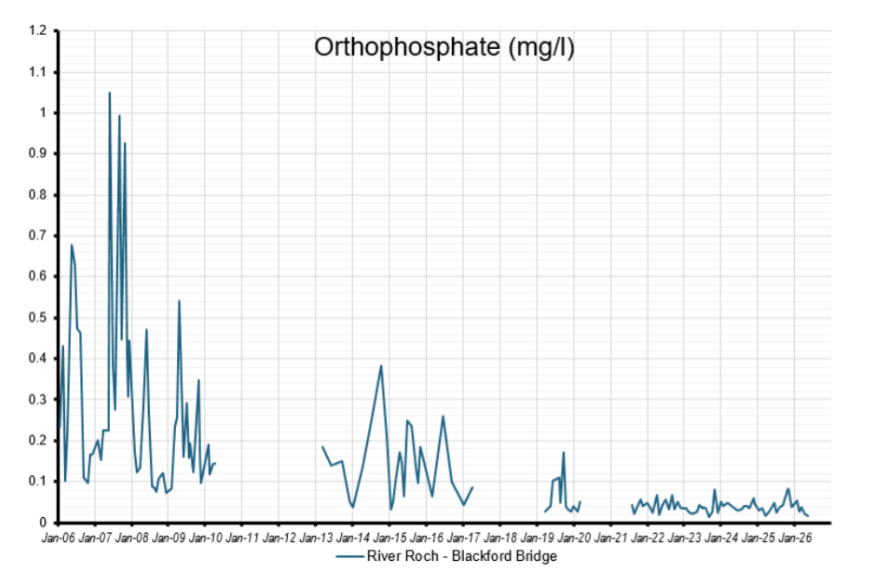 Graph showing the reduction in phosphorous concentrations in the River Roch
Data from the Blackford Bridge monitoring site shows a sustained reduction in phosphate concentrations. Analysis of site-level monitoring data provides confidence that the improvement reflects a real change in water quality rather than changes in monitoring methods or assessment processes.
Returning salmon to the River Derwent
The return of salmon to the River Derwent shows what long-term river restoration can achieve.
For the first time in centuries, salmon are returning to parts of the river thanks to years of work to improve water quality and reconnect habitats. Working with partners, including the Trent Rivers Trust and Wild Trout Trust, we delivered fish passage projects and improvements at key weirs that reopened more than 28 kilometres of river habitat.
Salmon can now reach the River Ecclesborne for the first time since the Industrial Revolution.
This is more than a conservation success story. It is evidence that sustained action can restore rivers, reconnect wildlife with historic habitats and create healthier water environments for future generations.
The fish pass projects were delivered in 2022 and 2023. The status of fish has improved from moderate in 2019 to good in 2025. The results are not directly comparable as the sample sites we us to classify have changed, but the data is showing improvements in the species recorded.