
Sustainable Recovery Pilot project
- Created a short list of potential measures.
- Developed a contingency plan for managing flood risk until more sustainable plans can be implemented.
- Met with farmers and landowners to hear their ideas and gather feedback.
- Do Nothing (only used to compare against other scenarios)
- Do Minimum
- Rebuild and maintain
- Flood storage and resilience
- How well it meets the stakeholder and partner objectives.
- Economic viability (costs vs. benefits to check the scenario is worthwhile).
- Sustainability (minimising ecological and carbon impacts, and where possible, having a positive impact).
- Increased chance of securing funding
- Long-term benefits for local communities
- Unlocks innovative funding opportunities
- Wider impact beyond the pilot area
- Scalable across the Fens
Sustainable Recovery background
After being impacted by flooding in 2019 and again during winter 2023/24 farmers and landowners in the Fiskerton and Barlings Eau area approached the Environment Agency. They expressed that they wanted to do something different in terms of flood recovery rather than flood, recover, flood. The Environment Agency committed to facilitating a pilot project in this area. The aim of this is to work with partners and stakeholders to explore whether there is another way to manage flood risk and recover sustainably from flooding.
Flood compartments affected during Storm Babet that are hydraulically connected to each other, were combined to define the project area. They also have similar issues with long lengths of embanked defences, and low numbers of benefits (i.e. houses at risk etc.), which means our grants would not fund sustaining those defences.
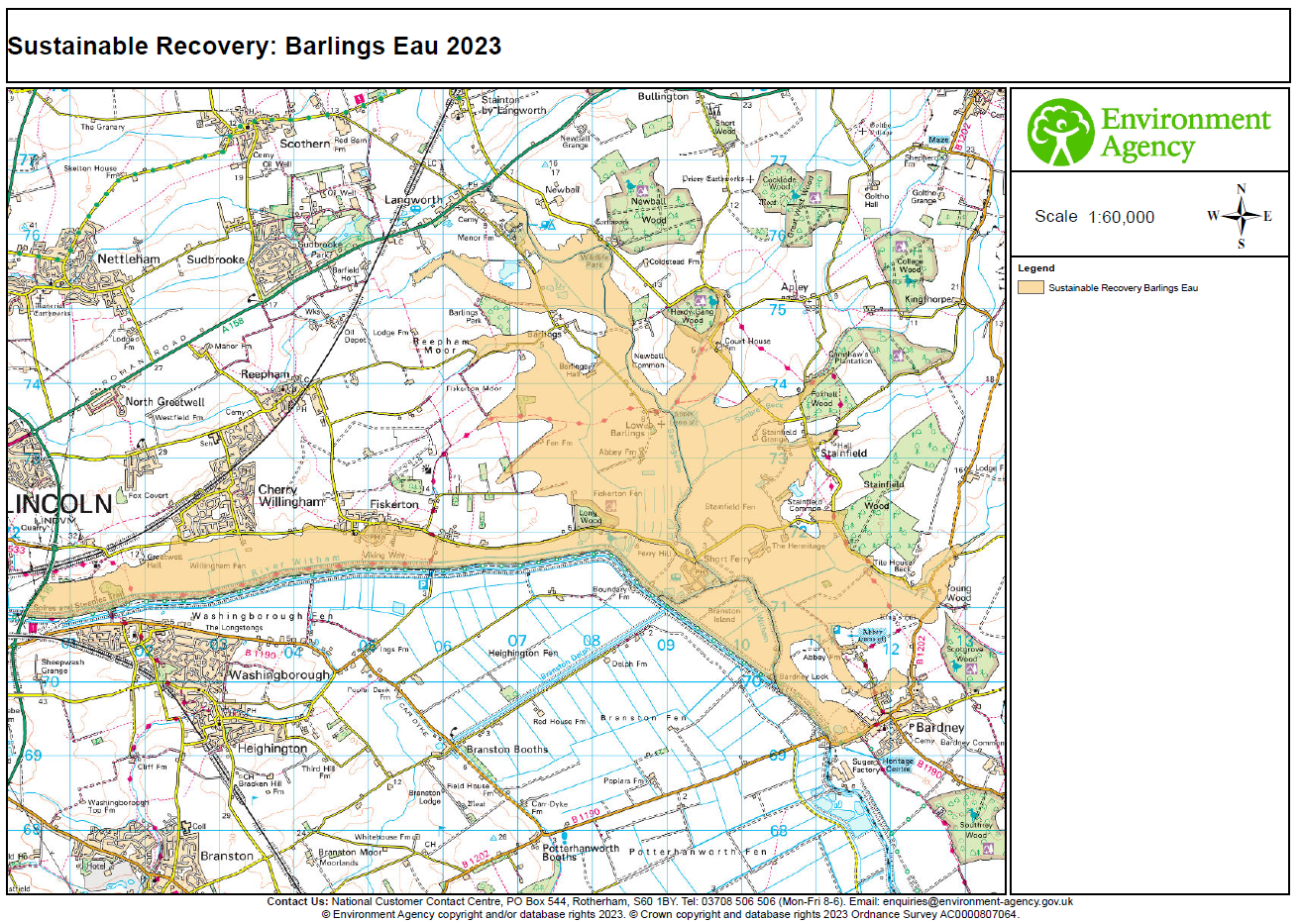 Sustainable Recovery Pilot project boundary.
 This project is a Fens 2100+ pilot project. Fens 2100+ is developing a Fens-wide approach to managing flood risk in a way that balances the needs of people, the environment and agriculture, both now and in the future. More information can be found on the Fens 2100+ information page.
We hope the work in this pilot project area can be a learning opportunity for how we manage flood risk and recover sustainably from future flooding- not just here, but across the rest of the Lower Witham area and the wider Fens landscape.
Why are we carrying out this project?
Flooding in this area in 2019 and 2023/24 highlighted the challenges of managing ageing flood risk assets and the limitations of current funding rules in addressing future risks.
What have we been doing?
We have created a ‘Partnership Group’ including the Witham Third Internal Drainage Board, Lincolnshire County Council, National Farmers Union and Natural England. Together, we’re developing a clear plan for the Sustainable Recovery project.
So far, we have:
For the latest project updates visit our Sustainable Recovery Pilot project newsfeed.
What scenarios have we considered?
We combined short listed measures into a small number of technically feasible scenarios including-
How did we review these scenarios?
The partnership reviewed and evaluated each proposed scenario on:
What's next?
Following this review the Partnership has reached the consensus that we can collectively support exploring flood storage and resilience in more detail. This decision differs from “business as usual” and is based on several key factors:
This Scenario is flexible. It can involve more or fewer actions depending on what’s affordable and agreed by everyone involved.
What potential measures have been considered as part of the flood storage and resilience scenario?
Flood storage and resilience potential measures |
Temporary or permanent recovery of breach in FCRM embankments |
Land drainage pumping stations - resilience |
Short Ferry Road – Localised raising of low spots |
Increase the number of river level gauges |
Reconnect some areas of floodplain with the river to provide space to store flood water |
Environmental Land Management Schemes (All options) |
Set back and reduce length of FCRM embankments |
Install permanent additional gravity discharge structures from flood compartments |
Upper catchment storage (Natural Flood Management) |
Block/decommission syphons for water management |
Maximise maintenance |
Investigate and consider innovative funding sources (including buying land) |