
Calne: Lower Compton Landfill Site
Lower Compton landfill site, Calne
What is this site?
Lower Compton Landfill site, Calne, is an active landfill site operated by Hills Waste Solutions Ltd.
It is one of several waste sites in the vicinity of the old RAF Compton Bassett airfield, east of Calne.
Hills Waste Solutions Ltd, hold an Environment Agency environmental permit to accept a variety of non-hazardous wastes.
The established landfill is made up of highly engineered cells for the deposit of waste. Each cell has a basal lining and surface capping systems to contain the wastes. A landfill leachate collection system removes liquid from the engineered cells and discharges the liquid to the sewer system, following treatment.
A landfill gas collection system collects naturally produced gases as the deposited waste biodegrades and is used on site as a fuel in engines that are generating electricity.
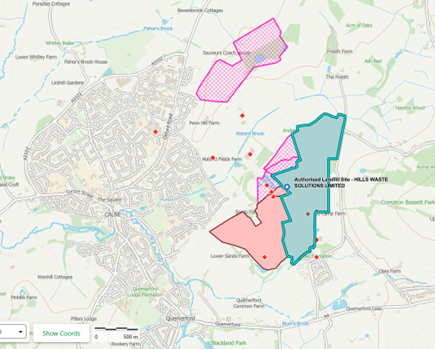
Map shows Lower Compton in Blue, Sands Farm landfill in Pink, Historic landfills pink hatch, Waste Management Licences (both current and historic) as red dots.
What activities are covered by the environmental permit?
The permit sets out how the landfill must be operated to ensure environmental protection, covering everything from the incoming waste to the management of gases, liquids, and overall site integrity, all with the aim of minimising any impacts on the surrounding community.
Our permits include a condition that requires operators to prevent odour leaving a site or, where that is not possible, to keep odours to a minimum.
The odour condition does not require the elimination of all odours outside the site boundary but states that emissions from activities shall be:
• free from odour at levels likely to cause pollution outside the site,
• as perceived by an authorised officer of the Environment Agency,
• unless the operator has used appropriate measures, including, but not limited to, those specified in any approved odour management plan,
• to prevent, or where that is not practicable, to minimise the odour.
As the regulator, it is the Environment Agency’s role to assess whether the operator is complying with the permit conditions, including managing odour effectively. Where operators are not complying with the permit, and we receive and can substantiate odour pollution reports, we may consider a range of interventions in accordance with our enforcement and sanctions policy.
We aim to make sure our enforcement response is proportionate and appropriate to each situation. We can provide advice and guidance, and where appropriate consider use of specific enforcement notices.
We will normally consider all other options before considering criminal proceedings.
How do we regulate this site and check for compliance?
In line with the permit conditions set we will undertake regular visits of the site to ensure compliance with conditions of the permit.
We will review the operator’s documents / data submissions . The operator is required to undertake routine monitoring and submit emission data to the Environment Agency
Where raised levels of odour reports have been made by the public, we will increase the frequency of visits to establish the effects of the activity on the area.
- Wiltshire Council, which leads on statutory nuisance odour.
- UK Health Security Agency (UKHSA), which provides expert advice on any potential health impacts
Calne Odour Reports
Odour Reports
| 2025 | 2026 |
January | 0 | 16 |
February | 2 | 101 |
March | 17 | 1510 |
April | 444 | 1342 |
May | 216 | 1113 |
June | 49 | 525 |
July | 123 | * |
August | 82 |
|
September | 68 |
|
October | 9 |
|
November | 4 |
|
December | 0 |
|
NB: this data is for reports of odour received by the Environment Agency in the Calne area. We are not able to attribute all reports of odour we receive to Lower Compton Landfill, however we have confirmed it currently presents the main source of landfill gas odour in the area.
*in progress
We have determined that the initial increase in reports at the end of January 2026 and into February was likely to have been caused by the installation of additional gas collection wells in the operational area of the landfill, which involved digging into recently deposited waste. However, we have continued to receive reports since this work was completed on 6 February 2026. Our recent inspections have found the main source of odour in the area is the current open landfill cell. Hills Waste Solutions are progressing with permanent capping works of the current operational area
Timeline for Lower Compton Landfill site, Calne
Early 2025
The Environment Agency began to receive significant numbers of odour complaints from the local community, and our officers began odour monitoring in the local area.
April 2025
Although there are multiple potential odour sources in the area, we were able to identify Lower Compton landfill as the main contributor and served an enforcement notice requiring Hills to complete engineering works in a recently filled area of the landfill to reduce emissions. Fugitive methane emissions and strong odours were substantiated by Environment Agency officers to the northern of the site and permanent capping work to this area was bought forward from June 2025. The work was completed on 16 May 2025. The operator was required by us to carry out a surface emissions survey of the complete site infrastructure, which was completed on 2 April by a third-party contractor.
The recommendations from this survey were included in the action plan requested by us for the site.
Remedial works identified in our initial survey of the site on 4 April have been completed, along with remedial works identified by the surface emissions survey were completed by 2 May 2025.
Our officers conducted odour monitoring in the community with handheld hydrogen sulphide detection equipment.
June 2025
On 4 June Hills Waste Solutions Ltd were served with a Regulation 36 enforcement notice under the Environmental Permitting Regulations 2016, to complete capping work to the northern end of the landfill by 18 July 2025 and install permanent gas infrastructure over the same area by 31 July 2025. We conducted regular inspections of the work as it progressed, permanent capping and gas well installation work covered by the notice was completed.
A public meeting was held at Calne Town Hall on 11 June 2025 to listen and address residents’ concerns.
Our officers continued to conduct odour monitoring, including use of handheld hydrogen sulphide detection equipment. Officers conducted further inspections including walkover surveys using methane and hydrogen sulphide detection equipment, and an inspection of the capping works at the northern end of the landfill.
Contractor work required as part of the notice and agreed with Wiltshire Council as it required weekend, and extended hour working was completed.
July 2025
Site inspections concluded that odour emissions from the newly capped area to the north end of the landfill had significantly reduced.
We conducted regular inspections of the work under the notice as it progressed. Permanent capping and gas well installation work covered by the notice is complete.
We asked the operator to review their management systems.
August 2025
Our inspection on 1 August found highly odorous gas emissions from the area of the landfill where waste was being tipped.
We identified that the composition of the waste being deposited at Lower Compton had changed, with a higher proportion of the waste being ‘trommel fines.
Trommel fines are small particles which have passed through a rotating screen (trommel) as part of waste processing. While the composition of trommel fines depends on the material being accepted at the processing site, they are a mixture of organic and inorganic waste types including soil, sand, plastics, wood, and aggregates. This waste type contains a level of sulphate from sources like plasterboard, which when combined with organic material under certain conditions produces hydrogen sulphide, which is highly odorous and commonly found in landfill gas.
After we raised our concerns with Hills, they implemented additional measures to contain and collect landfill gas produced as the cell is filled. These included additional gas collection pipework, minimising the working area, and additional clay/soil cover on other areas of the cell.
October 2025
On 5 October we installed an ambient air monitoring station in Calne to provide continuous monitoring of hydrogen sulphide and methane levels in the community. Reports of odour continued to reduce to the end of 2025, with no reports received in December.
January 2026
In January 2026 reports of odour increased again. Although installation of the next phase of gas collection pipework infrastructure by Hills in the landfill cell being filled was identified as the reason for the initial increase, after completion of the work levels of reports remained high. As the process involved digging into waste, odour was more noticeable during these works. We established this activity was likely to be the cause of the increase in complaints at the end of January. The gas well installation work was completed on 6 February.
March 2026
The high volume and persistence of reports indicates that odour management on site at Lower Compton landfill is still not optimised and further regulatory intervention is required.
We continue to work to ensure that additional corrective measures are put in place to minimise the likelihood of further recurrences.
• We have increased the frequency of off-site odour assessments, including early morning and evening visits when odours are commonly reported
• Our focus is on the current cell of the Lower Compton Landfill (cell 26D), due to the change in nature of the waste inputs in this cell, with “trommel fines” accounting for a higher proportion of waste inputs compared to previous cells.
After we raised this with Hills in August last year, they implemented additional measures to contain and collect landfill gas produced as the cell is filled. These included additional gas collection pipework, minimising the working area, and additional clay/soil cover on other areas of the cell,
We are discussing with Hills what action they will need to take to optimise gas collection and improve control of gas in cell 26D.
We have determined that the initial increase in reports at the end of January and into February was likely to have been caused by the installation of additional gas collection wells in the operational area of the landfill, which involved digging into recently deposited waste.
However, we continued to receive reports after the work was completed on 6 February.
Our recent inspections have found the main source of odour in the area is the current open landfill cell.
We are continuing to conduct offsite odour assessments, including early morning and evening visits when odours are commonly reported. Our ambient air monitoring station has been in place in Calne since October 2025 and has now collected sufficient data on levels of Hydrogen Sulphide, Methane and Particulates in the community to produce an interim report. The data will now be validated and shared with UKHSA so they can provide updated public health advice; we will publish this report with the dataset once it is completed.
Our ambient air station remains in place, and we have extended the study due to the ongoing reports of odour in the community.
Following strong odour identified in recent inspections, we have required Hills to provide a short to long-term action plan identifying how they will minimise odour and emissions from this area, and the likelihood of reoccurrence in future cells.
We are currently discussing the scope and timescale of the actions required with Hills.
April 2026
We are conducting weekly inspections of Lower Compton landfill as improvements are made to ensure they are effective; this included a thermal imaging survey undertaken on 28 April 2026 to check for potential emissions from the operational area and surrounding cells.
Our ambient air monitoring station has been in place in Calne since October 2025 and has now collected sufficient data on levels of Hydrogen Sulphide, Methane, and particulates in the community to produce an interim report. We have extended the study due to the ongoing reports of odour in the community, and the air monitoring station will remain in place.
UKHSA will review and validate the monitoring data collected from the ambient air unit, and we will publish the report once complete.
Current landfill gas odour has been traced to cell 26D of Lower Compton Landfill site. We have asked Hills to provide us with a short to long-term action plan identifying how they will minimise odour and emissions from this area, and the likelihood of reoccurrence in future cells. We are currently discussing the scope and timescale of the actions required with Hills. However, actions already underway include:
• Change in material used as cover in the operational area from ‘trommel fines’ to soil. Work has been ongoing since 27 March to cover the operational area with soil, and we expect this work to be completed by early May.
• Ongoing review of temporary gas collection within the cell and installation of further gas collection wells.
• Ongoing monitoring to check the effectiveness of the cover
• Permanent capping of the current operational area.
Capping has been brought forward from July and will now start w/c 11th May. The work is expected to be completed within 13 weeks. Permanent capping and installation of permanent gas collection infrastructure is the best long-term solution to minimise odour and emissions. We are closely monitoring these works as they progress and are now undertaking weekly inspections of the site.
Further regulatory measures will be considered if improvements are not delivered at pace, these can include enforcement notices, restricting waste inputs, or other enforcement in line with the Environmental Permitting Regulations.
Partnership working at Calne
We recognise and acknowledge the impact the current odours are having on the community and are working closely with Wiltshire Council and the UK Health Security Agency (UKHSA) to identify specific odour sources and ensure action is taken to bring odour back to minimal levels.
We are also working closely with our partners:
Is air quality at and near the Lower Compton landfill site being monitored?
Yes. Our ambient air monitoring system installed in October 2025 along with readings from our officer’s handheld devices and the companies own data is constantly under review.