
Calne monitoring update 15 July 2026
We wanted to share information to address some of the feedback and comments received from residents and the community around the location of the Environment Agency’s monitoring facility in Calne following publication last week of the UK Health Security Agency (UKHSA) Public Health Assessment. The Environment Agency will be able to address any further questions at the public drop in engagement event at Calne Town Hall on 21 July 4-7 pm.
The primary purpose of the Environment Agency’s monitoring is to support our regulatory responsibilities and assess compliance with the site’s Environmental Permit. The purpose of an Environmental Permit is to ensure waste activities are carried out in a way that protects the environment and people. More information about environmental permits can be found here: Waste: environmental permits - GOV.UK.
The Environment Agency understands why residents may want air quality monitors located in different parts of the community. However, the placement of air quality monitoring equipment involves balancing scientific, practical and operational considerations. While some residents may feel the monitor is not in the ideal location, our assessment is supported by analysis of odour reports received from the community.
The monitor’s current location at the school was chosen following an assessment of a range of factors. The monitoring unit is a large, specialist piece of equipment that requires a secure location, a reliable power supply, compliance with strict electrical safety requirements, and permission from the landowner. Suitable sites that meet all of these requirements can be difficult to secure.
When selecting a monitoring location, it is important that we collect data that is representative over time, rather than continually moving equipment in response to individual reports or changing weather conditions. If the monitor were regularly relocated to follow where odours are being reported on a particular day, we would risk "chasing the plume" rather than gathering robust, representative data about air quality and potential exposure within the wider community.
By keeping the monitor in one location for an extended period, we are able to capture a range of operating conditions, weather patterns, wind directions, temperatures and atmospheric pressures. This provides a more complete picture of air quality over time, allowing us to assess periods when emissions may increase, decrease or change direction. Longer-term monitoring therefore produces data that is more reliable and representative than a series of short-term measurements taken at multiple locations.
We recognise that no single monitoring location will satisfy everyone's expectations, and there is always an element of compromise in the siting process. However, based on the available evidence and the practical constraints involved, we are confident that the current location at the school provides an appropriate balance between scientific robustness, operational practicality and the need to obtain meaningful monitoring data.
The mobile monitoring facility (MMF) located at the school was not deployed for public health investigations and is not the primary source of evidence used to determine permit compliance.
The most important evidence comes from trained Environment Agency officers carrying out odour assessments within the community. These officers are qualified to detect and assess the presence, character and intensity of odours, providing the key evidence used to determine whether permit conditions are being met. Data collected by the MMF is used to complement and support this officer-based evidence.
The Environmental Permit does not have specific limits for air pollutants. Instead, it includes a more powerful condition that requires the site “not to cause odour to escape the site at a level likely to cause pollution as perceived by an authorised officer”. As a result, officer observations are an important part of our assessment because people can often detect odours at levels below the detection limits of monitoring equipment.
The Environment Agency does not have the powers or specialist public health expertise to investigate potential health impacts on local communities. Responsibility for assessing and responding to public health concerns sits with Wiltshire Council and the UK Health Security Agency (UKHSA). This includes the potential for extra monitoring in the community. To support their work, the Environment Agency has shared the monitoring data collected by the MMF with the UKHSA who completed their public health risk assessment which can be accessed here UKHSA Full PHRA for Lower Compton Landfill
We look forward to welcoming you to our event next week.
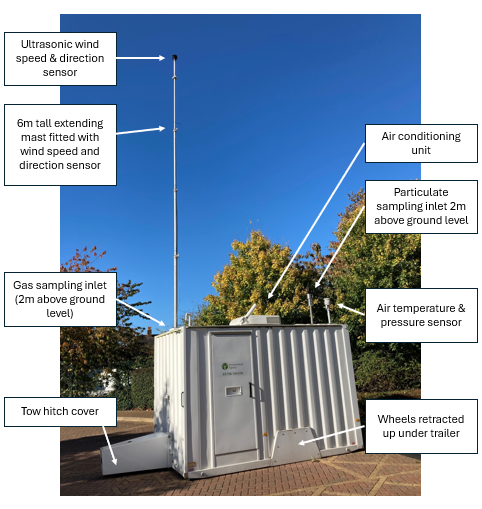 Annotated Mobile Monitoring Facility
Thank you for your contribution!
Help us reach out to more people in the community
Share this with family and friends