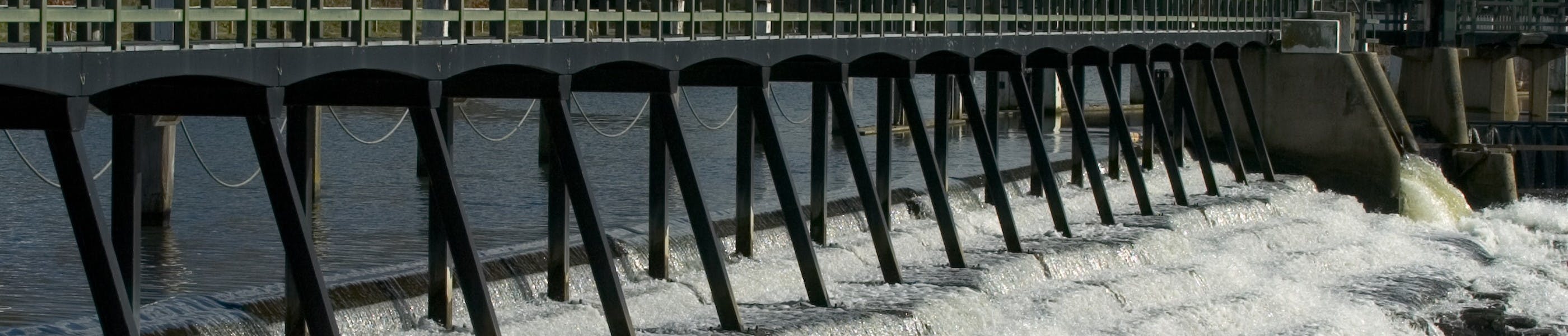
Bell Weir refurbishment
Bell Weir refurbishment
- safe navigation of the river by recreational and commercial boats
- provision of drinking water
- the river’s ecology
- manging the risk of flooding
- Removal of the existing walkway over the fixed crest weir, with key elements including support frames dismantled.
- Installation of a replacement temporary walkway over the fixed crest weir, to ensure our staff can still access it necessary.
- Piling works from the riverbank, which are progressing. The piles (steel columns) are driven deep into the riverbed and form part of the foundations for the new fish and eel pass that is being incorporated into the weir. The first piles have been driven down to the required depth, with the preparations for installing additional larger piles now being carried out.
- Installing mooring piles and a landing stage so that we can use barges to transport materials and remove large sections of the old weir structure, helping to reduce impacts on local roads.
Bell Weir refurbishment
Introduction
We are carrying out an extensive refurbishment of the weir at our Bell Weir lock and weir complex on the River Thames in Egham, Surrey. At a total cost of £22m, the work will ensure the weir continues help us manage the level of water in the river to support:
Site set‑up and early construction works are now underway as part of this major refurbishment programme.
Latest developments
The site compound has been established and good progress has been made since construction work started in April. Work carried out in these first few weeks has included:
We are maintaining a safe navigation channel for river traffic throughout the works.
Piling for the new fish and eel pass
As mentioned, we are driving steel columns or ‘piles’ into the riverbed to form part of the foundation structure for the new fish and eel pass. This can generate noise and vibration, and we apologise for any disturbance this may cause to local residents and visitors over the coming weeks. The work is being carried out in accordance with an approved Section 61 consent agreed with the local authorities. A Section 61 notice (under the Control of Pollution Act 1974) is a formal agreement that allows construction work to take place within defined constraints, including agreed working hours and measures to control noise and disruption. Under this consent, noisy activities are permitted between 8am and 6pm on weekdays, and from 8am until midday on Saturday. We are not currently working at weekends however.
Piling work is likely to continue until mid-June subject to ground conditions, but intermittently, not continuously throughout this period. We are also monitoring noise levels at various locations to ensure they remain within the agreed limits, and are using mitigation measures, such as noise-reducing equipment where practicable, to minimise impacts as far as possible.
There will be further construction activity in the coming months however these are not expected to generate the same level of noise as the piling works.
What do weirs do?
The very earliest forms of weirs in the Thames were simple barriers installed to trap fish or to raise water levels to power a mill. Modern weirs are substantial and sophisticated structures, carefully engineered so that water levels upstream of them can be raised or lowered for the purposes listed above. Some weirs are solid barriers with no moving parts, and some have adjustable gates in them. Most weir complexes on the Thames, including the one at Bell Weir, are a mixture of both.
In all, the Environment Agency owns, maintains and operates 44 lock and weir complexes along the 135 miles of navigable non-tidal river Thames, and one on the River Kennet where it joins the Thames at Reading in Berkshire. They are operated by specially trained staff from our River Thames Waterways department.
During the summer months, when rainfall is low and river levels naturally drop, weir gates are usually closed. This helps retain water upstream and ensure a safe depth for boating is maintained. It also protects plant and animal species from being adversely affected by excessively low water levels.
The weirs at Bell Weir also plays a critical role in ensuring the surrounding area has access to clean drinking water - by maintaining upstream water levels so that Thames Water can remove (or ‘abstract’) what they need at their Water Treatment Works at Staines without causing river levels to significantly drop as a result.
In autumn and winter, as river levels rise in response to wet weather, weir gates are opened in a controlled sequence to allow increasing volumes of water to pass through them. This helps prevent water from backing up and potentially overtopping the riverbanks and causing flooding. This continues until all the weir gates are fully open. Once this point is reached, we can no longer exert any more control should river levels continue to rise.
The weirs at Bell Weir
Bell Weir’s weir complex is comprised of a solid ‘fixed crest’ weir, and another weir with 10 adjustable ‘radial’ gates – 9 large, and one small.
The fixed crest weir is a 50m long solid wall. It raises the level of the water until it reaches the point where it flows over the top. The radial gate weir is referred to as the main weir. Each gate in the main weir can be adjusted individually to allow fine control of the upstream water level.
The radial gates in the main weir are shaped like the arc of a circle, with the convex curved section facing upstream. This design makes it easier for the gates to move through the water. Arms on both sides of each gate extend back to the operating mechanism, which raises or lowers them as required. Radial gates are our preferred type of gate for the non-tidal River Thames, due to their effectiveness and reduced risk of being blocked by debris – such as fallen tress – compared to other types of weir.
What does the work we’re doing involve?
Bell Weir’s weir complex had its last major refurbishment in 1967. Almost 60 years on our regular structural surveys, through which we monitor its condition, have shown that it is now in need of an extensive refurbishment. This will be a major and complex engineering project.
We will replace all 9 of the large radial gates in the main weir, the walkway structure over them and the mechanical and electrical operating equipment. We will also refurbish the main weir’s concrete substructure, add additional erosion protection and improve the stability of the north riverbank downstream. The small radial weir gate will be replaced with a new multi-species fish and eel pass. This will allow fish and eels to migrate to areas either upstream or downstream of the weir where food, shelter and spawning conditions may be more favourable, helping to increase the number, spread and diversity of fish and eel populations in the Thames. The design of the new large radial gates has been modified to ensure that the weir complex retains the same overall water level management capability as before.
When and how we will carry out the work
Work started in spring 2026 and is planned to be completed by autumn 2027. Our contractor started setting up the site in February 2026, and early construction works are now taking place. We will replace no more than two weir gates at time, so that we can still continue to manage water levels. When weir gates are to be replaced, we will install a dam around them and pump out the water so that work can be carried out safely in dry conditions.
A temporary construction compound has been established with access to the river at Runnymede Pleasure Ground, with vehicle access from the A308 via an existing entrance to the car park.
A smaller satellite compound has also been established on the southern bank next to the weir. Barges are being used to transport construction machinery and materials by river where possible.
Bell Weir lock will remain operational throughout.
There will be some disruption while work is being carried out. This will include a small increase in traffic, the visual impact of construction equipment and reduced availability of the Pleasure Ground. We will, however, do all that we reasonably can to reduce any disruption while we carry out this essential work.
Unfortunately, we will need to temporarily divert the Thames Towpath (Thames Path National Trail) at the Runnymede Pleasure Ground while work is being carried out. We apologise for the unavoidable inconvenience this will cause.
Managing environmental impacts
Measures are being put in place to protect local wildlife and prevent disruption to tree and vegetation species, and to monitor the site from an archaeological perspective.
An Ecological Clerk of Works (ECoW) will supervise and advise on repurposing of left over materials to benefit wildlife.
Planning and permissions
Work will be carried out under the Environment Agency’s Permitted Development rights (The Town and Country Planning General Permitted Development (England) Order 2015, Schedule 2 Part 13, Class D). A Certificate of Lawful Development has been obtained from the local authority.
Some history of Bell Weir lock and weir site
Bell Weir lock and weir site was built in 1818 by the Thames Commissioners as part of a programme of works carried out between 1817 and 1845. In total, 7 new locks were built at this time, 2 of them as replacements to earlier locks at existing sites. The walls of the lock were originally made of timber, and the weir was a ‘paddle and rymer’ type, a version of one of the oldest types of weir used on the Thames since the 13th century. They consist of long posts (rymers) that fit into a slotted beam or cill on the river bed. This creates a supporting framework that allows sections of wood to be dropped between the posts and stacked up to create a barrier. The sections of wood have handles attached to them, making them look like a crude form of paddle, hence the name ‘paddle and rymer’ weir. This original weir can be seen in the background of the picture below:
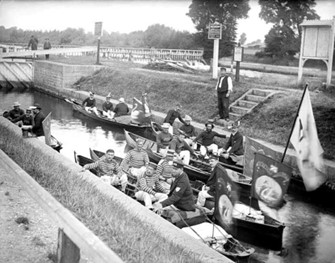
Photograph taken 1860 - 1922 © Reproduced by permission of Historic England Archive ref: CC73/00652
Originally was known as Egham Lock. It was later renamed after Charles Bell, who ran a nearby inn called The Anglers Retreat and was responsible for operating the lock and weir.
The weir has had a few dramatic moments. It collapsed in 1827 under the weight of ice, and the lock itself failed in 1866. Both were rebuilt the following year, and the lock was reconstructed in stone in 1877. A new weir was added in 1904, and refurbished in 1967.