FAQs
Construction
- Refurbishment of the seawall through concrete encasement, incorporating a Victorian blockwork finish to complement the conservation area. Inclusion of a wave recurve feature to help deflect wave energy back out to sea.
- Installation of an upstand wall and black handrailing along Esplanade, set back to allow visitors to continue sitting along the seawall.
- Refurbishment of existing steps, with some being encased and others rebuilt. Steps will be bought up to current safety standards, with the addition of stainless-steel handrailing’s.
- Refurbishment of Pier Head and Palestine slipways, including resurfacing whilst retaining the existing cobble stones where possible.
- Refurbishment of concrete groynes. At Hope Groyne, the broken end section will be removed and sealed. For Osbourne Groyne, a concrete encasement solution has been developed, with the final approach to be confirmed following ground investigation works at the start of construction to determine condition of the structure.
- Replacement of all timber groynes and the timber breastwork wall by Shanklin Beach Huts.
When will the construction work take place?
Subject to approval of our Final Business Case, and securing the necessary funding, consents, and licenses, construction is estimated to commence from Summer 2027.
What does the refurbishment work involve?
The works involve:
How long will construction last?
We are currently working with a contractor providing early advice to inform a potential construction programme and methodology.
However, our construction contractor has not yet been appointed. Following the tender process, we will announce the successful supplier in early 2027.
Construction is currently estimated to take three to four years, although this programme will be refined following appointment of the delivery contractor. Construction is expected to be delivered in phases with no full closure of the beach.
How can local businesses get involved in the Shanklin Coastal Defence Scheme?
We are committed to supporting small island-based businesses and encourage our larger suppliers to consider small and medium sized enterprises (SMEs) when identifying sub-contracting and supply chain opportunities.
The construction contract for the Shanklin Coastal Defence Scheme is expected to be awarded through the Environment Agency's Beach Management Framework, which has been established specifically for the delivery of coastal engineering and beach management projects.
The tender process is underway and we expect to announce the successful contractor in early 2027.
Once appointed, organisations wishing to supply goods, services or specialist expertise will be able to contact the successful contractor directly to discuss potential commercial opportunities.
For further information:
More info on Beach Management Framework can be found here
Our procurement mission statement can be found here
What will the impacts of construction look like?
The current expectation is that Esplanade Road will remain open throughout construction, with a single lane closure and temporary traffic lights required. Detailed traffic management arrangements will be developed alongside the appointed contractor.
Most construction activities will be carried out during standard daytime working hours, although some activities may need to take place earlier or later to take advantage of tidal working windows. Noisy activities such as piling will be restricted to normal daytime working hours.
Our priority is minimising disruption and reducing impacts wherever possible, as well as maximising opportunities to encourage visitors to Shanklin during construction.
General
What is the impact of climate change?
Sea levels, wave heights and the frequency of winter storms are all anticipated to increase as a result of climate change. More information on climate change can be found: here.
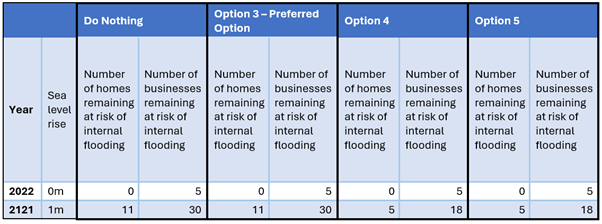
The risk of flooding from the sea over the next 100 years with 1 metre of sea level rise was modelled to improve our understanding of how the risk of flooding in the area may change in the future. It is estimated that without increasing the height of the sea wall, 11 homes and 30 businesses would be at risk of internal flooding from the sea by the year 2121. Raising the height of the sea wall would still leave 5 homes and 18 businesses at risk of internal property flooding from the sea by the year 2121.
The financial analysis has indicated that raising the height of the sea wall is not an economically viable option to take forward currently. As part of the refurbishment project, we will include works which strengthen the foundations of the seawall with the foresight that a decision to raise the height of the seawall may be a viable option in 50 years’ time.
Who is responsible for the sea wall and groynes?
The Environment Agency, together with Coastal Protection Authorities (CPAs) such as the Isle of Wight Council, however, this is not a legal obligation. This means that the Environment Agency and the Isle of Wight Council have the ‘power to’ carry out coastal protection works but is not duty bound to do so. Our ability to exercise these powers is also constrained by the need to take into account the costs and benefits (both tangible and intangible) of any investment, as set out in HM Treasury and Defra guidance. In general, CPAs and the Environment Agency will only act where there is a clear economic benefit and/or an appropriate engineering solution that is achievable, and where environmental legislation is not contravened.
Ownership/maintenance of the sea wall and groynes in the Shanklin scheme area rests with the Isle of Wight Council. Once any scheme is completed, it is intended that the current ownership/maintenance arrangements will continue.
How have you chosen where to deliver coastal flood and erosion risk management schemes?
Flood and coastal erosion risk management infrastructure needs have been assessed for the Isle of Wight coastline through a number of plans, strategies and studies undertaken by the Isle of Wight Council in partnership with the Environment Agency. These help us to decide how and where coastal risks can be reduced, and where it is appropriate to allow the coastline to evolve naturally.
The Isle of Wight Shoreline Management Plan (SMP, 2010) sets the policy for how the risks facing each section of coastline should be managed for the next 100 years.
This is followed by a Flood and Coastal Erosion Risk Management Strategy or Study. The Isle of Wight is divided into three strategy/study areas, where appropriate schemes are identified to put the policies into place, and the high-level costs and benefits are assessed. This work has produced a list of priority schemes in locations where existing flood and coastal erosion walls and embankments are at the most immediate risk of failure, where such a failure would put people, property and the environment at risk, and where the availability of central government funding justifies development of a coastal risk management proposal.
In areas where the SMP and a strategy/study has identified a need for infrastructure improvements but priority schemes are not currently being developed, this may be because sufficient government funding cannot currently be justified, or because there is not an immediate risk and work on these schemes can be commenced once the initial priority schemes are underway.
Where the costs and benefits of a scheme do not currently enable us to justify a significant investment of government funding, both the Environment Agency and the Isle of Wight Council complete routine monitoring and inspections of the structures within our respective ownership. This will continue with the aim of managing any health and safety risks, completing repairs where necessary and affordable, and maximising the life span of these structures.
Are the coastal defences south of Shanklin Chine (study unit IW28) included in the Shanklin Coastal Defence Scheme?
The SMP policy for Sandown and Shanklin is ‘Hold the Line’, this can be viewed here.
An initial appraisal and scheme identification study was completed in 20181 for Sandown Bay. This study assessed the costs and benefits of the management approaches available to implement the Hold the Line SMP policy for distinct study units along the frontage.
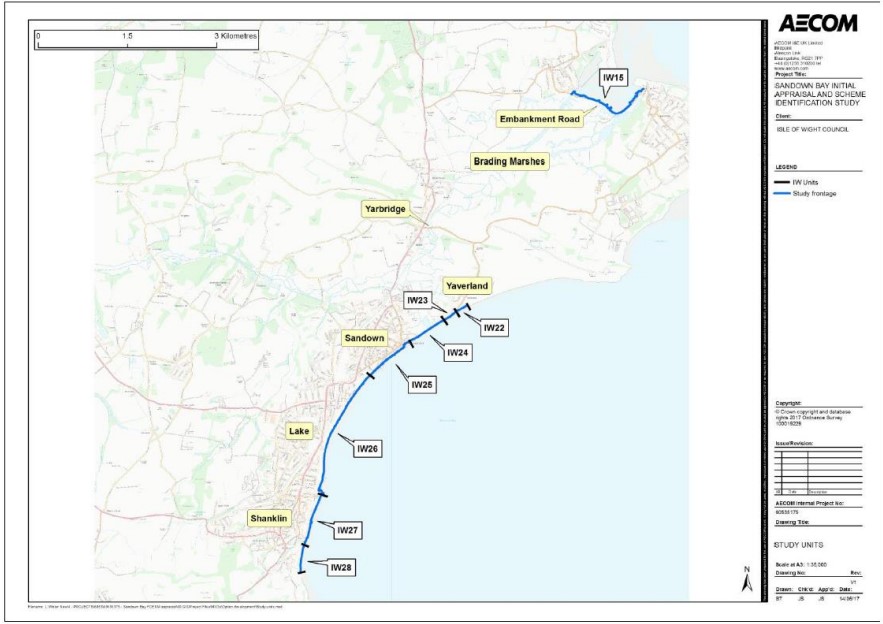 IW Study Units (Image extracted from Sandown Bay Initial Appraisal and Scheme Identification Study)
The study Unit IW28 is 457m long and is located to the south of Shanklin Esplanade, extending from Shanklin Chine southwards to approximately the position of Luccombe Hall (located on the cliff top). This study unit is a transition between the hard sea defences (timber revetment and groynes) to the north and the undefended cliffs to the south.
The Sandown Bay study concluded that the leading economic option for the coastal defences south of Shanklin Chine was the ‘Do Minimum’ option. The Do Minimum option involves small scale reactive maintenance and ‘patch and repair’ work to the existing timber revetment and groynes to extend their remaining life alongside the continued small scale cliff stabilisation measures. The Do minimum option has the highest benefit cost ratio of the short listed options.
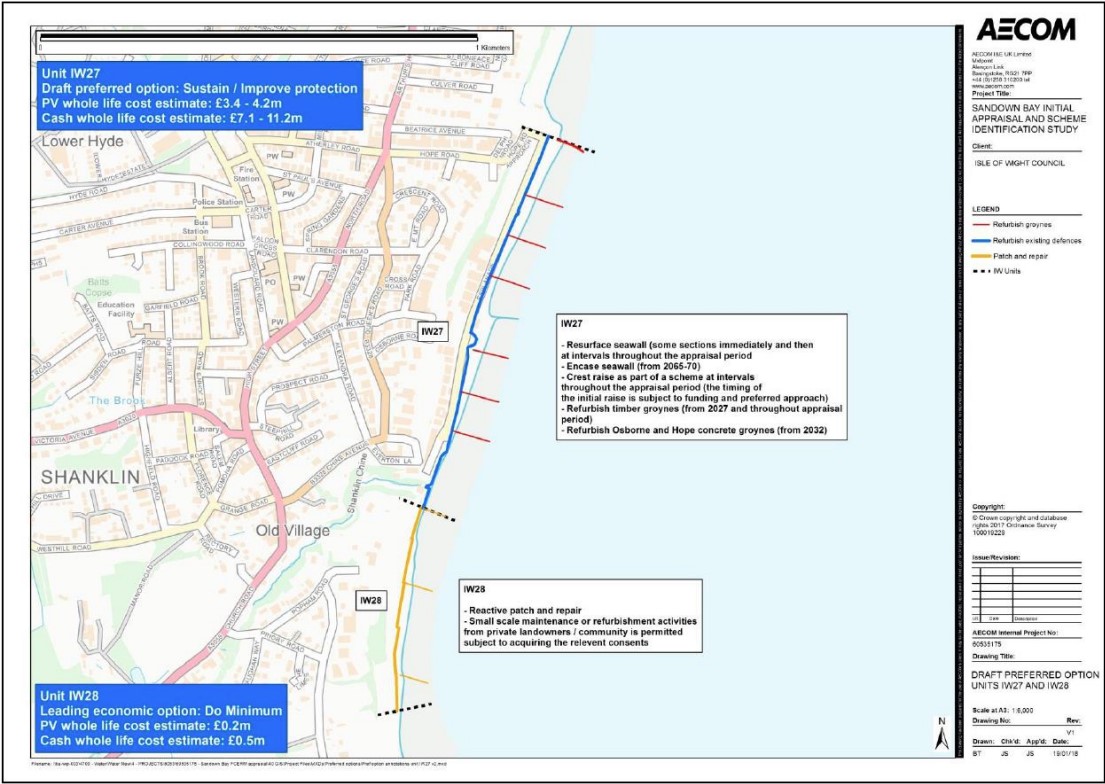 Leading economic option for IW28 (Shanklin Chine to Luccombe Hall)
It is not economically justifiable to implement a ‘do something’ option such as maintaining, sustaining or improving the coastal defences. This is because the number of properties at risk is limited compared to the cost of the works required to better protect them from coastal erosion. In addition, most properties at risk along the cliff tops are anticipated to be affected in the longer term rather than the shorter term. The Sandown Bay study estimates that just 2 properties are at risk of coastal erosion by 2057 and 28 properties at risk by 2117. This means that central government funding (known as Flood and Coastal Erosion Risk Management Grant in Aid funding) is not available for this section of coastal defences. For this reason, the timber defences just south of Shanklin Chine are not included in the Shanklin Coastal Defence Scheme currently being progressed by the Environment Agency and Isle of Wight Council.
The current Shoreline Management Plan policy for the existing coastal defences south of Shanklin Chine is to Hold the Line, therefore refurbishment activities from private landowners / the local community would be permitted under this SMP policy, subject to acquiring the relevant consents. The Isle of Wight Council complete routine monitoring and inspections of the structures. This will continue with the aim of managing any health and safety risks, undertaking repairs where necessary and affordable, and maximising the life span of these structures.
Option Selection
- The criteria grouped by PESTLE (Political, Economic, Social, Technical, Legal, Environmental).
- The criteria grouped by Objectives.
- Economic, Financial, and Carbon ranking
How was the preferred option selected?
An overview of the options appraisal process at Outline Business Case stage is presented in the poster here
More detail about the process:
The Preferred Option has been selected using the decision-making process defined in the Flood and Coastal Erosion Risk Management Appraisal Guidance. For this type of project, Cost Benefit Analysis has been used to select the Preferred Option in accordance with the appraisal guidance. This guidance defines Cost Benefit Analysis as a type of appraisal or assessment which compares benefits and costs to identify the impact of different options on overall welfare.
The project objectives were split into criteria to allow the objectives to be assessed in more detail. Elected councillors were invited to participate in the process for assessing whether the options met broader Isle of Wight Council objectives. This exercise allowed the options to be ranked in order of acceptance.
The engineering implications of the options were assessed following a review of the Ground Investigation Report by the geotechnical and structural engineers. The carbon footprint for the short list of options was quantified and a high-level construction cost estimated. This is in addition to overtopping and inundation flood modelling, further environmental and Biodiversity Net Gain assessments, detailed economic appraisals and funding assessments which have also been carried out.
With the results of the appraisal and public consultation to hand, the project team were joined by Isle of Wight Council representatives at a workshop on 30 November 2023 to agree the preferred option. This recommendation was then reviewed by Isle of Wight Council’s Climate and Environment Board for consideration. The recommendation received approval with the stipulation that the design must not preclude a decision to raise the height of the seawall in the future.
Why was the preferred option selected?
The financial assessment compared the benefits and costs to identify the impact of each option overall. The benefits to the community of progressing Option 3 (the preferred option) outweigh the costs. The work will bring over £80 million worth of benefits to the community, the local infrastructure, and the local environment.
The figure below summarises the Short List appraisal for those options deemed to qualify for consideration as the Preferred Option (Options 3, 4 & 5).
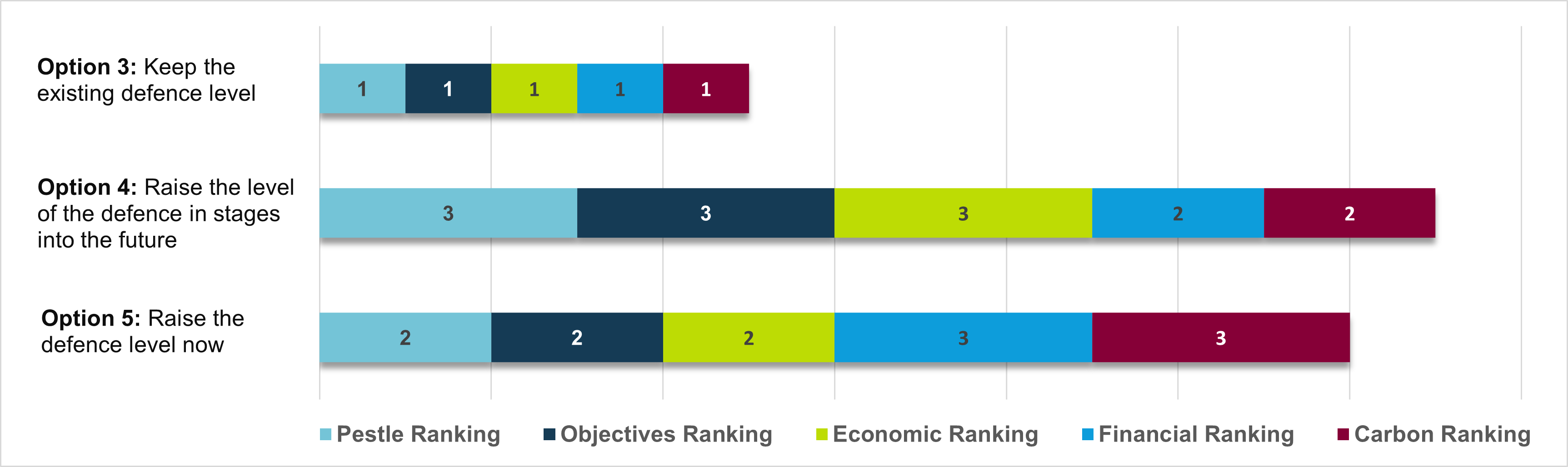
The ranking of the options is based on:
A PESTLE analysis studies the key external factors (Political, Economic, Social, Technical, Legal and Environmental) that influence an organisation or environment. It can be used in a range of different scenarios, and can guide people and professionals in strategic decision-making.
In terms of appraisal against the criteria, Option 3 at Shanklin was ranked first overall. Option 3 ranked second for PESTLE. Option 3 ranked second for scheme objectives but still meets all scheme objectives. Option 3 ranked highest of all options for economic, financial and carbon ranking. Option 3 has the longest duration of benefits (50 years) when compared to the other options (20-40 years). Other than the usual maintenance for Isle of Wight Council, no interim works are expected in the 50 years of the scheme.
Why is the height of the sea wall not being increased?
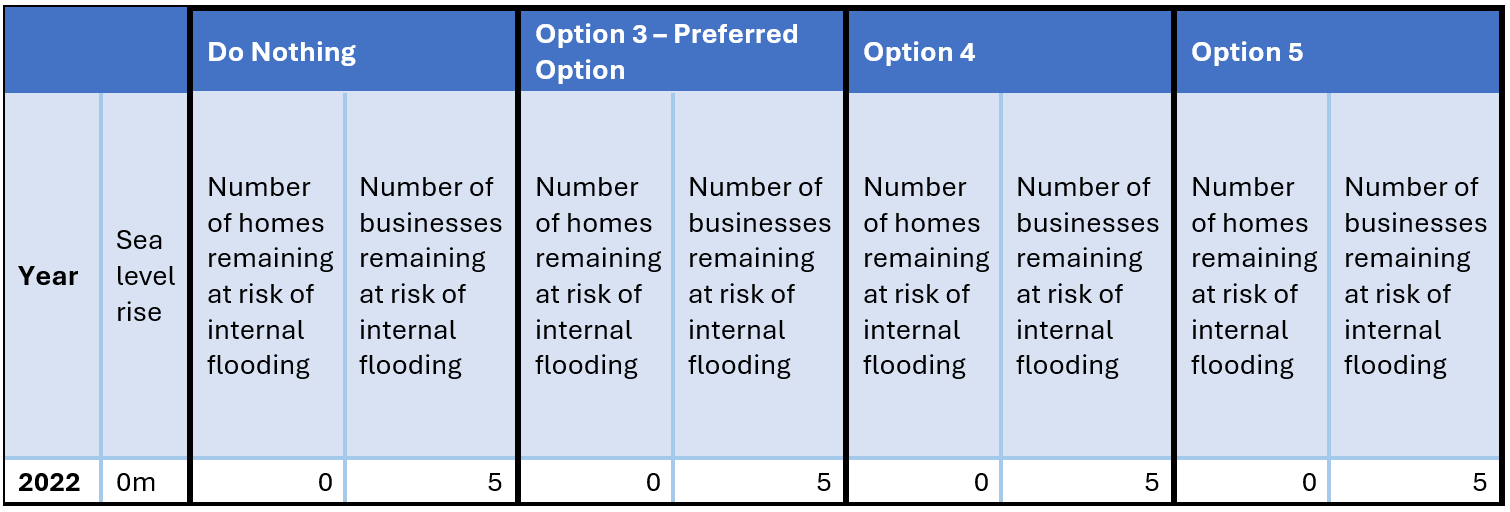
The flood risk assessment shows that the risk of internal property flooding from waves overtopping the existing sea wall is low given the height of the existing wall and raised floor levels of properties. Only a small number of properties would remain at risk of internal flooding from waves overtopping the sea wall after the refurbishment work is complete. Our modelling estimates that no homes and only 5 businesses would remain at risk of internal property flooding from a tidal flooding event with a 0.5% annual probability (1 in 200 chance each year).
The financial analysis suggests that other measures such as Property Flood Resilience (PFR) measures are a more cost-effective method of reducing the risk of internal flooding to these properties. This opportunity will be explored as part of the next phase of work on the scheme. PFR measures can include flood boards, air brick covers, non-return valves and pumps, as well as work to ensure that the fabric of the property is sound. More information about PFR can be found here: https://bluepages.org.uk/
We can never remove the risk of flooding entirely. Our flood risk assessment shows that if the height of the sea wall was to be increased, there would still be a risk of wave overtopping and associated internal property flooding. The same 5 businesses would remain at risk of internal flooding even if Option 4 and Option 5 were to be implemented.
The results of the financial analysis have shown that the additional scheme benefits from raising the height of the sea wall do not outweigh the additional scheme costs. Increasing the height of the sea wall almost doubles the cost of the scheme. The shortfall in funding makes the option to raise the height of the sea wall an unviable option for Isle of Wight Council to take forward.
What will happen with future sea level rise if we do not raise the height of the sea wall?
The risk of flooding from the sea over the next 100 years with 1 metre of sea level rise was modelled to improve our understanding of how the risk of flooding in the area may change in the future. It is estimated that without increasing the height of the sea wall, 11 homes and 30 businesses would be at risk of internal flooding from the sea by the year 2121. Raising the height of the sea wall would still leave 5 homes and 18 businesses at risk of internal property flooding from the sea by the year 2121.
As part of the refurbishment project, we will include works which strengthen the foundations of the seawall with the foresight that a decision to raise the height of the seawall may be a viable option in 50 years’ time.