The proposed flood scheme
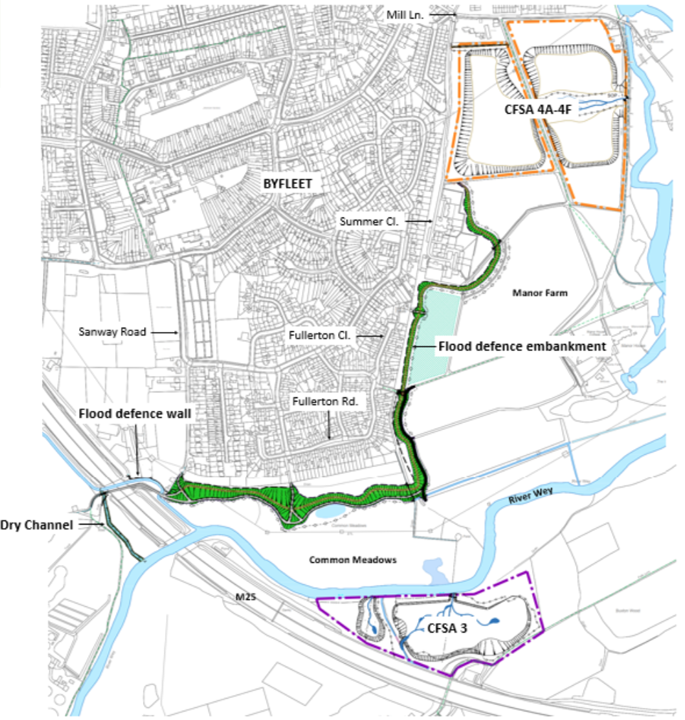
- Sheet pile flood wall from the M25 to the southern end of Sanway Road.
- Earth flood embankment between the southern end of Sanway Road and Summer Close.
- 3 floodplain storage areas.
- An overflow channel west of the M25 between the Broad Ditch and the River Wey. This channel will normally be dry
- Improvements to surface water drainage pipes that run underneath the flood embankment, to ensure flood water cannot bypass them.
- The plan below shows the proposed alignment of the flood wall and embankment and the areas where there will be floodplain storage (labelled CFSA).
- Increased biodiversity of habitats within Common Meadows and Manor Farm.
- Enhancement of existing grassland areas to more distinctive grassland habitats (i.e. lowland meadow).
- Creation of wetland features and ditches linked to the River Wey and increased marginal planting along the riverbanks.
- Providing a net increase in length of hedgerows within Manor Farm (currently under discussion with Surrey Wildlife Trust).
- Creation of pockets of wet woodland (woods that occur on ground that is often or seasonally wet).
- Enhanced provision and connectivity of footpaths and bridleways within Common Meadows and to the wider network both west of the M25 and northeast into Manor Farm.
Background and our proposals in detail
Background
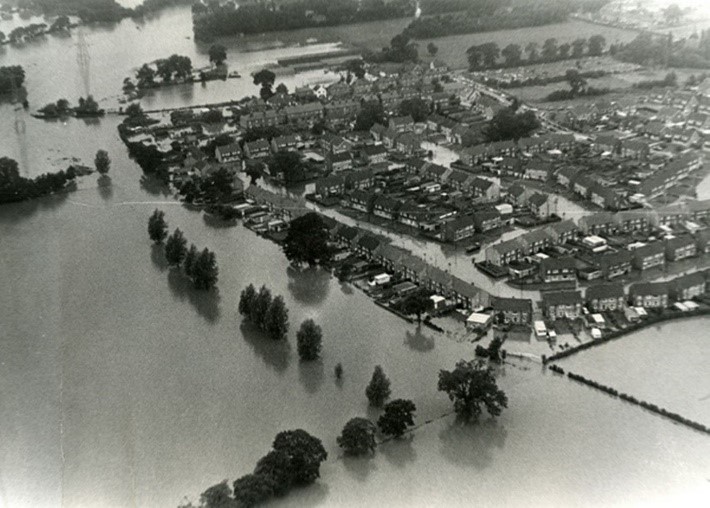
Byfleet has experienced several notable floods in 1968, 2000 and 2003. More recently, in 2013/14 prolonged heavy rainfall resulted in flooding from the River Wey when properties were flooded.
Following the flooding in 2013/14 flood the Environment Agency and Surrey County Council agreed to take action.
The Environment Agency reviewed options to reduce flood risk at several locations in the Byfleet and Weybridge area. The outcome was a scheme for the Sanway area in Byfleet
The below image shows a snapshot of the flood in the Sanway-Byfleet area in 1968.
The scheme in detail
To reduce flooding from the River Wey, we propose to build a combination of flood walls and flood embankments. These protect homes by acting as barriers to flood water.
The flood wall and embankment will range in height depending on whether the land is low lying. The western end of the scheme ties into the M25 embankment next to Broad Ditch and runs east in Common Meadows along the rear boundary of properties in the Fullerton Road and Sanway Road area. It then runs northwards to protect properties in Summer Close before ending on higher ground.
The wall and embankment will not increase flood risk to other areas because the scheme will also create new areas of floodplain storage, which will hold floodwater that is displaced by the flood wall and embankment.
Our current scheme proposals include:
Computer modelling showing the extent of flooding, completed May 2022
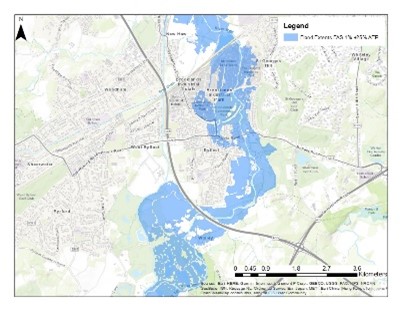
The maps below show the current likelihood of flooding in the area without a scheme and improved future flood risk with the scheme.
Flood risk without the scheme:
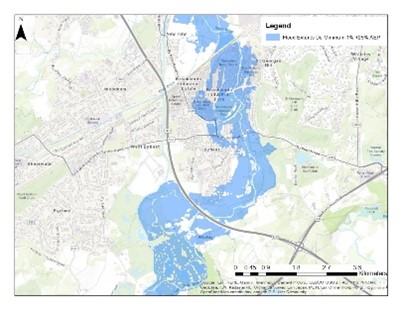
Flood risk with the scheme:
Environmental improvements
While the aim of the scheme is to reduce flooding, we also have an opportunity to deliver some wider benefits to the community and the natural environment in the area.
Biodiversity net gain (BNG) is an approach to development that aims to leave the natural environment in a measurably better state than it was beforehand. This new legislation was only introduced in February 2024 and now forms part of the Planning process. The environmental enhancements we create will be managed and monitored for 30 years. We aim to achieve a 20% biodiversity net gain in each of the 3 components: terrestrial habitats, hedgerows, and rivers. These improvements include:
We have identified a range of measures necessary to protect the environment and local communities before and during construction and once the scheme is in place. For example, minimising noise, checking air quality and traffic flow impacts. For more detail please look at the Construction section.