
Other helpful information
Who's responsible for managing flood risk?
- Areas at risk of flooding from main river and/or surface water - Check the long term flood risk for an area in England - GOV.UK.
- Areas at risk of flooding from ordinary watercourses, as well as critical drainage areas and their surface water hotspots - Aurora
- To check if there have been other reports of issues with sewers or utility pipes in your area - Check my area | In My Area | Severn Trent Water
- The Environment Agency
- Lead Local Flood Authorities (LLFAs)
- District Councils
- Internal Drainage Boards
- Highways Authorities
- Water and Sewerage companies
- Learn about and sign up to the Environment Agency's Flood Warning Service.
- Sign up to or check the Met Office's Weather Warnings
- Complete desilting works on the Melton Brook.
- Property owners unaware of their responsibilities as a riparian landowner.
- Info on this is being added to the interactive map.
Explainer + Check your flood risk
Flood risk is a combination of the likelihood of flooding and the potential consequences of flooding.
Areas at risk of flooding are those at risk of flooding from any source, now or in the future. Sources include rivers and the sea, direct rainfall on the ground surface, rising groundwater, overwhelmed sewers and drainage systems, reservoirs, canals and lakes and other artificial sources. Flood risk also accounts for the interactions between these different sources.
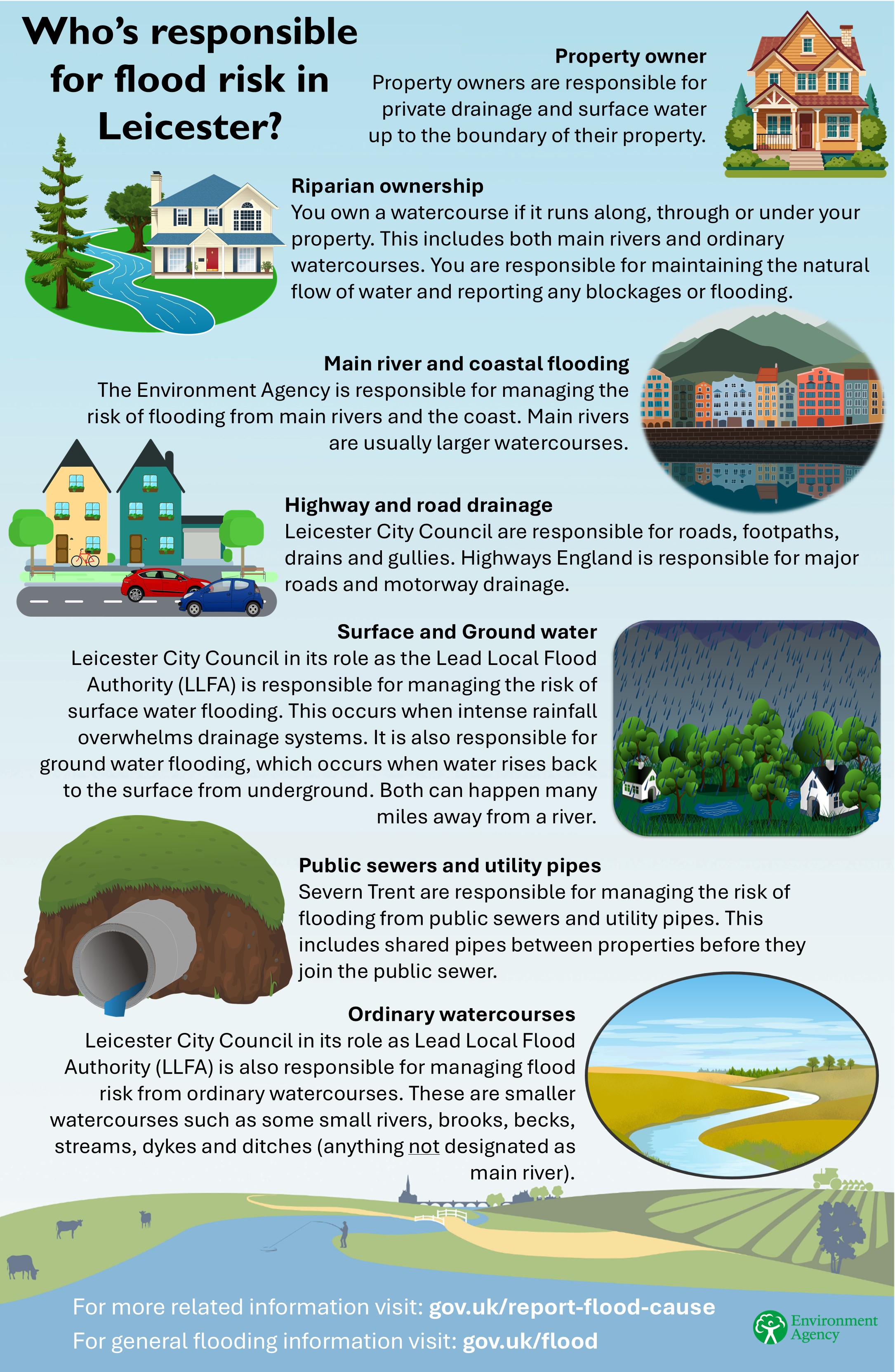
Poster detailing who is responsible for managing each of the different sources of flood risk.
It should be noted, that while there are many authorities/organisations who have a responsibility for managing flood risk, they can only "manage" flood risk and not eliminate it. This is usually done by applying the limited amount of available funding to where it is most cost-beneficial to reduce flood risk.
Ultimate responsibility for protecting yourself, your property, family and belongings, lies with you. However, we are striving to support you wherever possible.
For a more detailed explanation:
How to report a flood:
To check if/what source of flooding you are at risk from:
The Environment Agency's role in managing flood risk
The Flood and Water Management Act 2010 places a statutory duty on the Environment Agency to develop a National Flood and Coastal Erosion Risk Management Strategy for England. This strategy describes what needs to be done by the Risk Management Authorities (RMAs) in respect to all sources of flooding and coastal erosion for the benefit of people, places and the environment. These RMAs include:
As a result of this strategy the Environment Agency itself has operational responsibility for managing the risk of flooding from main rivers, reservoirs, estuaries and the sea, as well as being a coastal erosion risk management authority. It is through this role that we have our most direct impact in Leicester - by managing Flood Risk from main rivers. (To see who the other Risk Management Authorities are and what they are responsible for, see the poster at the top of this page.)
In this capacity, the Environment Agency has permissive powers to maintain and improve main rivers for the efficient passage of flood flows. As these powers are permissive only, the Environment Agency is not obliged to carry out either maintenance or new works on main rivers. Funding is allocated to work where it provides the greatest benefit to flood risk to better protect people, property, and wildlife.
The Environment Agency also has powers to construct and maintain defences against flooding, to issue flood warnings, and to manage water levels. In some cases the Environment Agency may choose to stop maintaining and operating the assets on main rivers. This happens either because the costs are greater than the benefits of reducing flood risk, or there is another party better placed to take on these responsibilities.
Section 19 Flood Investigation Report - Leicester City Council
When certain criteria are met following a significant flood event, the Lead Local Flood Authority (Leicester City Council) will investigate:
a) which risk management authorities have relevant flood risk management functions, and
b) whether each of those risk management authorities has exercised, or is proposing to exercise, those functions in response to the flood
The LLFA must then publish the result of its findings in a detailed report, known as a 'Section 19 Flood Investigation Report'.
We have linked the report published for the 6th January 2025, here, and on the home page - Section 19 Flood Investigation Report for the 6th January 2025 flood event.
It is a large report full of information that might be of interest. But we have extracted some bits that are more relevant to you and the Environment Agency, into the below table.
Chapter/Section of the report | Relevant parts | Where on this page you can find support or more info about it |
|---|---|---|
13. Recommendations | Property owners to investigate the flood risk posed to their property, and undertake the following actions: • Sign up to Environment Agency’s Flood Warnings service and Met Office Weather warnings. • Prepare a flood plan for their property. • Explore options for installation of appropriate flood resilience measures. • Ensure that they have an adequate level of insurance, to cover flooding. | |
14. Proposed actions (by Risk Management Authorities) |
All this supporting information and more can be found on the main page through the links down the right hand side and the interactive tools at the bottom.