
Watercourse Maintenance
Who's responsible for maintaining my local watercourse?
- it runs on or under your land
- it borders the boundary of your land (you will own up to its centre - i.e. from the boundary of your land to the centre of the watercourse)
- Knighton Park (Saffron Brook)
- Braunstone Park (Braunstone Brook)
- Willowbrook Park (Bushby Brook)
- Melton Brook (Appleton Park)
- Bushby Brook (Ocean Road)
- Humberstone Road (Melton Brook)
- Westcotes Park, Braunstone Park (Braunstone Brook)
- Nether Hall (Scraptoft Brook)
- Knighton Park (Saffron Brook)
- Braunstone Park (Braunstone Brook)
- Willowbrook Park (Bushby Brook)
- Tilting Gate (Saffron Brook)
- Melton Brook & overflow
- Scraptoft Brook
- Thurnby Brook
- Bushby Brook
- Evington Brook
- Willow Brook
- Saffron Brook
- Braunstone Brook
- Knighton Park (Saffron Brook)
- Braunstone Park (Braunstone Brook)
- Willowbrook Park (Bushby Brook)
- Oakland Avenue (Melton Brook / River Soar)
- Cutting back weeds within the concrete channels.
- Cutting back any branches overhanging water which hinder flow.
- Removal of trees which are blocking flow if they are in the channel
- Each watercourse is assessed and the frequency decided by priority depending on the risk of flooding.
- Melton Brook & overflow
- Scraptoft Brook
- Thurnby Brook
- Bushby Brook
- Evington Brook
- Willow Brook
- Saffron Brook
- Braunstone Brook
- Melton Brook & overflow
- Scraptoft Brook
- Thurnby Brook
- Bushby Brook
- Evington Brook
- Willow Brook
- Saffron Brook
- Braunstone Brook
The importance of maintaining watercourses
A considerable amount of Main River in Leicester consists of deep, narrow and often concreted channels. Many of these watercourses are little more than small streams in the drier parts of the year. However, following storms or in the wetter months they can transport massive, rapid flows.
Due in part to the amount of hard impermeable surfaces in the city, causing a high degree of run-off, these watercourses respond very quickly to rainfall and can change from a small trickle to a torrent in a short space of time.
This, combined with their narrowness, results in these brooks being at especially high risk of flooding due to blockages or restrictions. These blockages are often caused by the dumping of garden/household waste, collapse of poorly maintained walls/fencing, fly-tipping, fallen trees, overgrown vegetation, etc. (Leicester City Council provides a Bulky waste collections service for most kinds of waste, that is free up to a certain threshold. Alternatively, check out their Garden waste scheme or their other useful Recycling and waste services and guides).
It is therefore critically important that these watercourses are maintained and treated appropriately to minimise flood risk. Which has the added benefit of making them cleaner, safer and more enjoyable for both people and wildlife. (To learn about the wildlife native to our waterways as well as invasive species, visit Canal & river wildlife. Additionally click these links if you're concerned about Japanese knotweed, or want to Report an environmental problem).
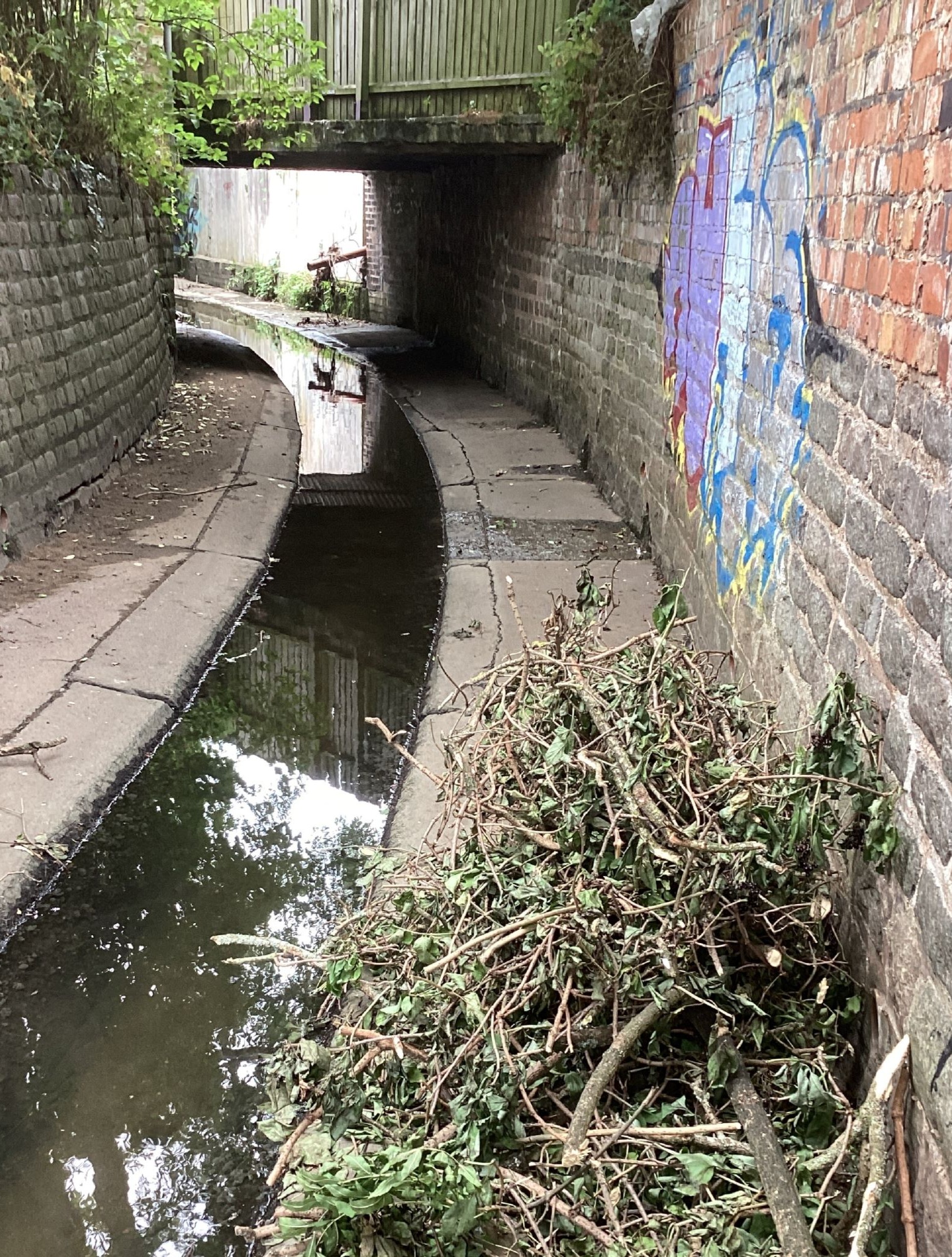 | 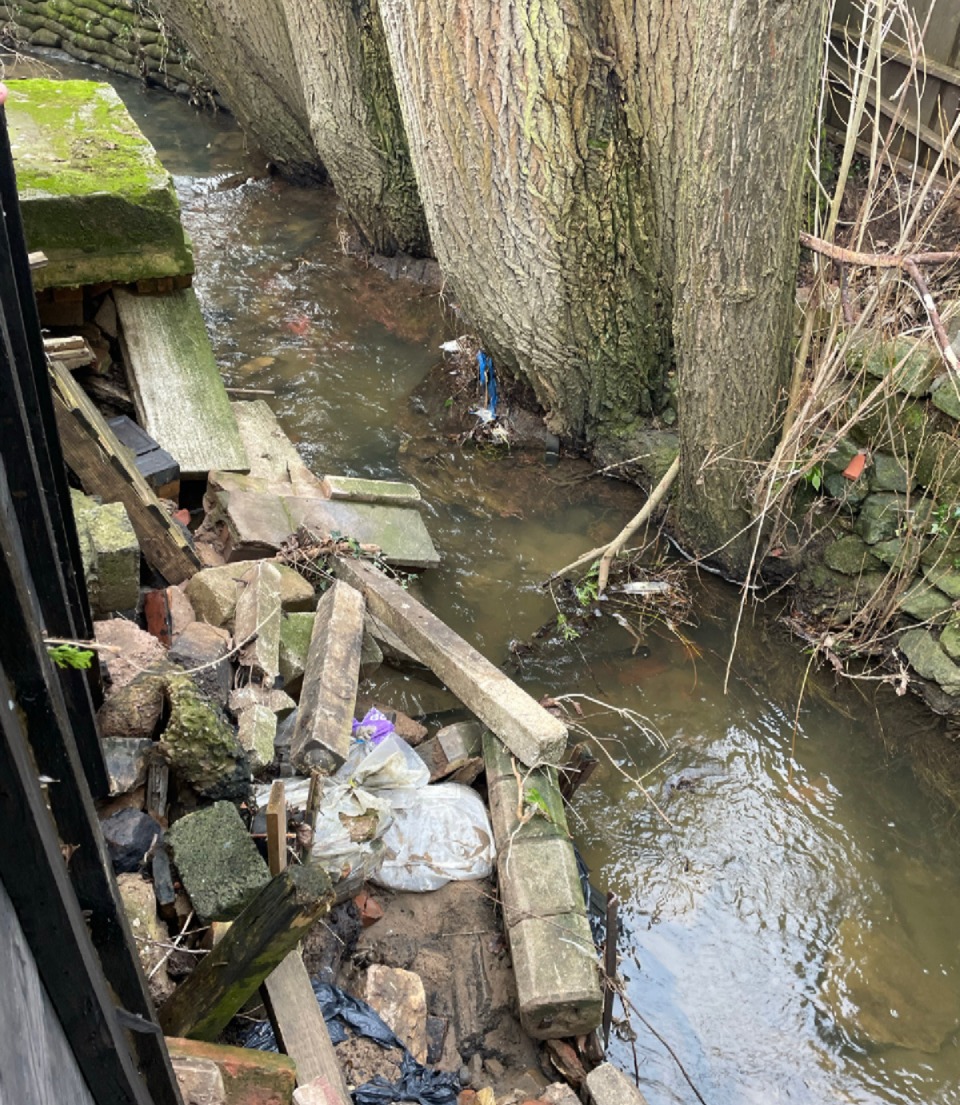 | 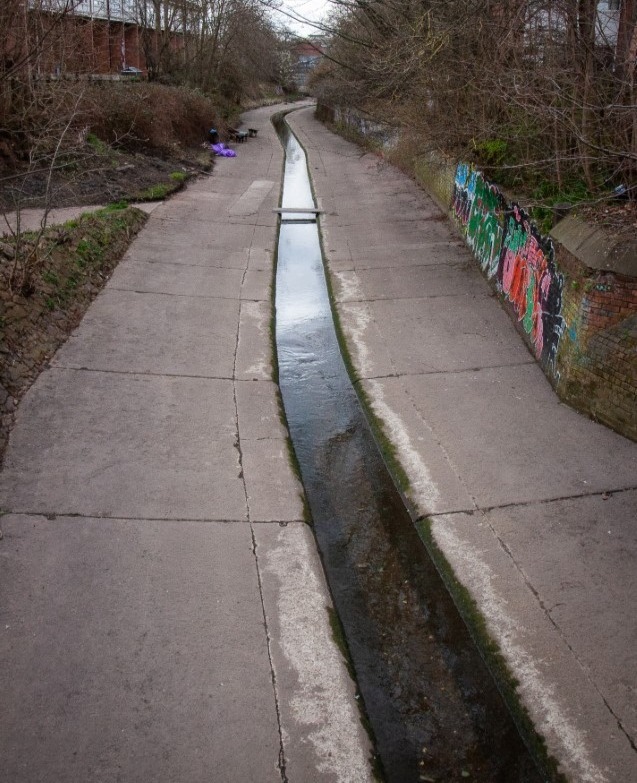 |
Photo of the narrow and deep Evington Brook channel in August, with only minor flows just filling the small central summer channel | Debris in Bushby Brook | Willow Brook following cleaning work, demonstrating how many of the Brooks in Leicester could look with better care and community involvement |
Unfortunately, most of the rivers and brooks in Leicester are suffering from extreme biodiversity loss. To help rectify this, the Environment Agency's approach to maintenance has improved over the years to minimise its impact on nature. It is now carried out with far more precision and a greater consideration of natural ecosystems, while still maximising improvements in conveyance (the ability of a watercourse channel to transport water) where it is needed.
However, creating safe, pleasant and biodiverse watercourses is more readily and effectively achieved when everyone works together. The responsibility for maintaining them falls on us all.
For some of us, more than we may realise...
Riparian Ownership
Owning a watercourse - You will, in most circumstances, be the owner of a stretch of watercourse if:
If this applies to you, you are considered what is called a riparian owner - with 'riparian' meaning 'related to or situated on a river'.
As a riparian owner you are entitled to certain rights. However, in addition to this, many of the responsibilities for maintaining watercourses ultimately lie with the riparian owner.
To find out about riparian rights and responsibilities, see ‘Your Watercourse: rights and roles’ and click on the bottom option.
For additional guidance and videos visit: https://thefloodhub.co.uk/riparian-owner-toolkit/
Community Maintenance Guidance
If you or your local community group want to reduce flood risk by maintaining drainage, watercourses and flood defences but you don't know where to start, the following document can help:
'C821a Taking action. Reducing the risk of flooding for your community by maintaining drainage, watercourses and flood defences' - was created to explore enabling community maintenance for local flood risk management. It describes the necessary steps to organise a group with a view of doing maintenance activities on local watercourses and flood risk assets.
Unfortunately due to this document being copyrighted, it cannot be linked or attached directly to this page.
To access this document, visit - CIRIA, where you'll need to create an account, and then you will be able to download the document for free from the bookshop.
It also comes with 2 additional documents that will be useful for members of Risk Management Authorities and other policy and strategy staff:
C821b Risk Management Authorities' guide to supporting community maintenance was produced for risk management authorities. It describes the benefits of a positive collaboration with local groups to sustain flood risk assets.
C821c Briefing note for policy and strategy staff: enabling and supporting communities in voluntary maintenance of flood assets is a short briefing note created for strategic/policy staff, which traces a line through existing policies involving community groups in maintaining flood risk assets.
The Environment Agency Maintenance Schedule
As a Risk Management Authority the Environment Agency is concerned with Flood Risk. Our maintenance activities are therefore focused on preserving conveyance (flow of water in a channel) and our flood defence assets/structures. It is not our responsibility to maintain any other structures.
As the Environment Agency’s powers are permissive only, we are not obliged to carry out either routine or improvement works to assets or watercourses. Work is prioritised according to need and is dependent on funding being available (this is primarily determined by budgetary constraints and/or the economic benefits of the work in question), while also prioritising safe methods of working and protecting biodiversity.
To learn how the economic benefits of a project are calculated, please see - Calculate Grant-in-Aid (GiA) funding for FCERM projects - it is possible the way these are calculated may change in the near future, following discussions in parliament.
To learn about desilting and dredging, and in what circumstances the Environment Agency will undertake these works, visit - Floods and dredging: explaining the Environment Agency’s approach – Creating a better place.
As part of our role as a Flood Risk Management Authority, we carry out the following routine maintenance on watercourses and our flood defence assets in Leicester:
Maintenance Type | Description | Location | Times |
Grass Cut | Regular cuts of EA flood defences (embankments, Reservoirs) | Three times per year (April-May, June-July and August-September) | |
Sides of channel | Late summer single cut | ||
Maintenance & Operational Checks | Clearance of debris from the front of protective screens to ensure water will flow through in heavy rainfall | Weekly (or as necessary immediately prior to, during, and immediately following a high flow event)
| |
| Ensuring EA assets are operating correctly | Weekly | ||
Regular monthly walks of the accessible parts of the brooks in Leicester City with clearance of simple blockages | Monthly | ||
Vermin Control | Preventing animal burrows from causing embankments to fail | Monthly
| |
| Every three months | |||
Vegetation and bush maintenance | Work can only be carried out between October and February, and when water levels are low enough for this to be done safely.
| ||
Silt removal | Removing accumulations of mud to restore the level of the bed to what it was designed to be. Each watercourse is assessed and the frequency decided by priority depending on the risk of flooding | When required and the work will produce a benefit. This is a complex operation to plan where it happens in the middle of the city, and cannot be done at all sites
|