Integrated Water Management programme
The challenge and the opportunity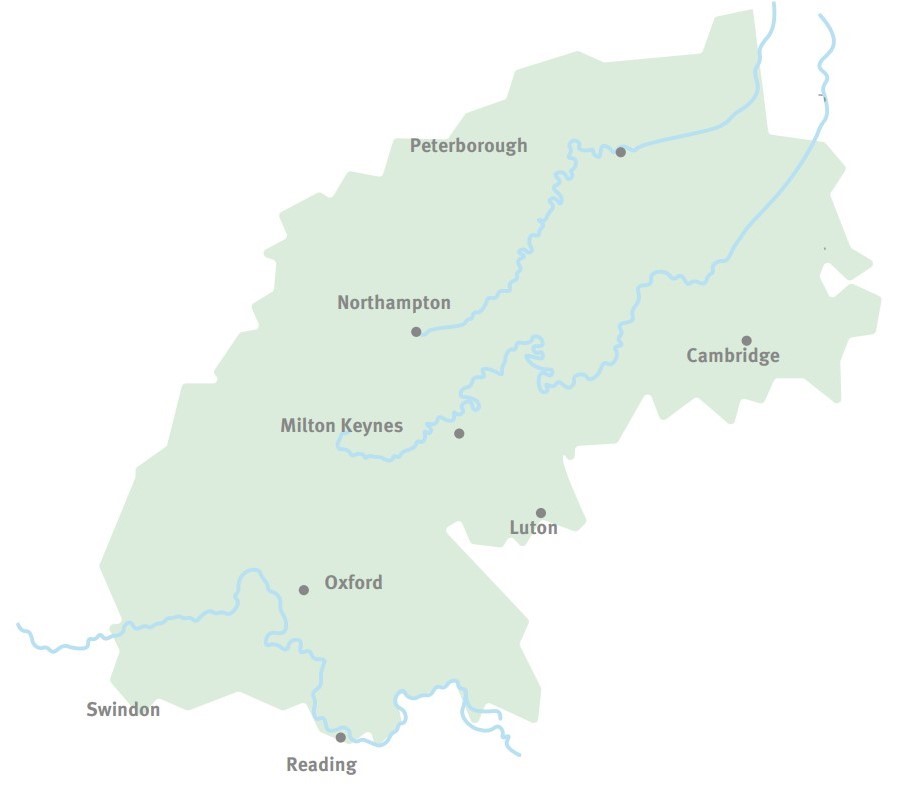
The Oxford to Cambridge Growth Corridor has significant existing water pressures alongside ambitious growth plans and a changing climate. Last year, due to the hot dry summer, reservoir and groundwater levels were low with drought conditions remaining into later autumn and early winter.
At the Environment Agency, we work alongside partner organisation towards ensuring that growth is sustainable. For example, by supporting the planning process to ensure water resource, wastewater, flood risk and the water environment are all incorporated early in planning.
Working at a regional scale, alongside a government led growth programme, offers the opportunity to plan strategically across boundaries to ensure appropriate water infrastructure is included early in planning to help shape sustainable growth.
The Environment Agency's Oxford to Cambridge team are working on their Integrated Water Management Programme, which looks to deliver projects that test and trial new ways of addressing water challenges. By providing evidence, creating guidance, and shaping strategy, plans and policy, the team are working to move beyond business as usual to a more integrated approach to water management.
Resources
To find out more about our Integrated Water Management projects and to explore the team's resources and products, please see the widgets to the right of this page or visit our website for more information.
Please find below our newsletter, keeping you up to date with the teams work and progress.
-
Integrated Water Management March newsletter 2026
Working in partnership, our team develops, tests, and trials innovative approaches through projects that form part of our Integrated Water Management programme.
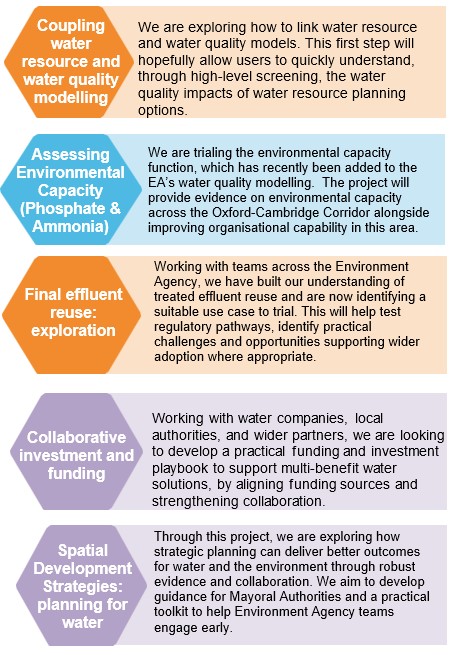
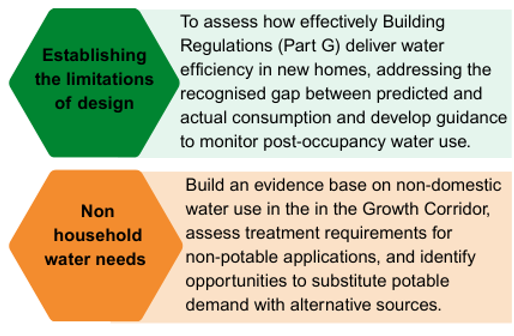
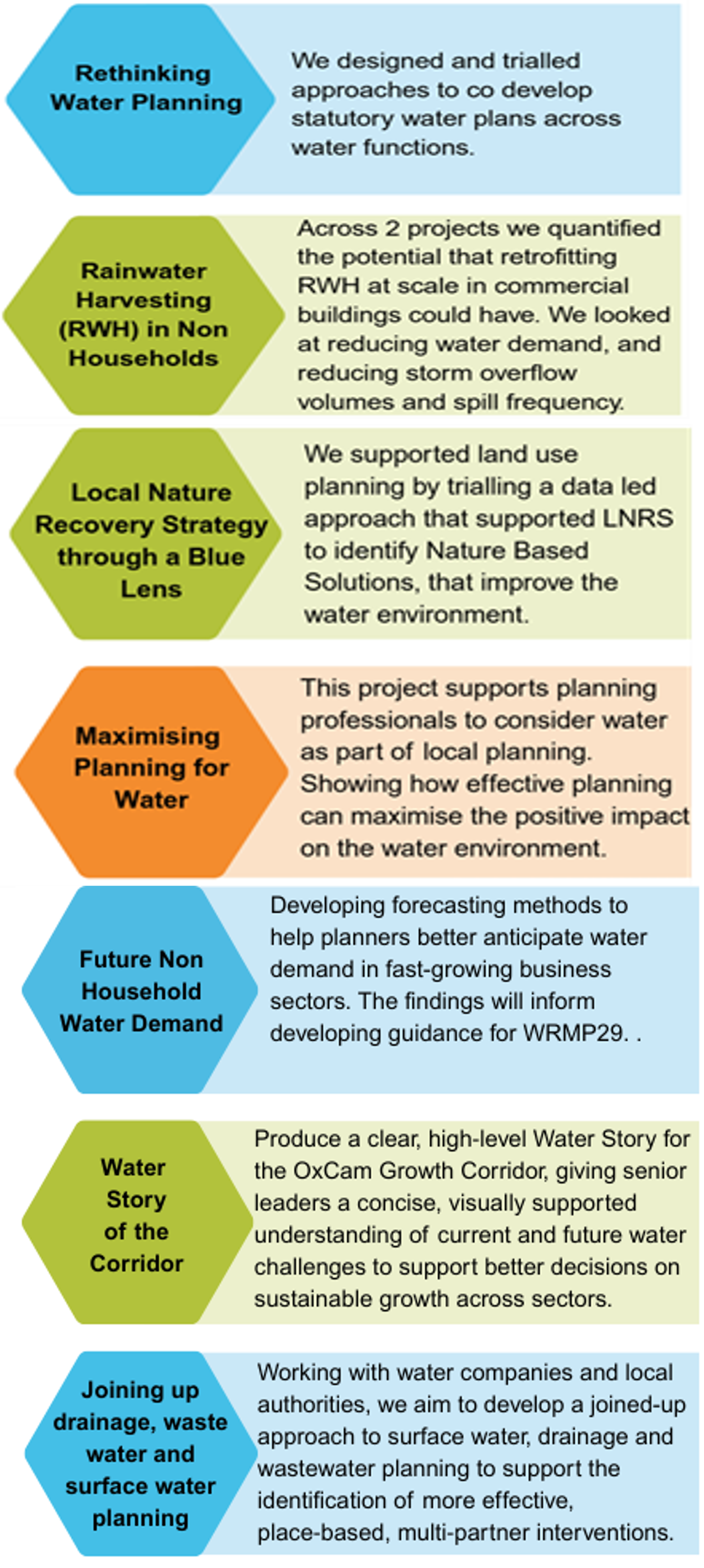
The diagram below illustrates how our programme has evolved, showing our progression from establishing the baseline: gathering evidence and building understanding of the challenges in creating water-resilient places, to identifying and responding to opportunities to help overcome these challenges and integrate water planning and delivery systems. By developing, testing, and trialling new approaches we are providing evidence, creating guidance, and shaping strategy, plans and policy to support the transition from business as usual to a more integrated approach to water management.
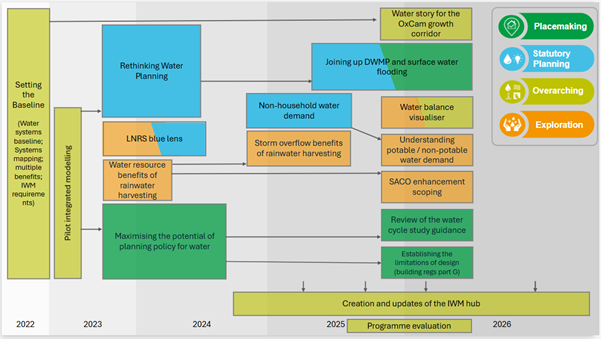 Integrated Water Management Programme, mapping out our completed and upcoming projects Sharing project learning
Once projects are completed, we publish them on our external Integrated Water Management hub, designed as a central resource to:
share insights
foster collaboration between stakeholders
support ongoing learning and transition towards Integrated Water Management
The hub features key messages from our projects, tailored to a range of stakeholder groups, alongside our project publications for easy reference.
We also write non-technical summaries for each project, which are added to the hub. Summaries for some of our latest projects will be uploaded in the coming months, so keep an eye out for these. If you'd like to review the technical reports before these summaries are available, please email us at Ox.Cam@environment-agency.gov.uk.
Future work
We are currently identifying and prioritising embedding actions and Research and Development projects ideas for the next financial year 26/27 – if you would like to know more about this process or get involved, please contact us at Ox.Cam@environment-agency.gov.uk.
Ongoing projects
This month we are pleased to share progress on our Water story of the Growth Corridor and our Water balance visualiser projects. Both projects are in full swing, with the team collaborating with our Integrated Water Management board and our senior user from Defra Water Services on the Water story as well as working with national planning and area operations colleagues within the Environment Agency on our Water balance visualiser work.
Water story of the Growth Corridor
We aim to create a clear and joined-up Water story of the Oxford to Cambridge Growth Corridor. It will bring together facts, plans, and expert knowledge from across the water sector to provide a shared situational awareness of the regions water situation. We have kicked off the Water Story project and have been successful in establishing a suitable programme schedule. We have been working through finalising the topics the project will investigate to complete a comprehensive account of the water system within the geography. Focusing on the 4 water disciplines: water resources, water quality, flood and water environment, the reader will be guided through the past and current situation of these sectors as well as exploring what might be needed to support future growth. We will showcase the challenges and opportunities within each water discipline through discussing a range of spotlight subjects including resilient water supply infrastructure and capacity of sewage treatment works.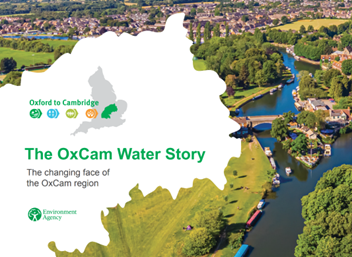 Draft front cover of The OxCam Water Story overview
Water balance visualiser
We are developing and building a visualisation tool that enables users to explore and test the impacts of ‘proposed changes’ to discharges and abstractions. The tool will encourage scenario-based thinking and experimentation allowing users to “play” to understand the art of the possible, rather than trying to find a single definitive solution.
We recently ran 3 workshops to develop “user stories”, which have been used to direct the design of the tool. Stakeholders represented the Environment Agency, regional water resource bodies, and water companies. The main development will be done through 3 development sprints, which started in early February.
Engagement and events updates
Joining up drainage, wastewater and surface water planning January workshops
Working with water company and local authority partners, this project aims to develop a joined-up approach to surface water, drainage and wastewater planning. The work will strengthen collaboration and clarify how surface water and wastewater planning best interact. Piloted in West Northamptonshire, it will build a shared understanding of risks and opportunities for co‑benefits and develop a transferable method for integrated water management that will support identification of more effective, place‑based, multi‑partner interventions.
We recently ran 2 workshops, the sessions were designed to build on our trial findings and gather feedback on the proposed approach for better integrating these 3 areas of water management. Their insights were particularly valuable in helping us understand how this work can be effectively shared, adopted and embedded into existing ways of working. While the feedback was overwhelmingly positive, we also received constructive suggestions for improvement, which will now be incorporated into the final design.
If you are aware of any events or engagement opportunities that the OxCam team could support, particularly showcasing our Integrated Water Management project work please email us at Ox.Cam@environment-agency.gov.uk.
What's next
Thank you for taking an interest in our Integrated Water Management Programme newsletter - March edition.
To sign up directly for our Engagement HQ updates newsletter updates or to hear more about our work please email the team at OX.Cam@environment-agency.gov.uk. Otherwise please look out for our next newsletter.
Contact the Oxford to Cambridge team via email at OX.Cam@environment-agency.gov.uk.
We look forward to hearing from you.