We use cookies to ensure our site functions properly and to store limited information about your usage. You may give or withdraw consent at any time. To find out more, read our privacy policy and cookie policy.
Manage Cookies
A cookie is information stored on your computer by a website you visit. Cookies often store your settings for a website, such as your preferred language or location. This allows the site to present you with information customized to fit your needs. As per the GDPR law, companies need to get your explicit approval to collect your data. Some of these cookies are ‘strictly necessary’ to provide the basic functions of the website and can not be turned off, while others if present, have the option of being turned off. Learn more about our Privacy and Cookie policies. These can be managed also from our cookie policy page.
Strictly necessary cookies(always on):
Necessary for enabling core functionality. The website cannot function properly without these cookies. This cannot be turned off. e.g. Sign in, Language
Analytics cookies:
Analytical cookies help us to analyse user behaviour, mainly to see if the users are able to find and act on things that they are looking for. They allow us to recognise and count the number of visitors and to see how visitors move around our website when they are using it. Tools used: Google Analytics
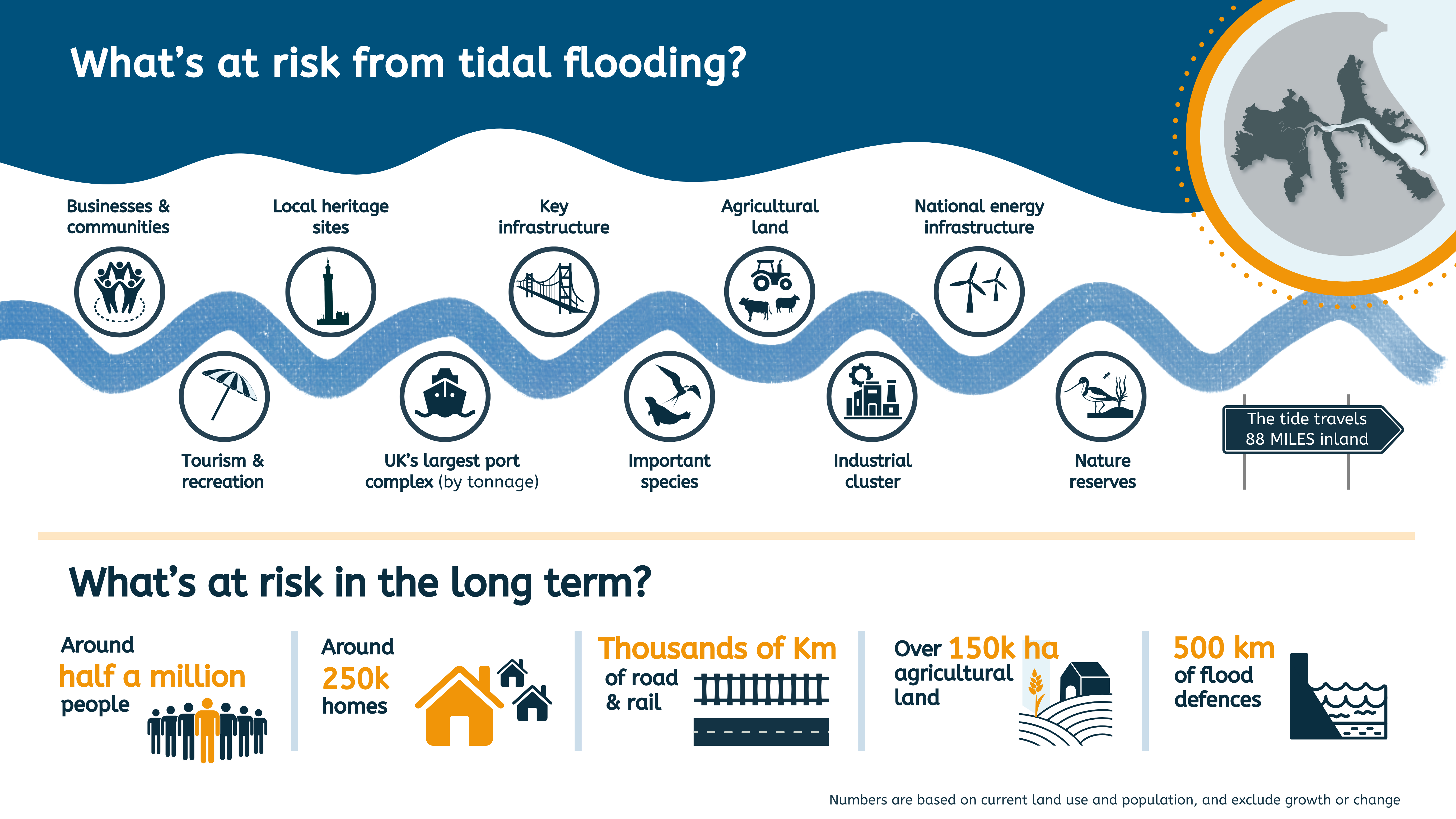
Tidal flood risk is a reality for many people who live and work around the Humber estuary. Much of the area around the estuary is low-lying, and the effects of flooding from the sea (or from tidal rivers that feed the estuary) can be devastating for local communities and industries.
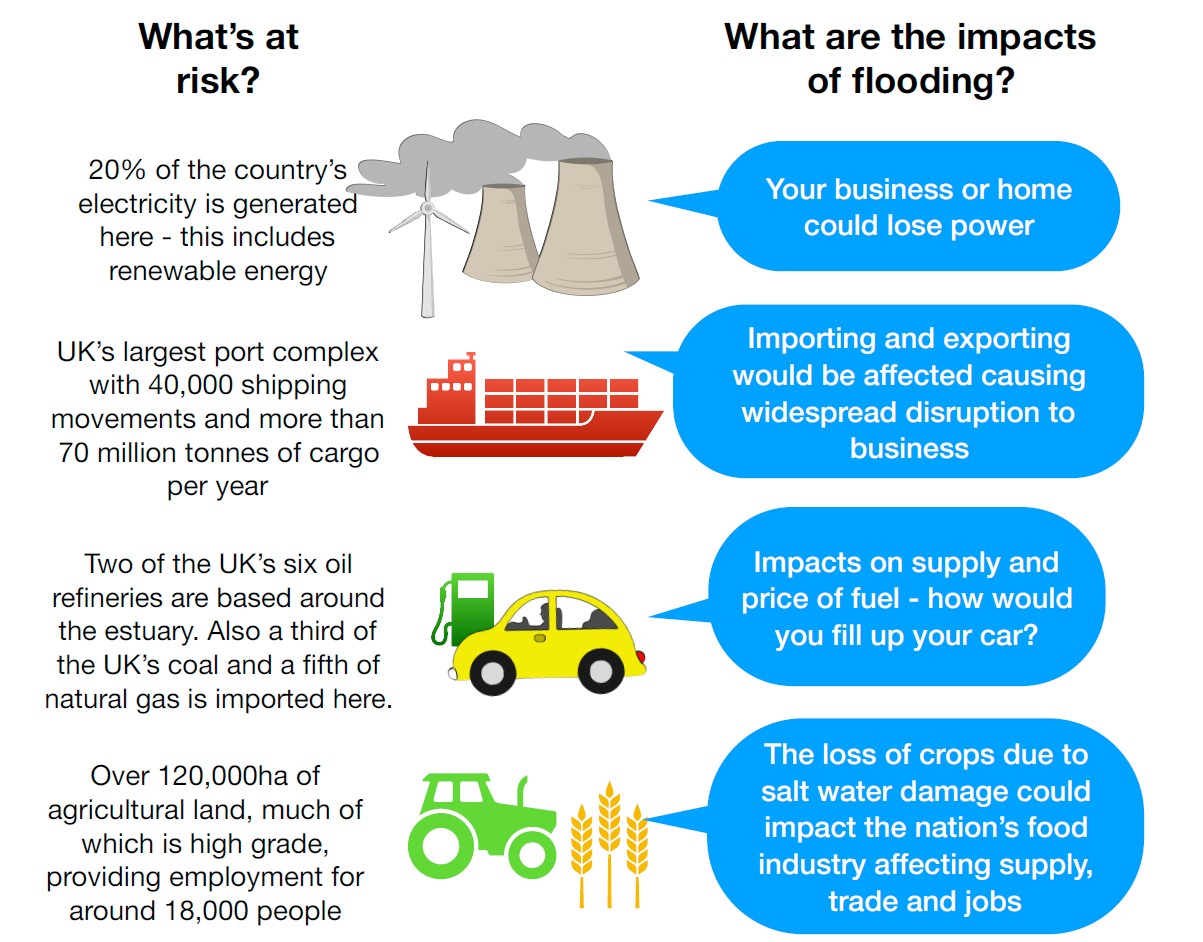
The area at risk is home to around 500,000 people and thousands of businesses, many of which are concentrated within the city of Hull and large towns such as Grimsby and Goole. Inland areas including parts of Doncaster, Selby and Gainsborough are also at risk as high tides move up-river.
Tidal flood risk affects major industries based around the Humber too. This includes power stations, refineries, and the UK's largest port complex, as well as around 120,000 hectares of high quality agricultural land.
The national importance of these industries means that tidal flooding on the Humber has a much wider impact.
Tidal flooding isn't the only source of flooding on the Humber; the area is also at risk of flooding from rivers, sewers, surface water, and groundwater. For example, the area around Hull and East Yorkshire experienced river and surface water flooding in 2007, with over 14,000 properties affected.
For more information about how rivers and sea affect each other, see the video below!
Tidal flood risk on the Humber is currently managed via the Humber Flood Risk Management Strategy ‘Planning for the Rising Tides’. This document, published in 2008, was the first of its kind in England, taking a joined-up approach to tackling tidal flood risk. It set out the Environment Agency’s vision for managing tidal flood risk from the Humber Estuary in the face of climate change and sea level rise, taking into consideration the impacts this could have on people, industry and wildlife.
The Humber Strategy outlined a programme of investment which would ensure that 99% of people living around the estuary continued to receive a good standard of protection from tidal flooding for the first 25 years and beyond. It also acknowledged that defence improvements would not be possible in all locations around the estuary. It was always intended that the Strategy would be reviewed to take account of changing circumstances and better information as it became available.
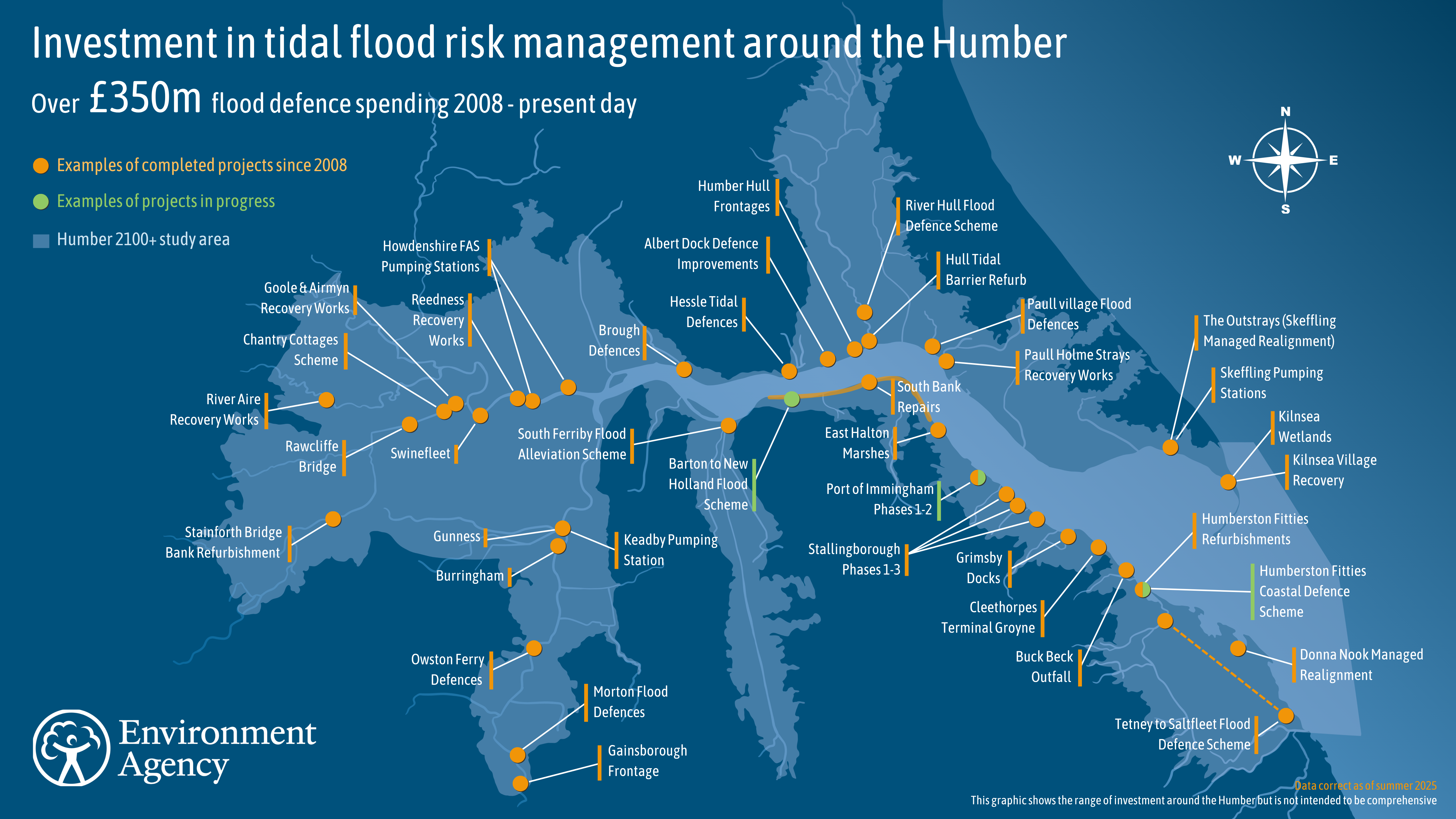
As a result of the Humber Strategy, over £350 million has been invested in tidal flood risk management, improving the standard of protection to over 70,000 properties.
The map shows some of the key schemes and projects that the current Humber Strategy has delivered.
Many of these projects and schemes have been delivered by the Environment Agency and local councils, often in partnership with others. Internal Drainage Boards (IDBs) also have a key role, particularly around the operation of assets such as pumping stations. The on-going maintenance and operation of assets often requires a joined-up approach between different organisations to ensure that the intended standard of protection continues to be provided for many years to come.
What's changed since 2008?
Since the publication of the existing Humber Strategy, more up-to-date technical information has become available, for example;
The December 2013 tidal surge provided us with improved evidence of tidal flood mechanisms and estuarine processes
Updated UK Climate Projections were released in 2018 (UKCP18)
There have also been policy changes that provide new opportunities for funding future tidal risk management schemes.
These developments acted as a catalyst for change. They highlighted the need to review the existing approach and consider how tidal flood risk can be managed more flexibly in the long-term. This led to the creation of the Humber 2100+ partnership, which is taking a more adaptive, collaborative approach to managing tidal flood risk and building long-term resilience across the estuary and its tidal rivers.
Climate change is one of the biggest global challenges that we face. We are already starting to feel the effects; the last decade was around 1.3ºC warmer than the pre-industrial period (1850-1900), and the ten hottest years on record in the UK have all occurred since 2002. Our climate is getting wetter with intense storms becoming more frequent, and mean sea levels around the UK have risen by around 17cm since the start of the 20th century.
The latest information suggests that the Humber could experience over a metre of sea level rise in the next 100 years. During this time, flows on the tidal rivers are also expected to increase significantly. It isn't possible to know exactly how quickly sea levels will rise, but we know that there will be increased pressure on flood defences, meaning it is more likely that they will be overtopped or damaged. The likelihood of high river flows coinciding with high tides and tidal surge events will also increase. The scale of flooding that we currently consider rare will therefore happen more often.
It is clear that climate change will increase tidal flood risk in the future, affecting homes, businesses and habitats. We must take action now to ensure that tidal flood risk management on the Humber takes account of these changes.
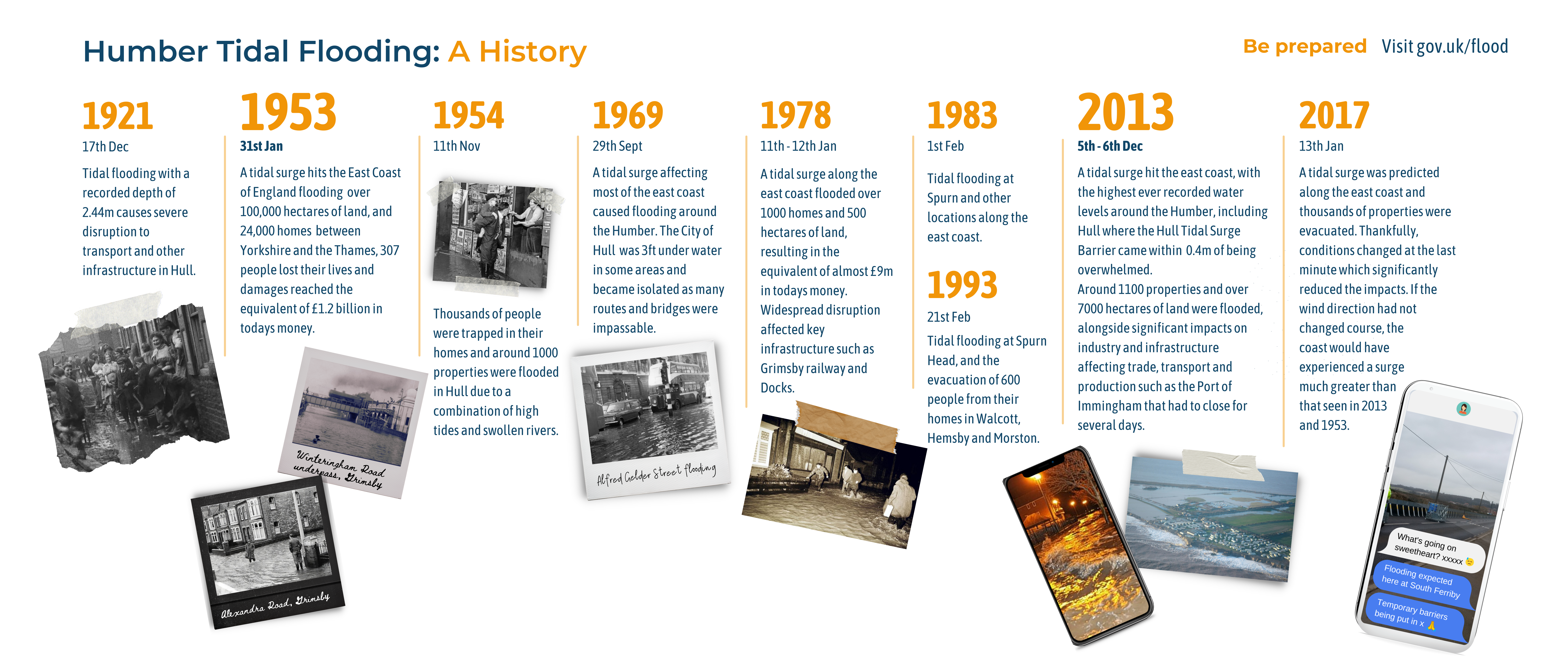
Past flood events have shown that an extreme flood due to a tidal surge would have a widespread and devastating impact. The UK Government’s National Risk Register identifies a coastal flood as one of the country's biggest risks, and the scale of risk on the Humber places it in the highest risk category. The graphic below shows just some of the tidal events that have occurred over the last century.
1953 North Sea Flood
On the night of 31st January 1953, a storm occurred over the North Sea, resulting in flooding in many coastal areas in the Netherlands, Belgium, Scotland and England, including on the Humber. Strong winds coincided with low pressure and high tides. The resulting tidal surge was the most damaging on record, leading to the loss of 300 lives in England and the evacuation of a further 300,000 people. Around 24,000 homes were flooded as well as almost 100,000 hectares of land between Yorkshire and the Thames.
Sadly, the 1953 tidal surge not only had devastating impacts for those on land. Many lives were lost at sea that night. Watch the video below for a first-hand account.
2013 Humber Tidal Surge
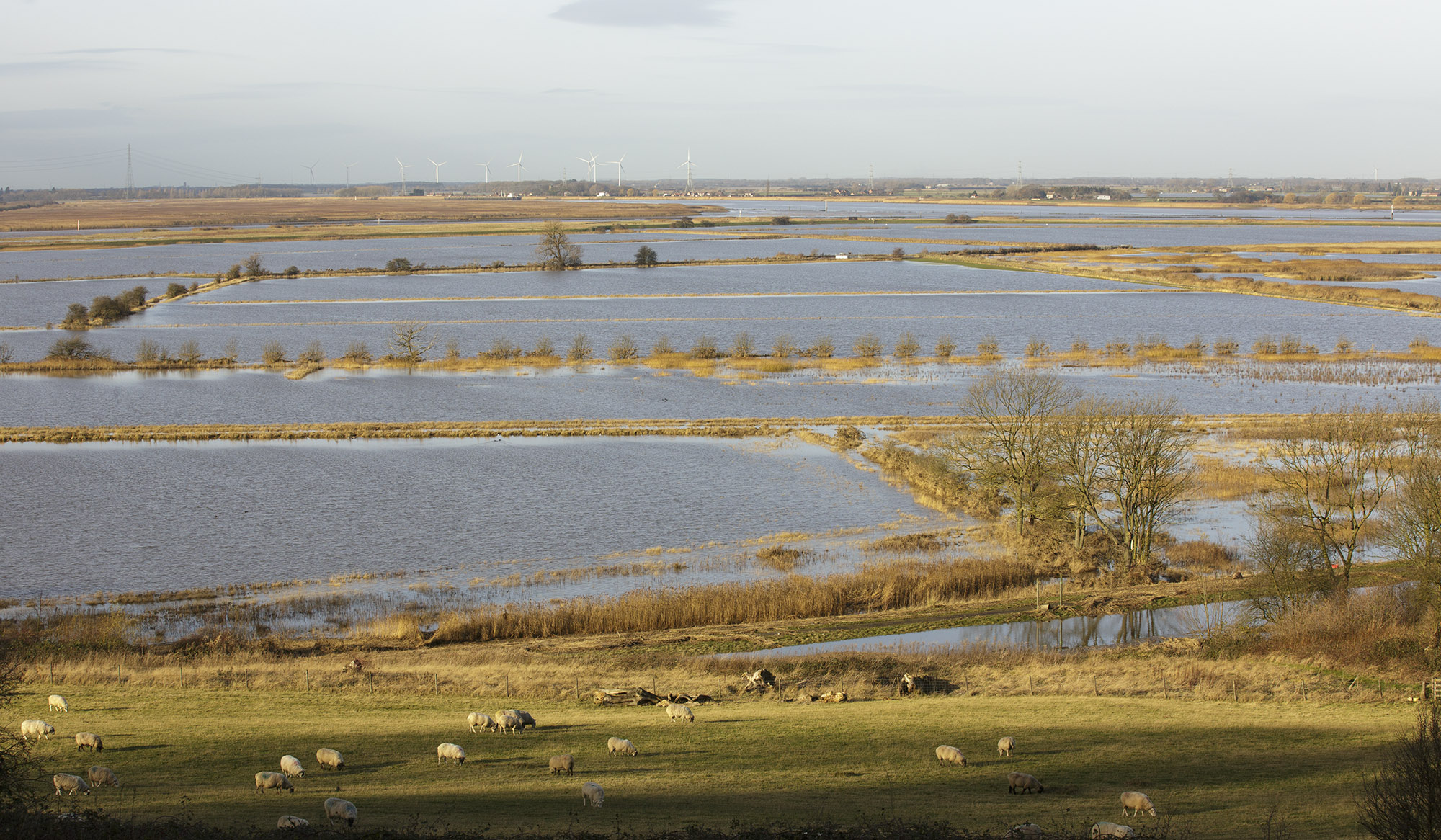
The largest tidal surge recorded on the Humber estuary was on 5th December 2013. The tidal surge combined with high spring tides and a deep low pressure system, resulting in the highest recorded water levels at several locations around the estuary, including Hull. Although water levels on the Humber were higher than the 1953 North Sea flood, impacts were significantly less due to the improved flood defences that had been developed around the estuary since the 1953 flood. More sophisticated forecasting and a flood warning system also helped to ensure that no lives were lost. However, 1100 properties and over 7000 hectares of land were still flooded. The tidal surge also had a significant impact on industry and infrastructure around the estuary, which affected trade, transport and production.
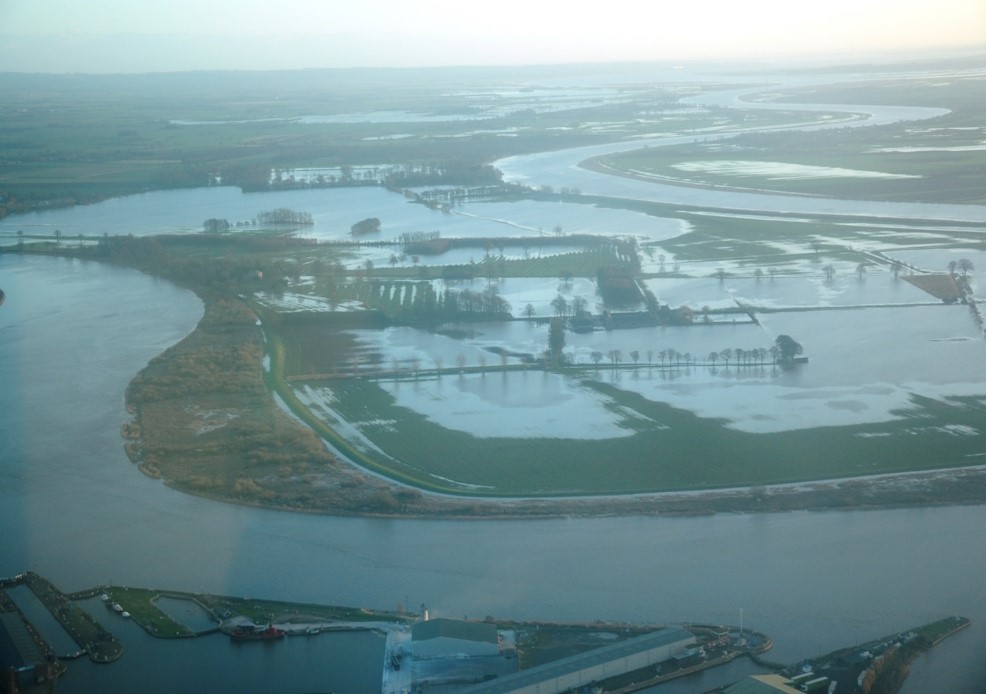
Goole during 2013 tidal surge
History shows that tidal flooding, particularly tidal surges, pose a grave risk to life. A Humber tidal surge would have the full force of the North Sea behind it. Powerful, fast, and relentless, the water moves in quickly leaving the unprepared exposed to its impacts.
The Humber has undergone significant changes over time due to both natural processes and human activities. The landscape has been shaped by factors such as sea-level changes, movement of sediment, and the impact of human interventions such as industrial development and urbanisation.
Humans have made changes over the centuries, managing the estuary's natural dynamics and supporting economic activities. Here are some key examples:
Flood defences - to protect surrounding areas from flooding, extensive flood defence systems have been constructed, including embankments, barriers, and drainage systems.
Industrial development - the estuary has been a hub for industries such as shipping, oil refineries, and manufacturing. Ports such as Hull and Immingham have expanded significantly over the years.
Land reclamation - Large areas of salt marsh and mudflats have been reclaimed for agriculture and development, altering the natural landscape.
Conservation - in recent years there has been a focus on balancing development with environmental conservation, protecting biodiversity while supporting sustainable use.
Check out the videos below that provide a glimpse into how some areas have changed over the centuries.


 Goole during 2013 tidal surge