
Solway Tweed
- Public Water Supply: 61%
- Industrial: 26%
- Agriculture: 12%
- Public Water Supply: 64%
- Industrial: 26%
- Agriculture: 10%
- Public Water Supply: <1 Ml/d
- Industrial: <1 Ml/d
- Agriculture: <1 Ml/d
- All numbers are indicative, do not include proposed catchment actions (e.g. 2024 Water Resources Management Plans), are based on consumptive abstraction, and are subject to local review
- Licences that are less than 20% consumptive have been filtered out, but may require action after local review
- If no abstraction reductions are identified, abstraction may still need to reduce once local data and information has been considered
- If a licence has a "Hands off Flow" (HOF) condition it may already have the appropriate level of constraint
Eden and Esk

Accessible version here
Catchment Summary Eden and Esk
1. Catchment Information
Catchment: Eden and Esk
Next Common End Date: 2042
2. Current Picture of Abstraction by Sector
Fully Licensed Consumptive Abstraction: 550 Ml/d
Proportion of the total volume of water abstracted by sector if licences were used to full capacity:
• Public Water Supply: 97%
• Industrial: 2%
• Agriculture: 1%
• Other: 0%
• Amenity: 0%
Recent Actual Consumptive Abstraction: 414 Ml/d
Proportion of the total volume of actual abstraction by sector based on an average of a 6 year period:
• Public Water Supply: 97%
• Industrial: 2%
• Agriculture: 1%
• Other: 0%
• Amenity: 0%
3. Consumptive vs Non-Consumptive Abstraction
• Consumptive Abstraction: 33%
• Non-Consumptive Abstraction: 67%
Proportion of non-consumptive abstraction in the catchment (not represented in current picture of abstraction by sector)
4. Recent Actual Abstraction Reductions by Sector (ML/d) to Meet Current RBMP Targets
Recent actual abstraction is based on a set 6 year period. Figures do not account for future planned actions in the catchment including licence capping proposals.
• Public Water Supply: 7 Ml/d
• Agriculture: <1 Ml/d
5. The range of potential abstraction reductions required in a fully licensed 2050 scenario considering potential future climate
Sector | Lower % | Lower Ml/d | Upper % | Upper Ml/d |
Amenity | 0% | 0 | 0% | 0 |
Industrial | 0% | 0 | 0% | 0 |
Other | 0% | 0 | 0% | 0 |
Agriculture | 0% | <1 | 0% | <1 |
Public Water Supply | 0% | 10 | 5% | 15 |
6. Important Notes
• All numbers are indicative, do not include proposed catchment actions (e.g. 2024 Water Resources Management Plans), are based on consumptive abstraction, and are subject to local review
• Licences that are less than 20% consumptive have been filtered out, but may require action after local review
• If no abstraction reductions are identified, abstraction may still need to reduce once local data and information has been considered
• If a licence has a “Hands off Flow” (HOF) condition it may already have the appropriate level of constraint
Esk and Coast
Accessible version here
Catchment Summary Esk and Coast
1. Catchment Information
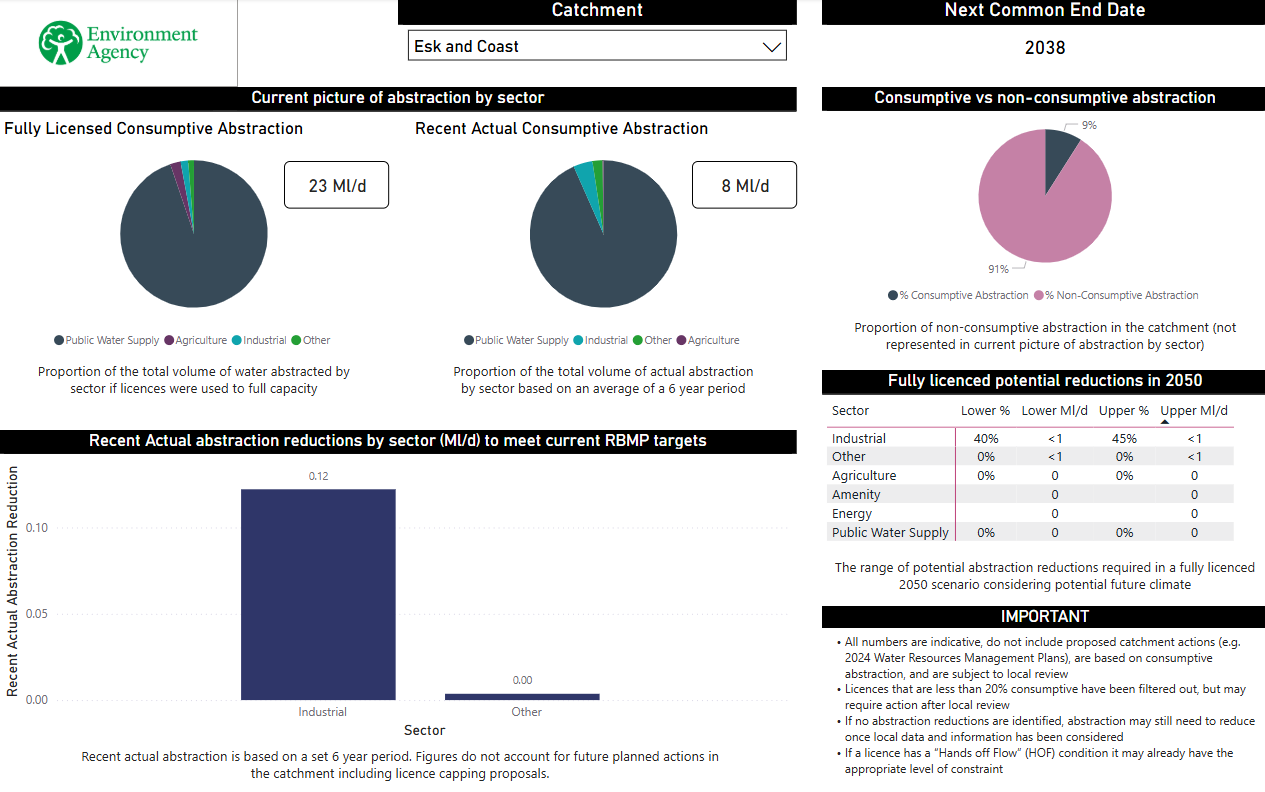
Catchment: Esk and Coast
Next Common End Date: 2038
2. Current Picture of Abstraction by Sector
Fully Licensed Consumptive Abstraction: 23 ML/d
Proportion of the total volume of water abstracted by sector if licences were used to full capacity:
• Public Water Supply: 95%
• Agriculture: 2%
• Industrial: 2%
• Other: 1%
Recent Actual Consumptive Abstraction: 8 ML/d
Proportion of the total volume of actual abstraction by sector based on an average of a 6 year period:
• Public Water Supply: 93%
• Industrial: 4%
• Other: 2%
• Agriculture: 0%
3. Consumptive vs Non-Consumptive Abstraction
Proportion of non-consumptive abstraction in the catchment (not represented in current picture of abstraction by sector):
• Consumptive Abstraction: 9%
• Non-Consumptive Abstraction: 91%
4. Recent Actual Abstraction Reductions by Sector (ML/d) to Meet Current RBMP Targets
Sector: Industrial — Reduction: <1 ML/d
Sector: Other — Reduction: 0 ML/d
5. The range of potential abstraction reductions required in a fully licensed 2050 scenario considering potential future climate
Sector | Lower % | Lower ML/d | Upper % | Upper ML/d |
Agriculture | 0% | 0 | 0% | 0 |
Public Water Supply | 0% | 0 | 0% | 0 |
Other | 0% | 0 | 0% | 0 |
Industrial | 40% | <1 | 45% | <1 |
6. Important Notes
• All numbers are indicative, do not include proposed catchment actions (e.g. 2024 Water Resources Management Plans), are based on consumptive abstraction, and are subject to local review
• Licences that are less than 20% consumptive have been filtered out, but may require action after local review
• If no abstraction reductions are identified, abstraction may still need to reduce once local data and information has been considered
• If a licence has a "Hands off Flow" (HOF) condition it may already have the appropriate level of constraint
Till
Accessible version here
Catchment Summary Till
1. Catchment Information
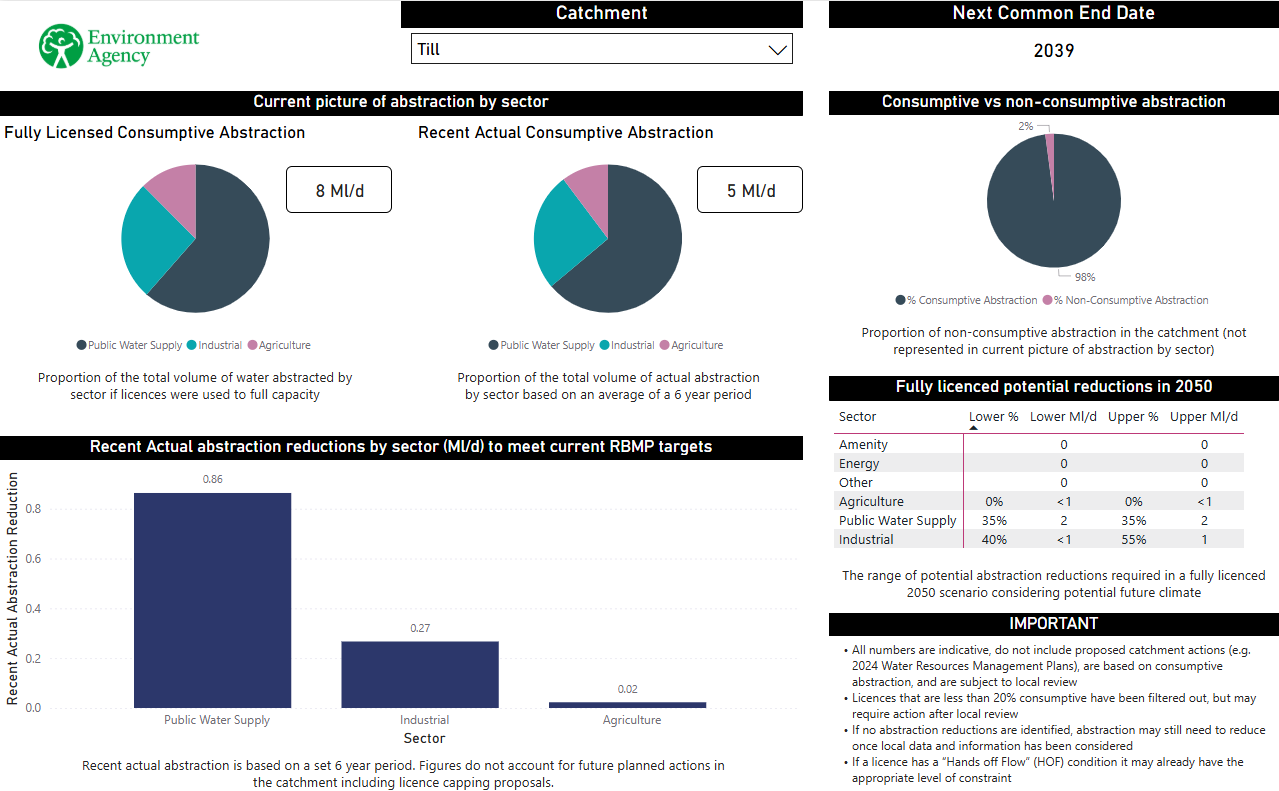
Catchment: Till
Next Common End Date: 2039
2. Current Picture of Abstraction by Sector
Fully Licensed Consumptive Abstraction: 8 Ml/d
Proportion of the total volume of water abstracted by sector if licences were used to full capacity:
Recent Actual Consumptive Abstraction: 5 Ml/d
Proportion of the total volume of actual abstraction by sector based on an average of a 6 year period:
3. Consumptive vs Non-Consumptive Abstraction
Proportion of non-consumptive abstraction in the catchment (not represented in current picture of abstraction by sector):
- Consumptive Abstraction: 2%
- Non-Consumptive Abstraction: 98%
4. Recent Actual Abstraction Reductions by Sector (ML/d) to Meet Current RBMP Targets
Recent actual abstraction is based on a set 6 year period. Figures do not account for future planned actions in the catchment including licence capping proposals.
5. The range of potential abstraction reductions required in a fully licensed 2050 scenario considering potential future climate
Sector | Lower % | Lower Ml/d | Upper % | Upper Ml/d |
Agriculture | 0% | <1 | 0% | <1 |
Industrial | 40% | <1 | 55% | 1 |
Public Water Supply | 35% | 2 | 35% | 2 |
6. Important Notes
Waver and Wampool
Accessible version here
Catchment Summary Waver & Wampool
1. Catchment Information
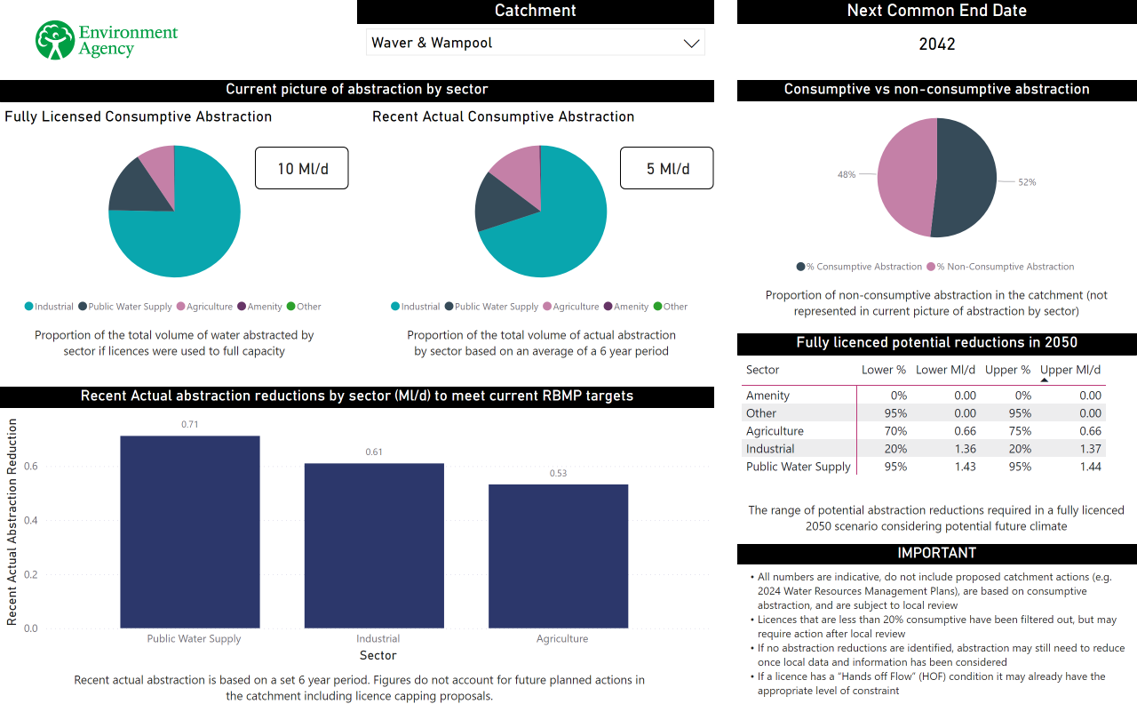
Catchment: Waver & Wampool
Next Common End Date: 2042
2. Current Picture of Abstraction by Sector
Fully Licensed Consumptive Abstraction: 10 ML/d
Proportion of the total volume of water abstracted by sector if licences were used to full capacity:
• Industrial: 75%
• Public Water Supply: 15%
• Agriculture: 9%
• Amenity: 0%
• Other: 0%
Recent Actual Consumptive Abstraction: 5 ML/d
Proportion of the total volume of actual abstraction by sector based on an average of a 6 year period:
• Industrial: 70%
• Public Water Supply: 15%
• Agriculture: 14%
• Amenity: 0%
• Other: 0%
3. Consumptive vs Non-Consumptive Abstraction
Proportion of non-consumptive abstraction in the catchment (not represented in current picture of abstraction by sector):
• Consumptive Abstraction: 48%
• Non-Consumptive Abstraction: 52%
4. Recent Actual Abstraction Reductions by Sector (ML/d) to Meet Current RBMP Targets
• Public Water Supply: <1 ML/d
• Industrial: <1 ML/d
• Agriculture: <1 ML/d
Recent actual abstraction is based on a set 6 year period. Figures do not account for future planned actions in the catchment including licence capping proposals.
5. The range of potential abstraction reductions required in a fully licensed 2050 scenario considering potential future climate
Sector | Lower % | Lower ML/d | Upper % | Upper ML/d |
Amenity | 0% | 0 | 0% | 0 |
Other | 95% | 0 | 95% | 0 |
Agriculture | 70% | <1 | 75% | <1 |
Industrial | 20% | 1 | 20% | 1 |
Public Water Supply | 95% | 1 | 95% | 1 |
6. Important Notes
• All numbers are indicative, do not include proposed catchment actions (e.g. 2024 Water Resources Management Plans), are based on consumptive abstraction, and are subject to local review
• Licences that are less than 20% consumptive have been filtered out, but may require action after local review
• If no abstraction reductions are identified, abstraction may still need to reduce once local data and information has been considered
• If a licence has a “Hands off Flow” (HOF) condition it may already have the appropriate level of constraint