
Anglian
- Public Water Supply: 85%
- Agriculture: 8%
- Amenity: 5%
- Industrial: 2%
- Other: 0%
- Public Water Supply: 87%
- Agriculture: 5%
- Amenity: 6%
- Industrial: 2%
- Other: 0%
- Public Water Supply: 10 Ml/d
- Industrial: <1 Ml/d
- Agriculture: <1 Ml/d
- Other: <1 Ml/d
- All numbers are indicative, do not include proposed catchment actions (e.g. 2024 Water Resources Management Plans), are based on consumptive abstraction, and are subject to local review
- Licences that are less than 20% consumptive have been filtered out, but may require action after local review
- If no abstraction reductions are identified, abstraction may still need to reduce once local data and information has been considered
- If a licence has a "Hands off Flow" (HOF) condition it may already have the appropriate level of constraint
- Public Water Supply: 87%
- Amenity: 5%
- Energy: 4%
- Agriculture: 3%
- Industrial: 2%
- Other: 0%
- Public Water Supply: 95%
- Energy: 3%
- Agriculture: 1%
- Industrial: 0%
- Other: 0%
- Amenity: 0%
- Public Water Supply: 12 Ml/d
- Agriculture: <1 Ml/d
- Industrial: <1 Ml/d
- Other: <1 Ml/d
- All numbers are indicative, do not include proposed catchment actions (e.g. 2024 Water Resources Management Plans), are based on consumptive abstraction, and are subject to local review
- Licences that are less than 20% consumptive have been filtered out, but may require action after local review
- If no abstraction reductions are identified, abstraction may still need to reduce once local data and information has been considered
- If a licence has a "Hands off Flow" (HOF) condition it may already have the appropriate level of constraint
Broadland Rivers
Accessible version here
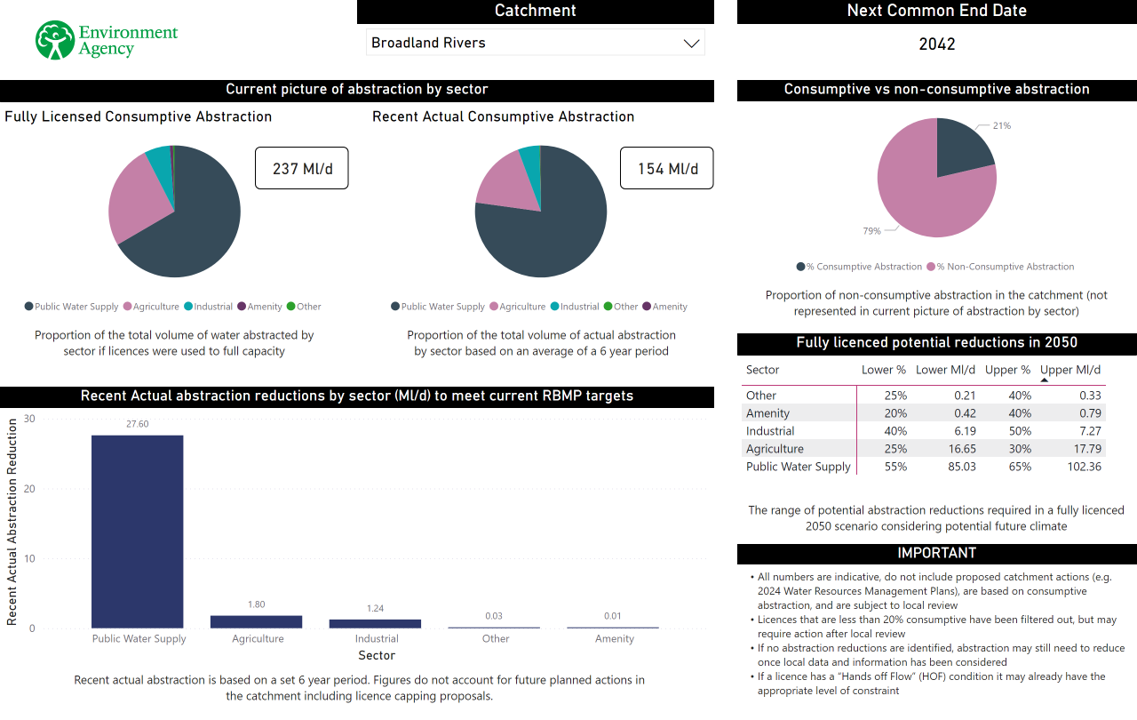
Catchment Summary Broadland Rivers
1. Catchment Information
Catchment: Broadland Rivers
Next Common End Date: 2042
2. Current Picture of Abstraction by Sector
Fully Licensed Consumptive Abstraction: 237 Ml/d
Proportion of the total volume of water abstracted by sector if licences were used to full capacity:
• Public Water Supply: 67%
• Agriculture: 26%
• Industrial: 6%
• Amenity: 1%
• Other: 0%
Recent Actual Consumptive Abstraction: 154 Ml/d
Proportion of the total volume of actual abstraction by sector based on an average of a 6 year period:
• Public Water Supply: 77%
• Agriculture: 17%
• Industrial: 5%
• Amenity: 0%
• Other: 0%
3. Consumptive vs Non-Consumptive Abstraction
• Consumptive Abstraction: 21%
• Non-Consumptive Abstraction: 79%
Proportion of non-consumptive abstraction in the catchment (not represented in current picture of abstraction by sector)
4. Recent Actual Abstraction Reductions by Sector (ML/d) to Meet Current RBMP Targets
Recent actual abstraction is based on a set 6 year period. Figures do not account for future planned actions in the catchment including licence capping proposals.
• Public Water Supply: 28 Ml/d
• Agriculture: 2 Ml/d
• Industrial: 1 Ml/d
• Other: <1 Ml/d
• Amenity: <1 Ml/d
5. The range of potential abstraction reductions required in a fully licensed 2050 scenario considering potential future climate
Sector | Lower % | Lower Ml/d | Upper % | Upper Ml/d |
Other | 25% | <1 | 40% | <1 |
Amenity | 20% | <1 | 40% | <1 |
Industrial | 40% | 6 | 50% | 7 |
Agriculture | 25% | 17 | 30% | 18 |
Public Water Supply | 55% | 85 | 65% | 102 |
6. Important Notes
• All numbers are indicative, do not include proposed catchment actions (e.g. 2024 Water Resources Management Plans), are based on consumptive abstraction, and are subject to local review
• Licences that are less than 20% consumptive have been filtered out, but may require action after local review
• If no abstraction reductions are identified, abstraction may still need to reduce once local data and information has been considered
• If a licence has a “Hands off Flow” (HOF) condition it may already have the appropriate level of constraint
Cam and Ely Ouse
Accessible version here
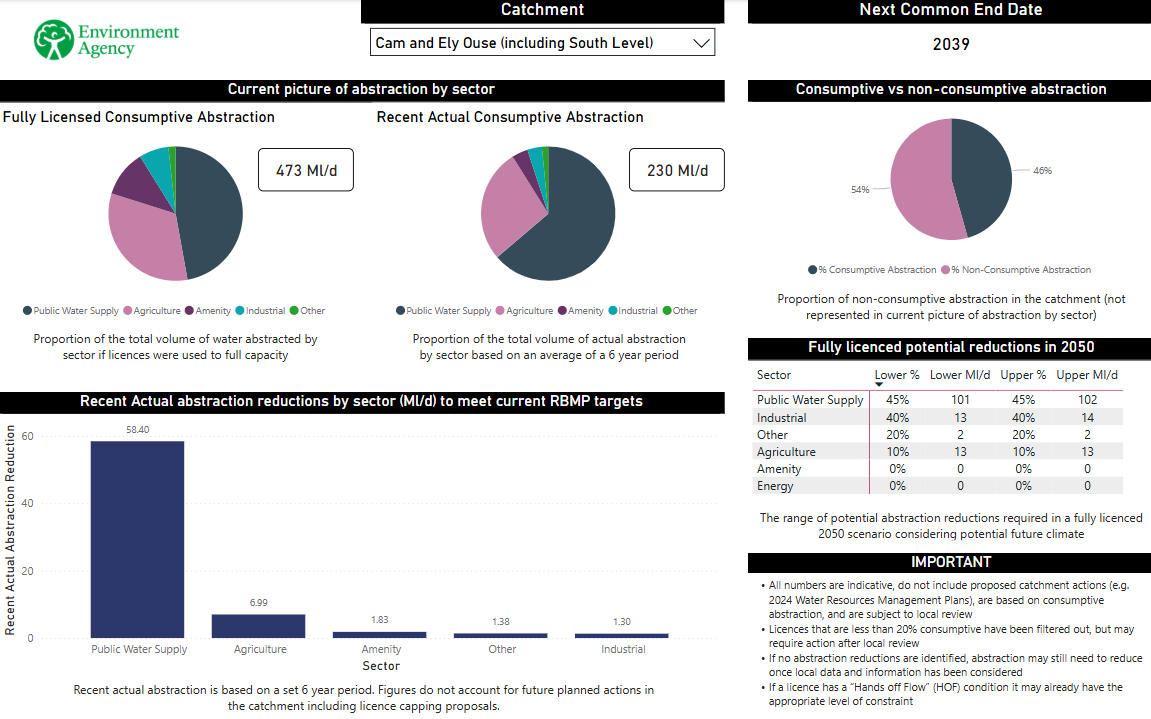
Catchment Summary Cam and Ely Ouse (including South Level)
1. Catchment Information
Catchment: Cam and Ely Ouse (including South Level)
Next Common End Date: 2039
2. Current Picture of Abstraction by Sector
Fully Licensed Consumptive Abstraction: 473 Ml/d
Proportion of the total volume of water abstracted by sector if licences were used to full capacity:
• Public Water Supply: 47%
• Agriculture: 33%
• Amenity: 11%
• Industrial: 7%
• Other: 2%
Recent Actual Consumptive Abstraction: 230 Ml/d
Proportion of the total volume of actual abstraction by sector based on an average of a 6 year period:
• Public Water Supply: 64%
• Agriculture: 27%
• Amenity: 4%
• Industrial: 4%
• Other: 2%
3. Consumptive vs Non-Consumptive Abstraction
• Consumptive Abstraction: 46%
• Non-Consumptive Abstraction: 54%
Proportion of non-consumptive abstraction in the catchment (not represented in current picture of abstraction by sector)
4. Recent Actual Abstraction Reductions by Sector (ML/d) to Meet Current RBMP Targets
Recent actual abstraction is based on a set 6 year period. Figures do not account for future planned actions in the catchment including licence capping proposals.
• Public Water Supply: 58 Ml/d
• Agriculture: 7 Ml/d
• Amenity: 2 Ml/d
• Other: 1 Ml/d
• Industrial: 1 Ml/d
5. The range of potential abstraction reductions required in a fully licensed 2050 scenario considering potential future climate
Sector | Lower % | Lower Ml/d | Upper % | Upper Ml/d |
Other | 20% | 2 | 20% | 2 |
Agriculture | 10% | 13 | 10% | 13 |
Industrial | 40% | 13 | 40% | 14 |
Amenity | 0% | 0 | 0% | 0 |
Public Water Supply | 45% | 101 | 45% | 102 |
6. Important Notes
• All numbers are indicative, do not include proposed catchment actions (e.g. 2024 Water Resources Management Plans), are based on consumptive abstraction, and are subject to local review
• Licences that are less than 20% consumptive have been filtered out, but may require action after local review
• If no abstraction reductions are identified, abstraction may still need to reduce once local data and information has been considered
• If a licence has a “Hands off Flow” (HOF) condition it may already have the appropriate level of constraint
East Suffolk
Accessible version here
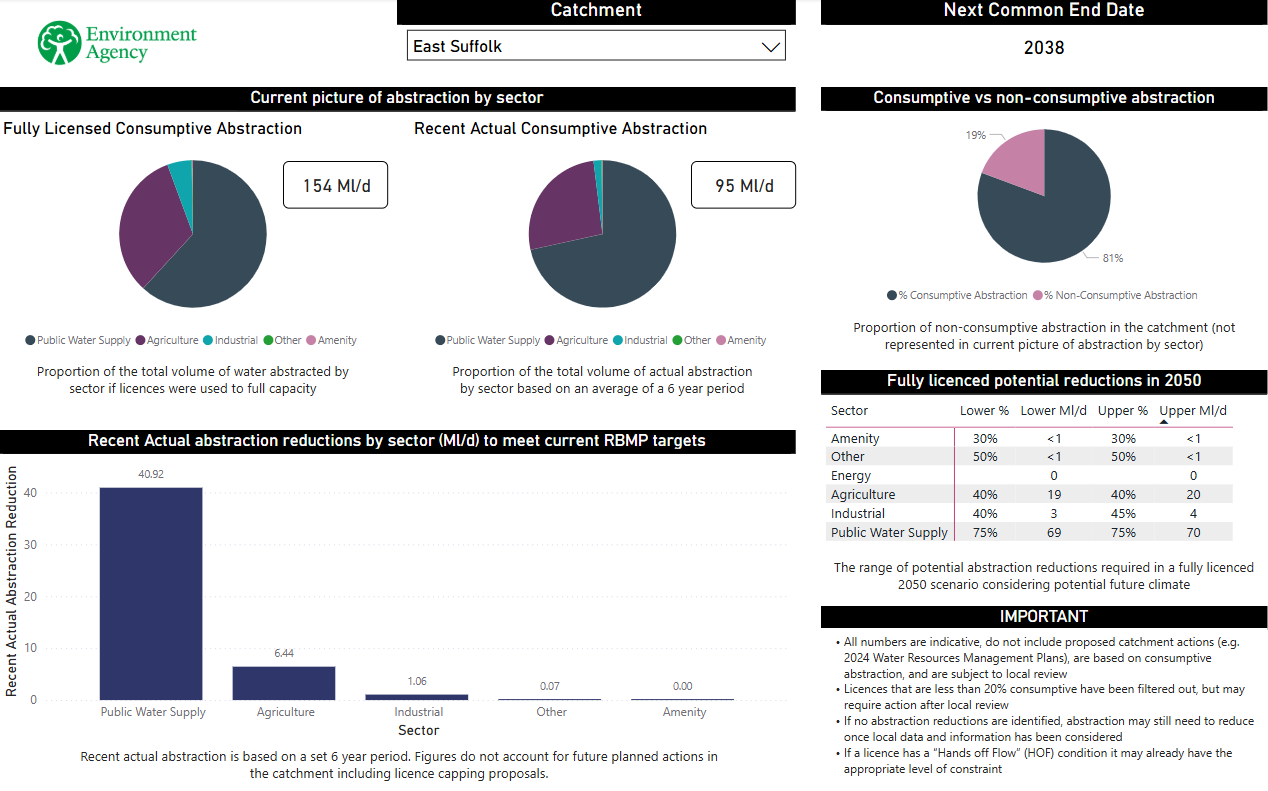
Catchment Summary East Suffolk
1. Catchment Information
Catchment: East Suffolk
Next Common End Date: 2038
2. Current Picture of Abstraction by Sector
Fully Licensed Consumptive Abstraction: 154 Ml/d
Proportion of the total volume of water abstracted by sector if licences were used to full capacity:
• Public Water Supply: 62%
• Agriculture: 33%
• Industrial: 5%
• Other: 0%
• Amenity: 0%
Recent Actual Consumptive Abstraction: 95 Ml/d
Proportion of the total volume of actual abstraction by sector based on an average of a 6 year period:
• Public Water Supply: 72%
• Agriculture: 26%
• Industrial: 2%
• Other: 0%
• Amenity: 0%
3. Consumptive vs Non-Consumptive Abstraction
• Consumptive Abstraction: 19%
• Non-Consumptive Abstraction: 81%
Proportion of non-consumptive abstraction in the catchment (not represented in current picture of abstraction by sector)
4. Recent Actual Abstraction Reductions by Sector (ML/d) to Meet Current RBMP Targets
Recent actual abstraction is based on a set 6 year period. Figures do not account for future planned actions in the catchment including licence capping proposals.
• Public Water Supply: 41 Ml/d
• Agriculture: 6 Ml/d
• Industrial: 1 Ml/d
• Other: <1 Ml/d
• Amenity: 0 Ml/d
5. The range of potential abstraction reductions required in a fully licensed 2050 scenario considering potential future climate
Sector | Lower % | Lower Ml/d | Upper % | Upper Ml/d |
Amenity | 30% | <1 | 30% | <1 |
Other | 50% | <1 | 50% | <1 |
Industrial | 40% | 3 | 45% | 4 |
Agriculture | 40% | 19 | 40% | 20 |
Public Water Supply | 75% | 69 | 75% | 70 |
6. Important Notes
• All numbers are indicative, do not include proposed catchment actions (e.g. 2024 Water Resources Management Plans), are based on consumptive abstraction, and are subject to local review
• Licences that are less than 20% consumptive have been filtered out, but may require action after local review
• If no abstraction reductions are identified, abstraction may still need to reduce once local data and information has been considered
• If a licence has a “Hands off Flow” (HOF) condition it may already have the appropriate level of constraint
Nene
Accessible version here
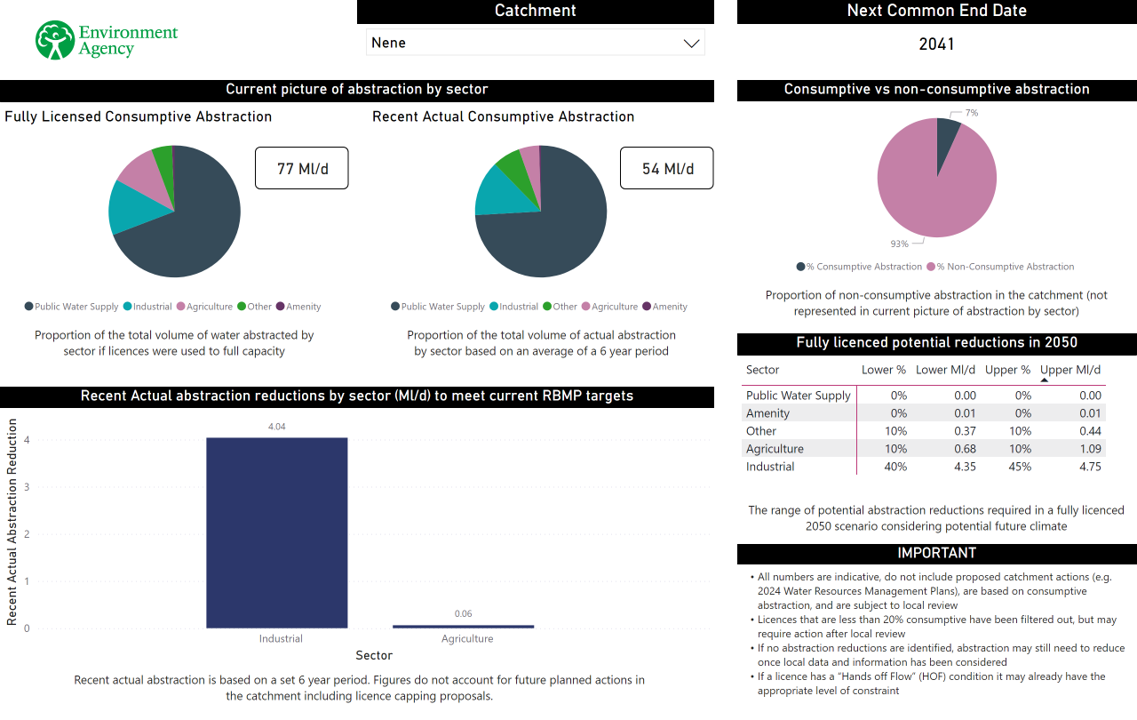
Catchment Summary Nene
1. Catchment Information
Catchment: Nene
Next Common End Date: 2041
2. Current Picture of Abstraction by Sector
Fully Licensed Consumptive Abstraction: 77 ML/d
Proportion of the total volume of water abstracted by sector if licences were used to full capacity:
• Public Water Supply: 69%
• Industrial: 14%
• Agriculture: 11%
• Other: 5%
• Amenity: 1%
Recent Actual Consumptive Abstraction: 54 ML/d
Proportion of the total volume of actual abstraction by sector based on an average of a 6 year period:
• Public Water Supply: 74%
• Industrial: 14%
• Agriculture: 5%
• Other: 7%
• Amenity: 0%
3. Consumptive vs Non-Consumptive Abstraction
Proportion of non-consumptive abstraction in the catchment (not represented in current picture of abstraction by sector):
• Consumptive Abstraction: 7%
• Non-Consumptive Abstraction: 93%
4. Recent Actual Abstraction Reductions by Sector (ML/d) to Meet Current RBMP Targets
Sector: Industrial — Reduction: 4 ML/d
Sector: Agriculture — Reduction: <1 ML/d
5. The range of potential abstraction reductions required in a fully licensed 2050 scenario considering potential future climate
Sector | Lower % | Lower ML/d | Upper % | Upper ML/d |
Public Water Supply | 0% | 0 | 0% | 0 |
Amenity | 0% | <1 | 0% | <1 |
Other | 10% | <1 | 10% | <1 |
Agriculture | 10% | <1 | 10% | 1 |
Industrial | 40% | 4 | 45% | 5 |
6. Important Notes
• All numbers are indicative, do not include proposed catchment actions (e.g. 2024 Water Resources Management Plans), are based on consumptive abstraction, and are subject to local review
• Licences that are less than 20% consumptive have been filtered out, but may require action after local review
• If no abstraction reductions are identified, abstraction may still need to reduce once local data and information has been considered
• If a licence has a "Hands off Flow" (HOF) condition it may already have the appropriate level of constraint
North Essex
Accessible version here
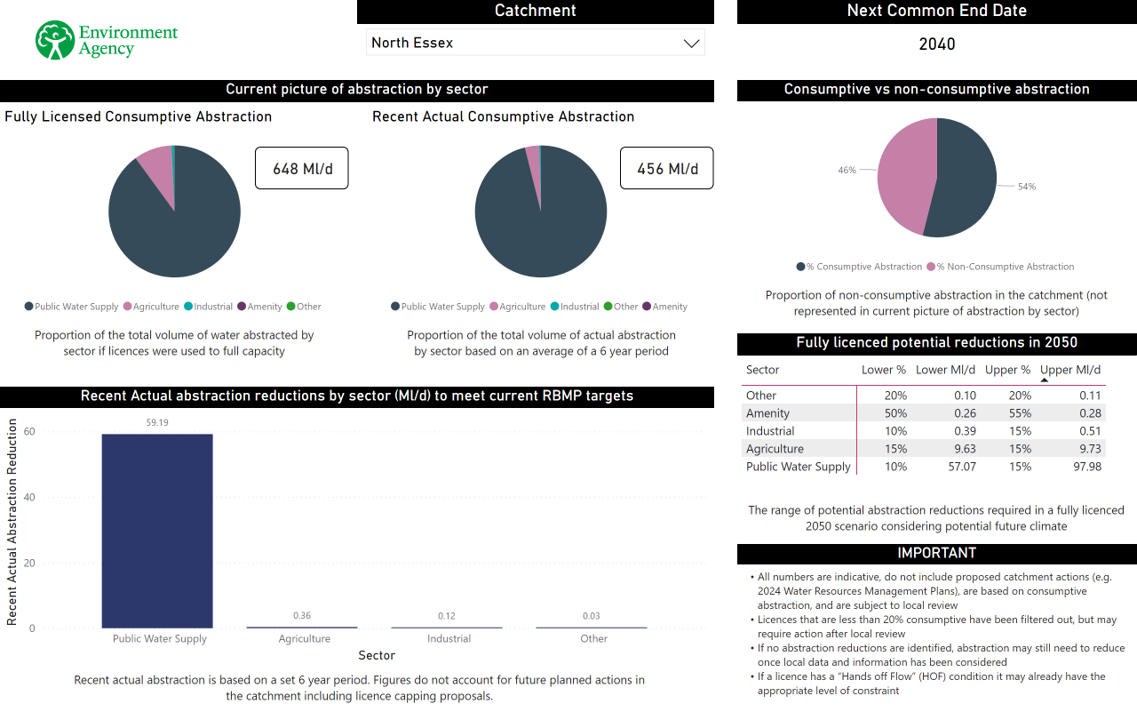
Catchment Summary North Essex
1. Catchment Information
Catchment: North Essex
Next Common End Date: 2040
2. Current Picture of Abstraction by Sector
Fully Licensed Consumptive Abstraction: 648 Ml/d
Proportion of the total volume of water abstracted by sector if licences were used to full capacity:
- Public Water Supply: 90%
- Agriculture: 9%
- Industrial: 1%
- Other: 0%
- Amenity: 0%
Recent Actual Consumptive Abstraction: 456 Ml/d
Proportion of the total volume of actual abstraction by sector based on an average of a 6 year period:
- Public Water Supply: 96%
- Agriculture: 4%
- Industrial: 0%
- Other: 0%
- Amenity: 0%
3. Consumptive vs Non-Consumptive Abstraction
Proportion of non-consumptive abstraction in the catchment (not represented in current picture of abstraction by sector):
- Consumptive Abstraction: 46%
- Non-Consumptive Abstraction: 54%
4. Recent Actual Abstraction Reductions by Sector (ML/d) to Meet Current RBMP Targets
- Public Water Supply: 59
- Agriculture: <1
- Industrial: <1
- Other: <1
Recent actual abstraction is based on a set 6 year period. Figures do not account for future planned actions in the catchment including licence capping proposals.
5. The range of potential abstraction reductions required in a fully licensed 2050 scenario considering potential future climate
Sector | Lower % | Lower Ml/d | Upper % | Upper Ml/d |
Other | 20% | <1 | 20% | <1 |
Amenity | 50% | <1 | 55% | <1 |
Industrial | 10% | <1 | 15% | <1 |
Agriculture | 15% | 10 | 15% | 10 |
Public Water Supply | 10% | 57 | 15% | 98 |
6. Important Notes
- All numbers are indicative, do not include proposed catchment actions (e.g. 2024 Water Resources Management Plans), are based on consumptive abstraction, and are subject to local review
- Licences that are less than 20% consumptive have been filtered out, but may require action after local review
- If no abstraction reductions are identified, abstraction may still need to reduce once local data and information has been considered
- If a licence has a "Hands off Flow" (HOF) condition it may already have the appropriate level of constraint
North Norfolk Rivers
Accessible version here
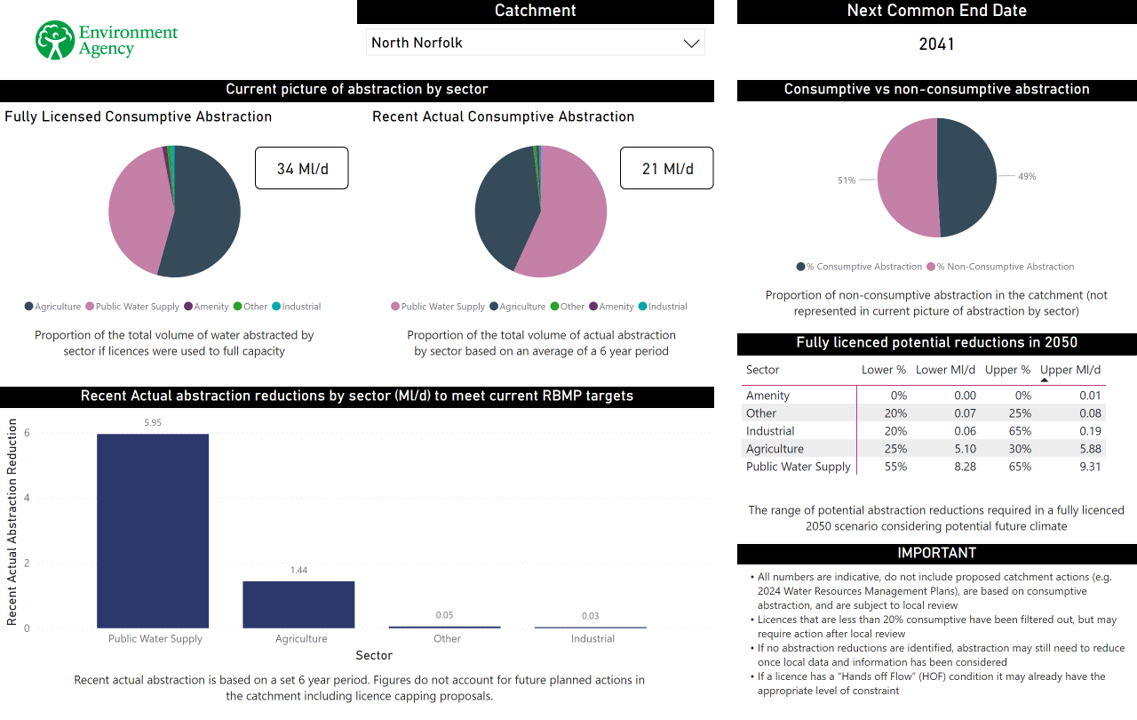
Catchment Summary North Norfolk
1. Catchment Information
Catchment: North Norfolk
Next Common End Date: 2041
2. Current Picture of Abstraction by Sector
Fully Licensed Consumptive Abstraction: 34 Ml/d
Proportion of the total volume of water abstracted by sector if licences were used to full capacity:
- Agriculture: 54%
- Public Water Supply: 43%
- Amenity: 1%
- Other: 1%
- Industrial: 1%
Recent Actual Consumptive Abstraction: 21 Ml/d
Proportion of the total volume of actual abstraction by sector based on an average of a 6 year period:
- Public Water Supply: 57%
- Agriculture: 41%
- Other: 1%
- Amenity: 1%
- Industrial: 0%
3. Consumptive vs Non-Consumptive Abstraction
Proportion of non-consumptive abstraction in the catchment (not represented in current picture of abstraction by sector):
- Consumptive Abstraction: 51%
- Non-Consumptive Abstraction: 49%
4. Recent Actual Abstraction Reductions by Sector (ML/d) to Meet Current RBMP Targets
- Public Water Supply: 6
- Agriculture: 1
- Other: <1
- Industrial: <1
Recent actual abstraction is based on a set 6 year period. Figures do not account for future planned actions in the catchment including licence capping proposals.
5. The range of potential abstraction reductions required in a fully licensed 2050 scenario considering potential future climate
Sector | Lower % | Lower Ml/d | Upper % | Upper Ml/d |
Amenity | 0% | 0 | 0% | <1 |
Other | 20% | <1 | 25% | <1 |
Industrial | 20% | <1 | 65% | <1 |
Agriculture | 25% | 5 | 30% | 6 |
Public Water Supply | 55% | 8 | 65% | 9 |
6. Important Notes
- All numbers are indicative, do not include proposed catchment actions (e.g. 2024 Water Resources Management Plans), are based on consumptive abstraction, and are subject to local review
- Licences that are less than 20% consumptive have been filtered out, but may require action after local review
- If no abstraction reductions are identified, abstraction may still need to reduce once local data and information has been considered
- If a licence has a "Hands off Flow" (HOF) condition it may already have the appropriate level of constraint
North West Norfolk
Accessible version here
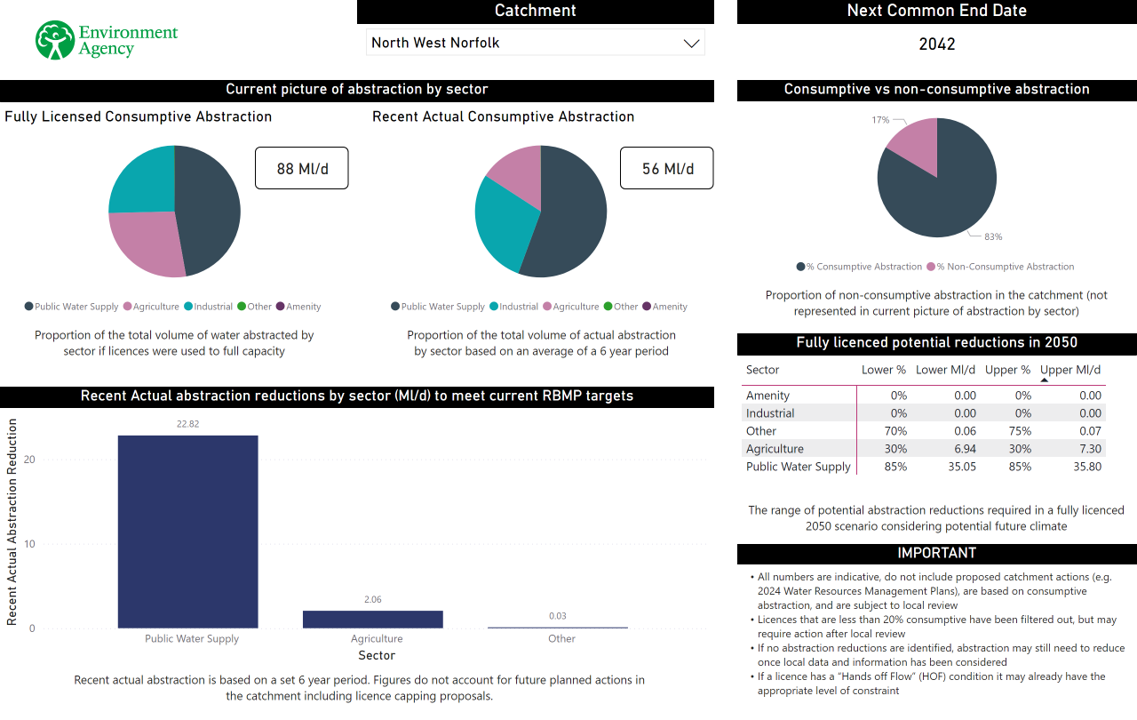
Catchment Summary North West Norfolk
1. Catchment Information
Catchment: North West Norfolk
Next Common End Date: 2042
2. Current Picture of Abstraction by Sector
Fully Licensed Consumptive Abstraction: 88 Ml/d
Proportion of the total volume of water abstracted by sector if licences were used to full capacity:
- Public Water Supply: 47%
- Agriculture: 27%
- Industrial: 25%
- Other: 0%
- Amenity: 0%
Recent Actual Consumptive Abstraction: 56 Ml/d
Proportion of the total volume of actual abstraction by sector based on an average of a 6 year period:
- Public Water Supply: 56%
- Industrial: 29%
- Agriculture: 16%
- Other: 0%
- Amenity: 0%
3. Consumptive vs Non-Consumptive Abstraction
Proportion of non-consumptive abstraction in the catchment (not represented in current picture of abstraction by sector):
- Consumptive Abstraction: 17%
- Non-Consumptive Abstraction: 83%
4. Recent Actual Abstraction Reductions by Sector (ML/d) to Meet Current RBMP Targets
- Public Water Supply: 23
- Agriculture: 2
- Other: <1
Recent actual abstraction is based on a set 6 year period. Figures do not account for future planned actions in the catchment including licence capping proposals.
5. The range of potential abstraction reductions required in a fully licensed 2050 scenario considering potential future climate
Sector | Lower % | Lower Ml/d | Upper % | Upper Ml/d |
Amenity | 0% | 0 | 0% | 0 |
Industrial | 0% | 0 | 0% | 0 |
Other | 70% | <1 | 75% | <1 |
Agriculture | 30% | 7 | 30% | 7 |
Public Water Supply | 85% | 35 | 85% | 36 |
6. Important Notes
- All numbers are indicative, do not include proposed catchment actions (e.g. 2024 Water Resources Management Plans), are based on consumptive abstraction, and are subject to local review
- Licences that are less than 20% consumptive have been filtered out, but may require action after local review
- If no abstraction reductions are identified, abstraction may still need to reduce once local data and information has been considered
- If a licence has a "Hands off Flow" (HOF) condition it may already have the appropriate level of constraint
Old Bedford and Middle Level
Accessible version here
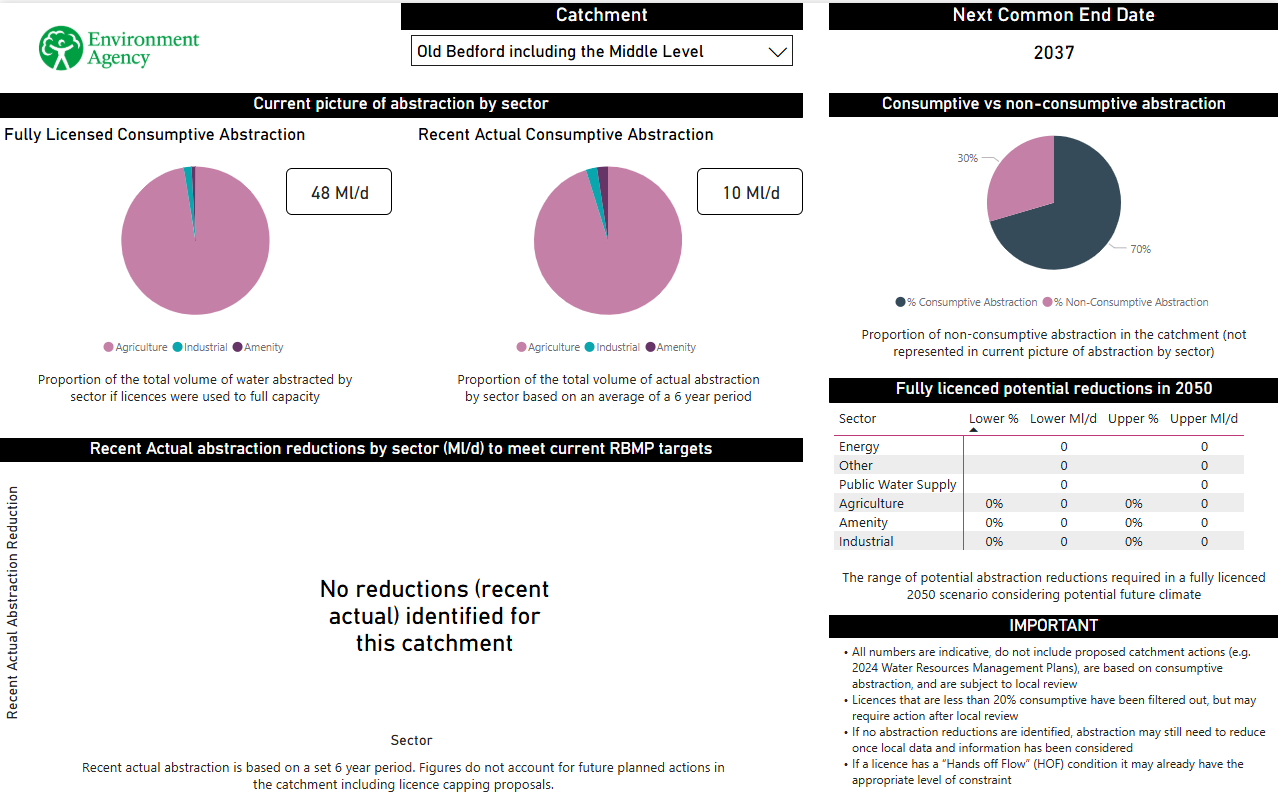
Catchment Summary Old Bedford including the Middle Level
1. Catchment Information
Catchment: Old Bedford including the Middle Level
Next Common End Date: 2037
2. Current Picture of Abstraction by Sector
Fully Licensed Consumptive Abstraction: 48 Ml/d
Proportion of the total volume of water abstracted by sector if licences were used to full capacity:
- Agriculture: 97%
- Industrial: 2%
- Amenity: 1%
Recent Actual Consumptive Abstraction: 10 Ml/d
Proportion of the total volume of actual abstraction by sector based on an average of a 6 year period:
- Agriculture: 95%
- Industrial: 2%
- Amenity: 2%
3. Consumptive vs Non-Consumptive Abstraction
Proportion of non-consumptive abstraction in the catchment (not represented in current picture of abstraction by sector):
- Consumptive Abstraction: 30%
- Non-Consumptive Abstraction: 70%
4. Recent Actual Abstraction Reductions by Sector (ML/d) to Meet Current RBMP Targets
No reductions (recent actual) identified for this catchment
Recent actual abstraction is based on a set 6 year period. Figures do not account for future planned actions in the catchment including licence capping proposals.
5. The range of potential abstraction reductions required in a fully licensed 2050 scenario considering potential future climate
Sector | Lower % | Lower Ml/d | Upper % | Upper Ml/d |
Agriculture | 0% | 0 | 0% | 0 |
Amenity | 0% | 0 | 0% | 0 |
Industrial | 0% | 0 | 0% | 0 |
6. Important Notes
- All numbers are indicative, do not include proposed catchment actions (e.g. 2024 Water Resources Management Plans), are based on consumptive abstraction, and are subject to local review
- Licences that are less than 20% consumptive have been filtered out, but may require action after local review
- If no abstraction reductions are identified, abstraction may still need to reduce once local data and information has been considered
- If a licence has a "Hands off Flow" (HOF) condition it may already have the appropriate level of constraint
Steeping Great Eau and Long Eau
Accessible version here
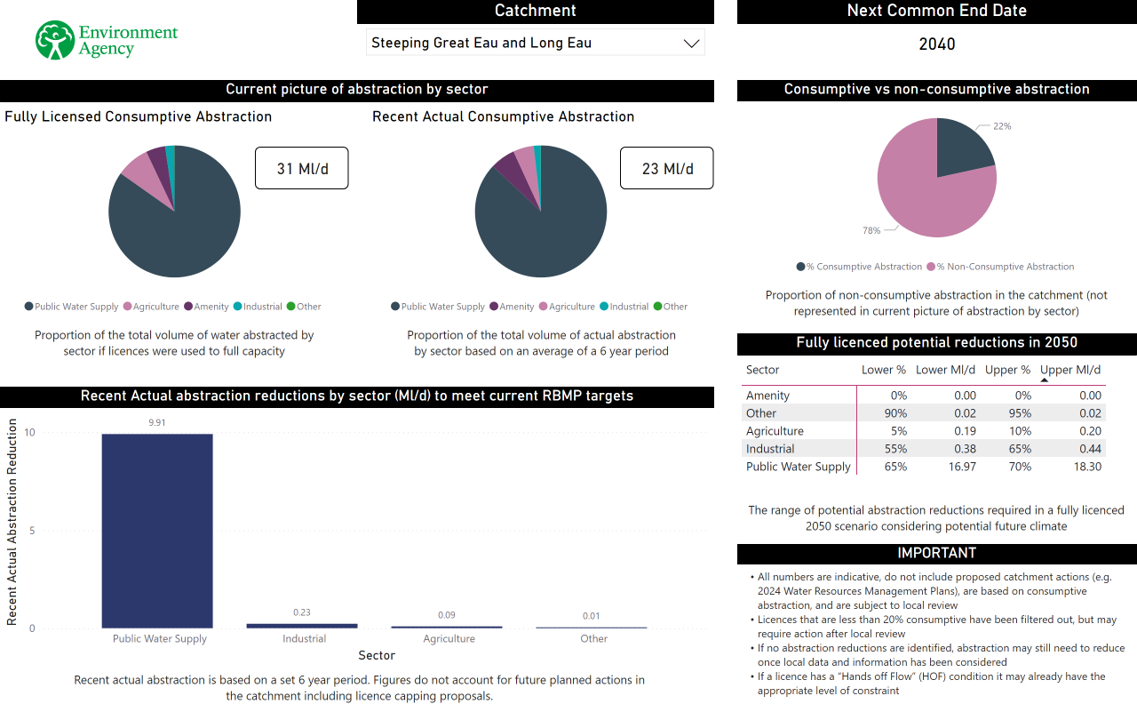
Catchment Summary Steeping Great Eau and Long Eau
1. Catchment Information
Catchment: Steeping Great Eau and Long Eau
Next Common End Date: 2040
2. Current Picture of Abstraction by Sector
Fully Licensed Consumptive Abstraction: 31 Ml/d
Proportion of the total volume of water abstracted by sector if licences were used to full capacity:
Recent Actual Consumptive Abstraction: 23 Ml/d
Proportion of the total volume of actual abstraction by sector based on an average of a 6 year period:
3. Consumptive vs Non-Consumptive Abstraction
Proportion of non-consumptive abstraction in the catchment (not represented in current picture of abstraction by sector):
- Consumptive Abstraction: 22%
- Non-Consumptive Abstraction: 78%
4. Recent Actual Abstraction Reductions by Sector (ML/d) to Meet Current RBMP Targets
Recent actual abstraction is based on a set 6 year period. Figures do not account for future planned actions in the catchment including licence capping proposals.
5. The range of potential abstraction reductions required in a fully licensed 2050 scenario considering potential future climate
Sector | Lower % | Lower Ml/d | Upper % | Upper Ml/d |
Amenity | 0% | 0 | 0% | 0 |
Other | 90% | <1 | 95% | <1 |
Agriculture | 5% | <1 | 10% | <1 |
Industrial | 55% | <1 | 65% | <1 |
Public Water Supply | 65% | 17 | 70% | 18 |
6. Important Notes
Upper Ouse and Bedford Ouse
Accessible version here
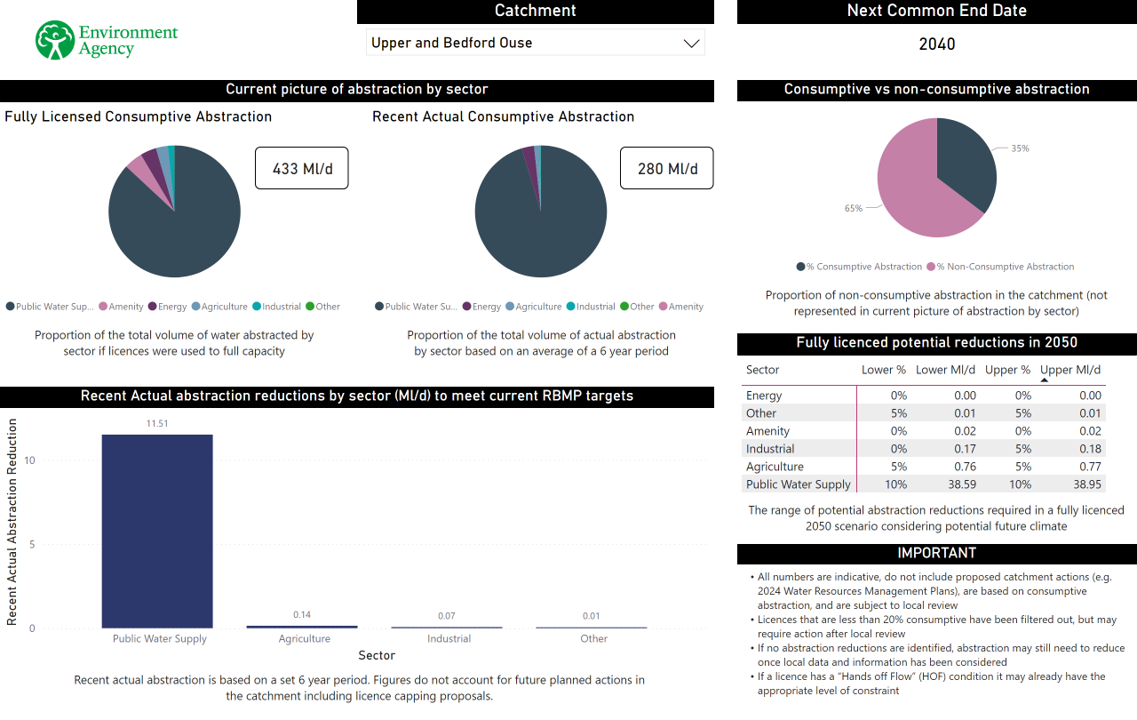
Catchment Summary Upper and Bedford Ouse
1. Catchment Information
Catchment: Upper and Bedford Ouse
Next Common End Date: 2040
2. Current Picture of Abstraction by Sector
Fully Licensed Consumptive Abstraction: 433 Ml/d
Proportion of the total volume of water abstracted by sector if licences were used to full capacity:
Recent Actual Consumptive Abstraction: 280 Ml/d
Proportion of the total volume of actual abstraction by sector based on an average of a 6 year period:
3. Consumptive vs Non-Consumptive Abstraction
Proportion of non-consumptive abstraction in the catchment (not represented in current picture of abstraction by sector):
- Consumptive Abstraction: 35%
- Non-Consumptive Abstraction: 65%
4. Recent Actual Abstraction Reductions by Sector (ML/d) to Meet Current RBMP Targets
Recent actual abstraction is based on a set 6 year period. Figures do not account for future planned actions in the catchment including licence capping proposals.
5. The range of potential abstraction reductions required in a fully licensed 2050 scenario considering potential future climate
Sector | Lower % | Lower Ml/d | Upper % | Upper Ml/d |
Energy | 0% | 0 | 0% | 0 |
Other | 5% | <1 | 5% | <1 |
Amenity | 0% | <1 | 0% | <1 |
Industrial | 0% | <1 | 5% | <1 |
Agriculture | 5% | <1 | 5% | <1 |
Public Water Supply | 10% | 39 | 10% | 39 |
6. Important Notes
Welland
Accessible version here
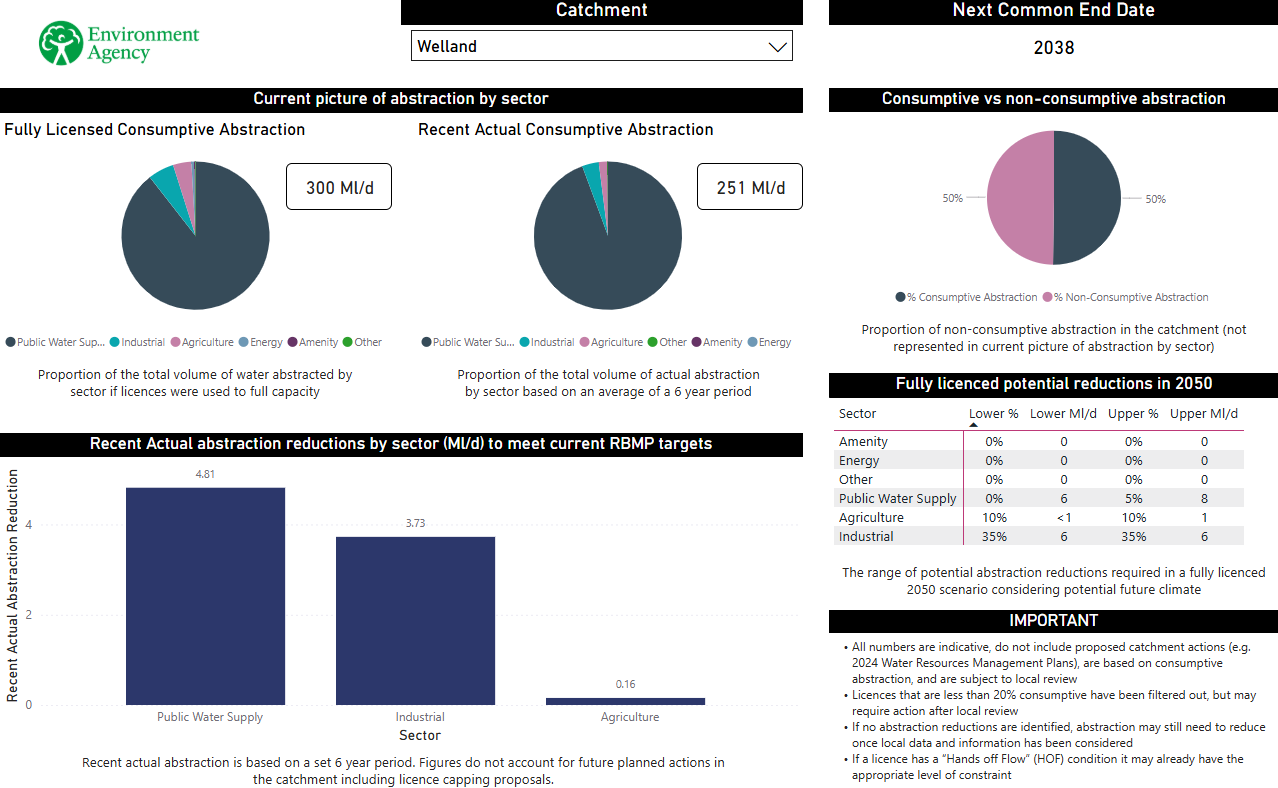
Catchment Summary Welland
1. Catchment Information
Catchment: Welland
Next Common End Date: 2038
2. Current Picture of Abstraction by Sector
Fully Licensed Consumptive Abstraction: 300 ML/d
Proportion of the total volume of water abstracted by sector if licences were used to full capacity:
• Public Water Supply: 89%
• Industrial: 6%
• Agriculture: 4%
• Energy: 1%
• Amenity: 0%
• Other: 0%
Recent Actual Consumptive Abstraction: 251 ML/d
Proportion of the total volume of actual abstraction by sector based on an average of a 6 year period:
• Public Water Supply: 94%
• Industrial: 4%
• Agriculture: 2%
• Energy: 0%
• Amenity: 0%
• Other: 0%
3. Consumptive vs Non-Consumptive Abstraction
Proportion of non-consumptive abstraction in the catchment (not represented in current picture of abstraction by sector):
• Consumptive Abstraction: 50%
• Non-Consumptive Abstraction: 50%
4. Recent Actual Abstraction Reductions by Sector (ML/d) to Meet Current RBMP Targets
• Public Water Supply: 5 ML/d
• Industrial: 4 ML/d
• Agriculture: <1 ML/d
Recent actual abstraction is based on a set 6 year period. Figures do not account for future planned actions in the catchment including licence capping proposals.
5. The range of potential abstraction reductions required in a fully licensed 2050 scenario considering potential future climate
Sector | Lower % | Lower ML/d | Upper % | Upper ML/d |
Amenity | 0% | 0 | 0% | 0 |
Energy | 0% | 0 | 0% | 0 |
Other | 0% | 0 | 0% | 0 |
Agriculture | 10% | <1 | 10% | 1 |
Industrial | 35% | 6 | 35% | 6 |
Public Water Supply | 0% | 6 | 5% | 8 |
6. Important Notes
• All numbers are indicative, do not include proposed catchment actions (e.g. 2024 Water Resources Management Plans), are based on consumptive abstraction, and are subject to local review
• Licences that are less than 20% consumptive have been filtered out, but may require action after local review
• If no abstraction reductions are identified, abstraction may still need to reduce once local data and information has been considered
• If a licence has a “Hands off Flow” (HOF) condition it may already have the appropriate level of constraint
Witham
Accessible version here
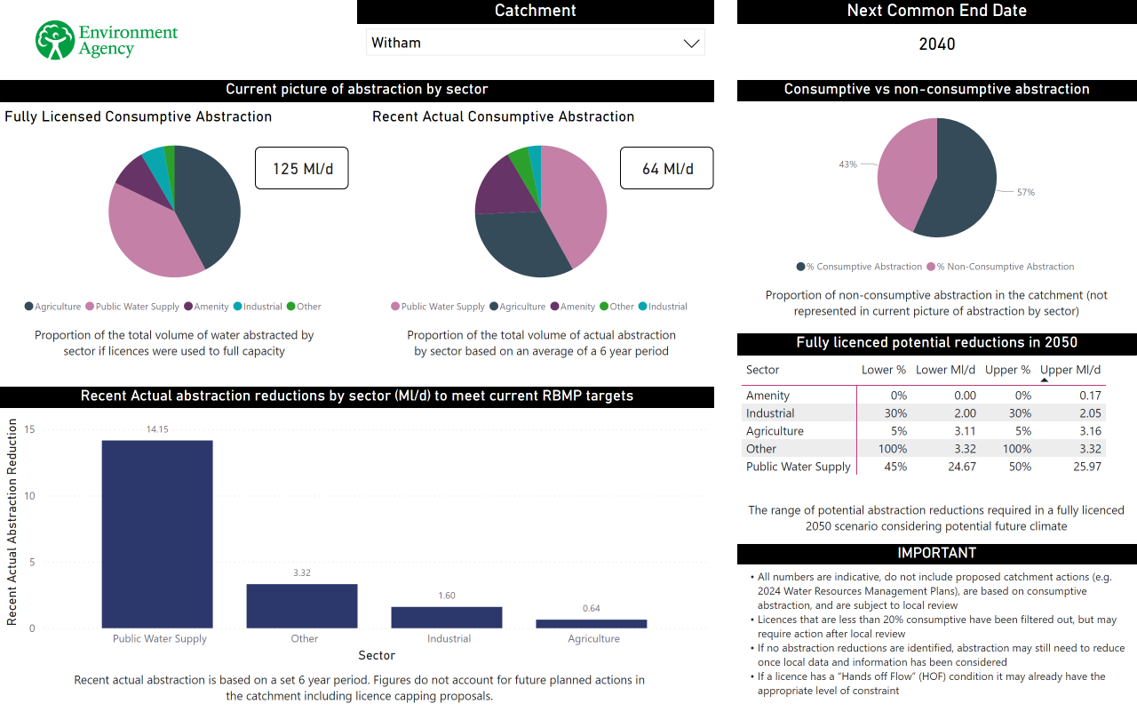
Catchment Summary Witham
1. Catchment Information
Catchment: Witham
Next Common End Date: 2040
2. Current Picture of Abstraction by Sector
Fully Licensed Consumptive Abstraction: 125 ML/d
Proportion of the total volume of water abstracted by sector if licences were used to full capacity:
• Agriculture: 42%
• Public Water Supply: 40%
• Amenity: 9%
• Industrial: 6%
• Other: 3%
Recent Actual Consumptive Abstraction: 64 ML/d
Proportion of the total volume of actual abstraction by sector based on an average of a 6 year period:
• Agriculture: 32%
• Public Water Supply: 42%
• Amenity: 17%
• Industrial: 3%
• Other: 5%
3. Consumptive vs Non-Consumptive Abstraction
Proportion of non-consumptive abstraction in the catchment (not represented in current picture of abstraction by sector):
• Consumptive Abstraction: 43%
• Non-Consumptive Abstraction: 57%
4. Recent Actual Abstraction Reductions by Sector (ML/d) to Meet Current RBMP Targets
• Public Water Supply: 14 ML/d
• Other: 3 ML/d
• Industrial: 2 ML/d
• Agriculture: <1 ML/d
Recent actual abstraction is based on a set 6 year period. Figures do not account for future planned actions in the catchment including licence capping proposals.
5. The range of potential abstraction reductions required in a fully licensed 2050 scenario considering potential future climate
Sector | Lower % | Lower ML/d | Upper % | Upper ML/d |
Amenity | 0% | 0 | 0% | <1 |
Industrial | 30% | 2 | 30% | 2 |
Agriculture | 5% | 3 | 5% | 3 |
Other | 100% | 3 | 100% | 3 |
Public Water Supply | 45% | 25 | 50% | 26 |
6. Important Notes
• All numbers are indicative, do not include proposed catchment actions (e.g. 2024 Water Resources Management Plans), are based on consumptive abstraction, and are subject to local review
• Licences that are less than 20% consumptive have been filtered out, but may require action after local review
• If no abstraction reductions are identified, abstraction may still need to reduce once local data and information has been considered
• If a licence has a “Hands off Flow” (HOF) condition it may already have the appropriate level of constraint