
Percentage Reductions
Looking for Local Information about Environmental Destination?
- The data aims to help abstractors understand the potential scale of abstraction licence reduction that may be required to meet Environmental Objectives.
- No decision has been made on future individual licence changes, but this provides an indication of what the future may be with less water available for people and the environment. It should be used to help you plan for the future.
- We will only make changes to abstraction licences where we have evidence that they are currently having an ecological impact or present a risk to the environment.
- We hope that it will be possible to significantly reduce the impact on abstractors through planning earlier and working on solutions with other abstractors (e.g. through abstractor groups and Regional Water Resources groups).
- We’re aware that the numbers presented will be difficult for many abstractors, which is why we want to share them sooner. If we wait until there is more certainty, it will reduce the time available to plan for potential change.
- These numbers relate to water abstraction at low flows (Q95). During times when river flows are higher the changes to abstraction licences may be much less or zero.
- Modelling has been undertaken using national data sets and includes a number of assumptions and should be used as a starting point to understand risk of future abstraction reduction.
The interactive map on the right of the page will help you to identify the name of the River Basin District you are interested in. You can zoom into the map to find your location of interest.
Click on the link to the River Basin District you are interested in
The next page will show the Management Catchments in that River Basin District
Click on the name of the Management Catchment you are interested in
The next page will show which Operational Catchments are in that Management Catchment
Click on the name of the Operational Catchment you are interested in
The next page will show which Water Bodies are in that Operational Catchment
Use the map to identify which waterbody you are interested in. You can return to the Modelled Percentage Reductions Spreadsheet and search for the waterbody name.
You also have the option to search by water body ID. You can find the Waterbody ID by visiting that waterbody’s page on Catchment Data Explorer and scrolling down the page to view the waterbody ID.
Explore the local data
Explore the summary spreadsheet of Modelled Abstraction Reductions for each water body, which helps support collaboration and implementation at the local scale. Note that:
The ultimate aim is to meet the water needs of both people and the environment in each catchment.
Return to Environmental Destination homepage
How to find the waterbody that you are interested in
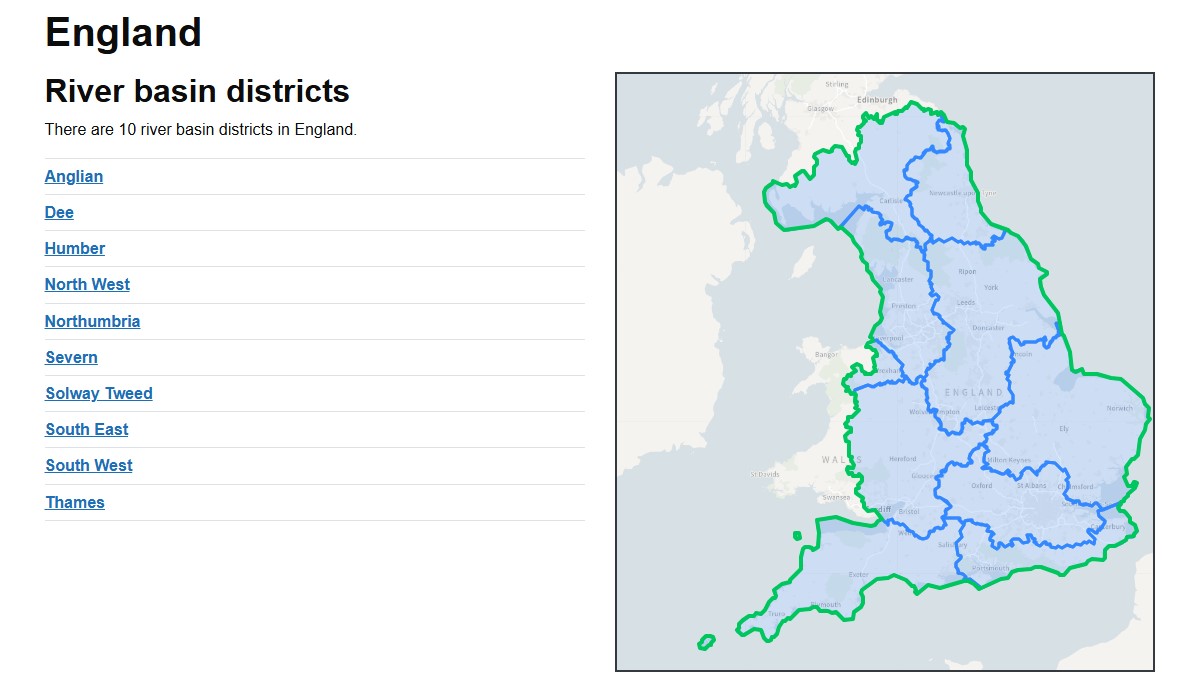
The data linked above is provided for each waterbody in England (rivers, lakes etc). To find your local waterbody, you can use our interactive map here: England | Catchment Data Explorer.
You can use the search bar to find your waterbodies of interest. Searches can be conducted by water body name, catchment name, place names, post codes and national grid references.
Or you can scroll down the page and use the interactive map to search for the location:
How do I make sense of the data?
- Sharing of the potential scale of future abstraction licence reductions is designed to help abstractors to plan for the future
- The aim is to find a way of meeting the water needs of both people and the environment
- The data can be used to discuss and collaborate on the choices about how water is used and shared in each locality
- Improved local information and evidence can be used to refine the assessments of environmental needs locally
- Collaboration when developing new resources can help to find the best solutions that could meet the needs of multiple abstractors
How to interpret the data
For a waterbody where the model has calculated (for example) a 10% Reduction, this means that during low flow periods we estimate that the total licensed water abstraction in this waterbody may need to be reduced by 10% to meet environmental objectives.
The % figure in the ‘Current’ column relates to the potential reduction in today's climate and under today's environmental regulations.
The Future Scenarios (2050) give a range of potential future reductions depending on how the climate changes, and how environmental regulations change in future. These scenarios should be used to understand the potential range of changes to abstraction licences that may be required in a water body by 2050.
Abstractors should consider how the suggested levels of reduction could be achieved. We are not specifying how the share of abstraction reductions should be distributed within a waterbody because we want to invite opportunities for collaboration on the best approach and solutions.
During medium and high flow periods a different amount of reduction (or no change) may be needed to meet environmental targets.
For surface water abstraction this may mean that abstraction may need to be reduced by this percentage during times when river flows are low. Abstractors from surface waters should use the information to consider how they could adapt to a reduction in abstraction during periods of low river flow (usually coinciding with periods of dry weather).
For groundwater abstraction the % reduction is more likely to represent a reduction in daily and annual abstraction licence volumes. Abstractors from groundwater should use the information to plan for how they could adapt to this % reduction in abstraction in their daily and annual licence volumes.
What do we want the data to be used for?
Approaches to sustainable abstraction
The data is for periods of low flow (Q95). It predicts the amount of abstraction licence reduction that may be needed during periods of low river flow. During periods of medium and high river flow, there is usually more water available, meaning abstraction licences may not need to be reduced to meet environmental targets, or the reduction required may be less.
The data is based on the Full Licensed quantity of abstraction licences, so any reduction is based on reducing the total allowed by each abstraction licence in a waterbody (i.e. it includes both the water that has typically been use in the past (Recent Actual usage), as well as the water that has not been used, but that an abstractor has a right to use). This means that in some catchments it may only be necessary for abstractors to give up unused headroom to meet the modelled reduction.
This modelling approach filters out Abstraction Licences that are classified as non-consumptive (80% or more of the abstracted water is returned to the environment locally). This means that these licences are not considered for abstraction reduction under this methodology. It is still possible that such licences may still require a licence change in the future if a local impact on the environment is identified.
The environmental destination is based on national modelling; as such, it does not include analysis that might have been undertaken for local site-based requirements and has not been adjusted to reflect any future “overriding public interest” decisions.
It is important to note that many licences will already be considered sustainable because they include conditions to protect flows/levels. These licences are less likely to require future regulatory action. However, it is also possible that the impacts of climate change may require conditions on abstraction licences to be reviewed in future.
Example approaches to planning for sustainable abstraction in a catchment
| Approach | Example |
|---|---|
| Reducing each abstraction licence that impacts the waterbody equally | e.g., all abstraction licence holders could implement water efficiency measures |
| Abstraction licences could have conditions added to reduce licensed abstraction at low flows only | e.g., water could be captured when it is more plentiful and stored in reservoirs for use in drier periods |
| Water rights could be shared to reduce the overall licensed abstraction in a waterbody | e.g., abstraction licence holders may choose to pool their licensed resource to make sharing of water easier. For example, a group of farmers in Lincolnshire have one licence which covers all the abstraction points for 12 farms. This allows them to allocate water between themselves (within the authorised licensed quantities) on a seasonal or annual basis and provides maximum flexibility for the abstractors and enables quick decision making. The Environment Agency will work with abstractors who want to do this. |
| Some abstractors may be able to adapt to larger reductions in their licences, thereby enabling other abstractors to retain more of their abstraction licences | e.g., one larger abstractor may be able to resolve the waterbody deficit through investing in more efficient water use |
| Nature-based solutions have the potential to deliver multiple benefits for water resources and the environment | They could form part of the solution in many waterbodies by improving the natural functioning of a catchment to support retention of water in the catchment, improve groundwater recharge and deliver improved environmental resilience. Appropriately designed nature-based solutions can enhance the ecological benefits of reducing abstraction and should be considered alongside, and in addition to, abstraction reduction. e.g., changing land management to improve groundwater recharge |
What is the Environment Agency's approach?
The Environment Agency's approach
In some places, abstraction goes beyond the amount of water that is environmentally sustainable and reliably available. As we see climate change reveal itself, there is likely to be an overall reduction in water availability, with significant changes rainfall patterns and the reliability of river flows. We will continue to review sustainable abstraction, and where necessary change abstraction licences, to protect the environment.
Our Environmental Destination modelling and data sharing shows a pathway for identifying future environmental needs and delivering the Environmental Destination. It allows for abstractors to collaborate to refine the high-level assessment of environmental need. We encourage abstractors to develop plans which take account of what is feasible and achievable considering the best value mix of solutions.
We always aim to give formal notice of abstraction licence changes, although this may not be possible in every case; sometimes the changes will be driven by a legal timeline, particularly where there may be a need to act quickly to prevent environmental damage, or to remove a risk of damage. The information we have provided here aims help abstractors proactively plan for these potential changes ahead of our formal notice of abstraction licence changes.
Technical notes
Engage with us!
- Please email us at wrEnvironmentalDestination@environment-agency.gov.uk if you have suggestions for how we can support you in planning for environmentally sustainable abstraction.
- You can also contact us to be added to our mailing list for future updates on Water Resources Environmental Destination.
We want to hear from you!
We see this data release as the start of an engagement process.
Return to Environmental Destination homepage