
Catchment Summaries
Background
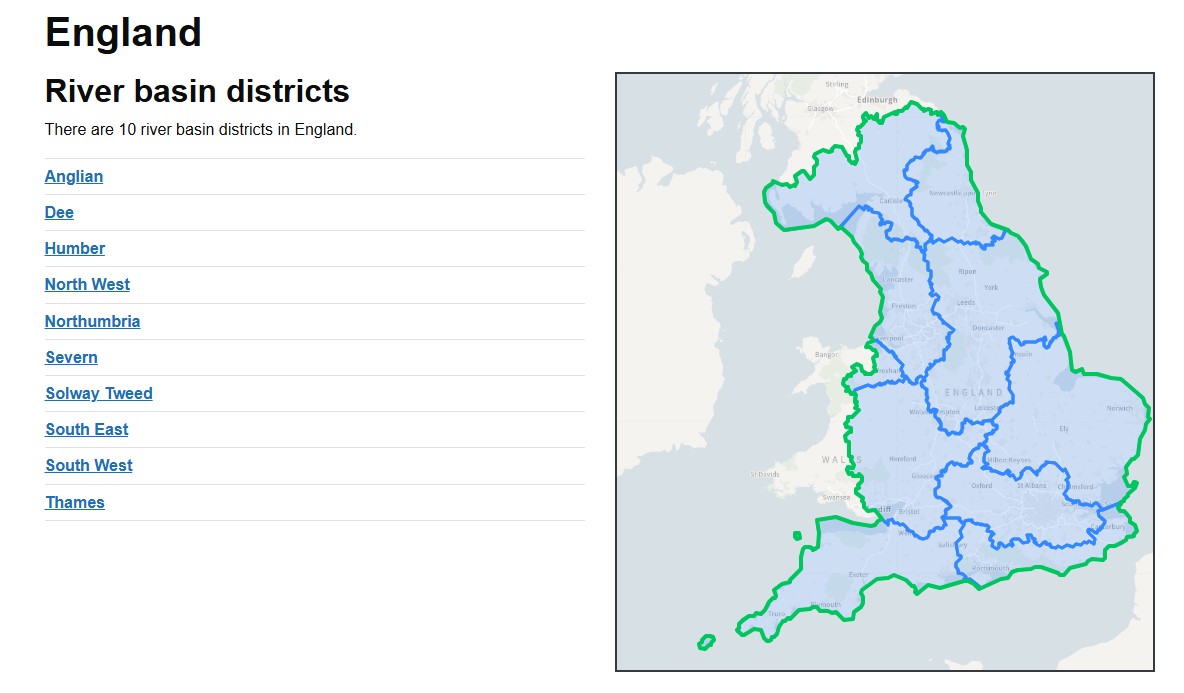
The interactive map on the right of the page will help you to identify the name of the River Basin District you are interested in.
Click on the link to the River Basin District you are interested in
The next page will show the Management Catchments in that River Basin District
Click on the name of the Management Catchment you are interested in
The next page will show which Operational Catchments are in that Management Catchment
Use the map to identify which Operational Catchment you are interested in.
Navigate to your chosen catchment from the list on the right of this page.
What are 'Catchment Summaries'?
The catchment summaries aim to help you understand the water resource challenges in your local catchment and how managing your use of water could contribute to addressing this challenge.
Catchment summaries provide a high level picture of current abstraction in the catchment and how much this abstraction may need to change, now and in the future, to be environmentally sustainable. They are based on national datasets, so local information will inform this picture.
Explore your local catchment summaryTo understand how the data and information in these summaries was developed, please refer to the Environmental Destination Technical Report in Appendix C
- Return to Environmental Destination homepage
What do these Catchment Summaries show?
Each catchment summary includes pie charts which show how much water is currently being abstracted, how much is licenced to be abstracted and how that is split by sector.
A bar chart indicates how abstraction may need to reduce to meet environmental requirements and ensure a healthy water environment in each catchment. The estimated abstraction reduction requirements are based on Environment Agency national modelled data; as such, they should be seen as a starting point for planning and to improve upon with local information where necessary.
They also indicate how abstraction may need to change in the future to adjust to climate change.
The catchment summaries will enable each sector to understand the potential risk of future reductions to abstraction licences for their and other sectors in their catchment. We hope this will encourage abstractors to seek opportunities to collaborate, either within their own sector or with other sectors to find solutions. We want all abstractors to aim for a future where water users and the environment all have enough water to meet their needs.
The information in the catchment summaries is based on consumptive abstraction; non-consumptive abstraction is not included. An abstraction is considered non-consumptive where the water removed is returned to the river at, or near, the point of abstraction without any significant loss. For more information on non-consumptive licences, please see the sections below.
- Return to Environmental Destination homepage
How can I find the catchment area I'm interested in?
You can find your local catchment by using our interactive map hosted on the .gov website: England | Catchment Data Explorer.
Once you have located your local catchment, come back to this site to view your catchment summary.
- Return to Environmental Destination homepage
The data behind the catchment summaries
Pie chart - Fully Licenced consumptive abstraction: The proportion of consumptive water abstraction per sector if all abstraction licences were being used to their full capacity, in Megalitres/day (Ml/d).
Pie chart - Recent Actual consumptive abstraction: The proportion of actual consumptive abstraction per sector based on an average of a 6-year period, in Ml/d.
Bar chart - Recent Actual abstraction reductions by sector (Ml/d) required to meet current River Basin Management Plan targets: The estimated quantity of recent actual abstraction reduction per sector required in order to meet environmental objectives, including preventing deterioration, in Ml/d. The reductions do not include licence constraints not yet applied such as licence capping (for time limited licences) that have been identified to prevent deterioration. These reductions may not apply uniformly across the catchment - sectors with more abstractions in the heavily impacted parts of the catchment will likely have a higher percentage reduction. Many licences may already be sustainable if they include conditions to protect flows/levels.
- Return to Environmental Destination homepage
- The next common end date, as set out in Managing water abstraction, is displayed for each catchment. The Environment Agency uses a Common End Date (CED) for time limited abstraction licences within an Abstraction Licensing Strategy (ALS). New licences within an ALS are typically assigned a CED, which ensures they can be reviewed at the same time. The next CED shown in the catchment summaries describes the furthest planned CED. Some catchments may also have an earlier CED than that shown. You find more information here.
Non-consumptive licences are excluded from the catchment summaries.
The Environment Agency may issue non-consumptive abstraction licenses. These abstractions return abstracted water to the river at, or near, the point of abstraction without any significant loss, for example for uses like Hydroelectric Power Schemes or non-evaporative cooling water. However, they can be subject to restrictions to protect the environment.
Please note that non-consumptive licences may have an impact on ecology. Local assessment might identify changes to these licences to support sustainable abstraction, for example there may be an affected reach between where the water is abstracted from and where it returns to. These changes are not considered in these high-level catchment summaries.
- The range of potential abstraction reductions required in a fully licenced 2050 scenario considering potential future climate.
Presents a range of values for estimated abstraction reductions from fully licenced abstraction for 2050, taking into account predicted climate change impacts on natural flows. They are based on current environmental regulatory requirements and they include reductions to meet current environmental objectives as outlined in the bar chart. The range shows potential fully licenced water abstraction (consumptive) reductions in a 2050 context using two climate scenarios – a lower scenario which predicts a lower impact on natural low flows, and an upper scenario which predicts a higher impact on natural low flows. These are best estimates using our current information and modelling.
Note: While some catchments might not show abstraction reduction is required for a sector, abstractors may still be required to reduce abstractions once local data and information has been considered.
- All numbers are indicative
- All numbers do not include proposed catchment actions, e.g. actions proposed in the Water Resources Management Plans (WRMP24), which set out how each water company plans to manage water supply and demand over (at least) the next 25 years
- All numbers are based on consumptive abstraction
- All numbers are subject to local review
- Information for 6 main sectors is provided - Public Water Supply (PWS), Industrial, Agriculture, Energy, Amenity (such as recreational lakes or ponds), and Other
The current picture of abstraction by sector
Next Common End Dates
- Return to Environmental Destination homepage
Consumptive versus non-consumptive abstraction
- Return to Environmental Destination homepage
Fully Licenced potential reductions in 2050
- Return to Environmental Destination homepage
Important notes applying to all Catchment Summaries