FAQs
- The Bartonian
- New Holland Ferryboat
- Missing Link
Project objectives
Increasing Flood Protection
We will aim to reduce flood risk to the communities along the Barton to New Holland frontage by the end of 2029 whilst maximising the number of properties and business with increased resilience.
Engaging the community
We will aim to ensure that the community and key stakeholders are engaged throughout all stages of the project from initial ideas to construction completion. We will seek to align our options with the objectives and aspirations of partners, community and stakeholders.
Protecting biodiversity and the environment
We will aim to minimise the impact on the environment, in particular the environmentally designated sites. Where possible we will aim to provide environmental enhancements in line with community aspirations.
Minimising our carbon impact
We will aim to develop a final solution that minimises the whole life carbon impact of the scheme while maximising against future flooding events. With the preferred option contributing to being a net zero organisation by 2030.
Key terms to know
Alleviation – The process of making a problem less severe.
Resilience – The capacity to withstand, adapt to, and recover from environmental impacts effectively.
Scheme Boundary – The area in which the scheme works will take place and where the outcomes and benefits of the project will be felt/seen.
Biodiversity Net Gain – The process of increasing the overall biodiversity value of a development site. It aims to leave the natural environment in a better state than prior to development.
Sustainability – The ability to maintain a process continuously over time to the same standard.
Staying up to date
To get updates on the project, register and subscribe to this page, or keep a look out for the project in one of the local newsletters:
Engaging with our stakeholders
We are committed to keeping the local community and our stakeholders informed and engaged throughout this project. To do this we have set up community working groups such as our Resilience Advisory Group and Steering Group.
These groups are made up of invited local residents, councillors, and representatives from agencies and community groups such as Natural England, Lincolnshire Wildlife trust and the Clay Pits group. The groups meet with the project team to discuss the work we have been doing and the importance of our ongoing surveys and landscape investigations which inform our option development and now detailed design.
Funding the project
A ‘partnership funding approach’ is used to calculate funding allocations for flood risk management projects. This approach allows for worthwhile projects (where benefits are greater than the overall cost) to qualify for government money, known as a Grant in Aid.
Funding is then calculated using a tool known as the partnership funding calculator. This tool works out the amount of Grant in Aid a project is entitled to, and the minimum amount of contribution it needs to obtain to complete the scheme. Where there is funding shortfall the project team will look for possible funding contributions from partners and key stakeholders.
Funding may also be obtained from other sources in relation to the delivery of benefits beyond the reduction of flood risk (i.e., additional sustainability, environmental and community benefits).
Considered options
As part of the design process, an appraisal was completed of the potential options to be carried forward. The options were presented at the February 2024 Community Events and considered an Enhancement option and a Viable option. The Viable option has been taken forward into detailed design and will continue to be developed throughout this stage.
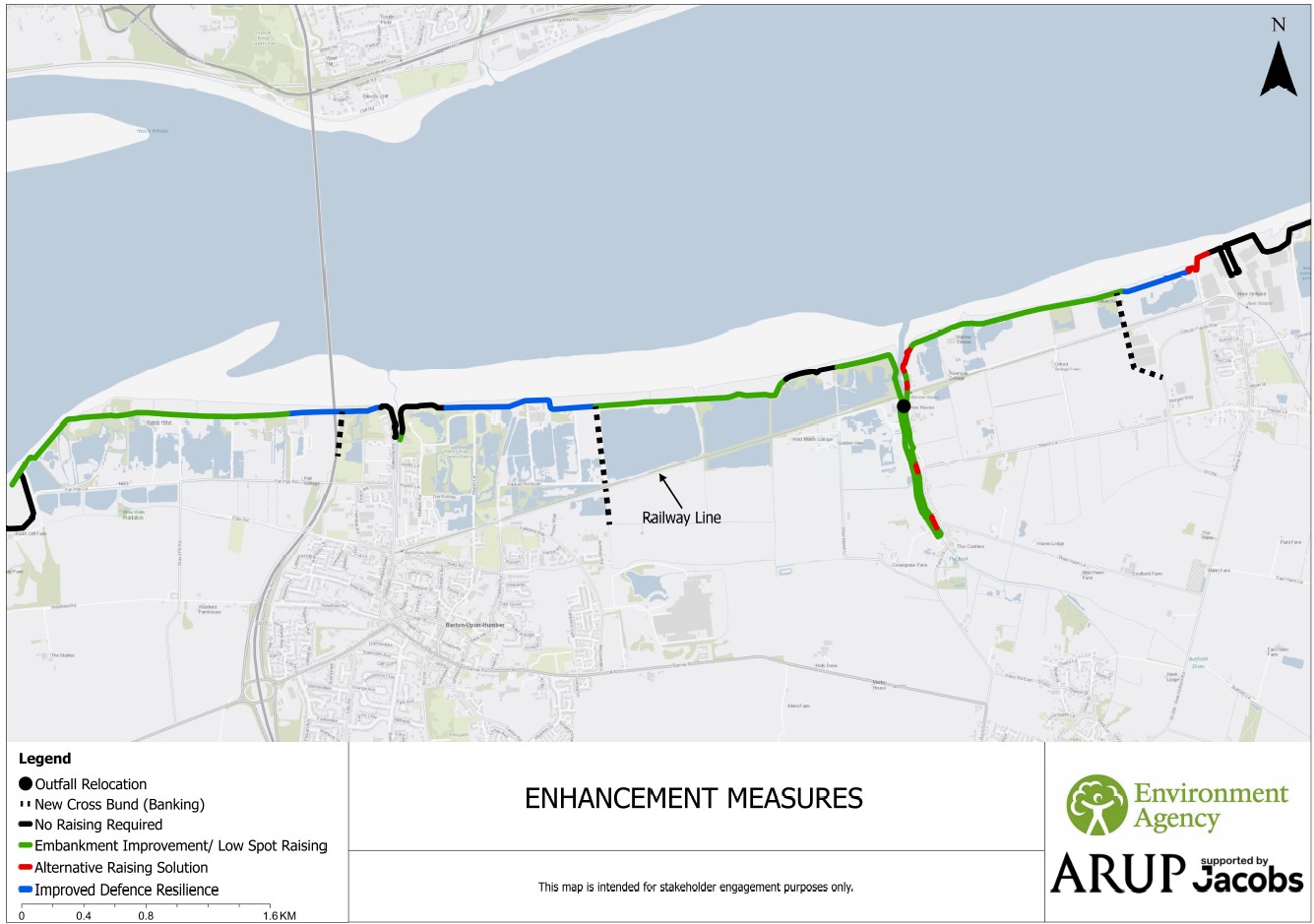 Enhancement Option
 Viable Option