FAQs
General
Who is responsible for the sea wall and groynes?
The Environment Agency, together with Coastal Protection Authorities (CPAs) such as the Isle of Wight Council, have the power to carry out sea defence works, but they are not legally required to do so and will not be liable for the failure to exercise these powers. These works depend on available funding and whether the benefits outweigh the costs.
Ownership of the sea wall and groynes in the Yaverland scheme area is shared. Some sections belong to the Environment Agency and others the Isle of Wight Council. A small stretch (from near the boating lake to the Grand Hotel) has unknown ownership, but the Environment Agency has looked after it in the past. After any improvements, the same maintenance arrangements are expected to continue.
Are you working with others on this project?
Yes. The Environment Agency is working with the Isle of Wight Council, JBA Consulting, and VolkerStevin. Just as importantly, we’ll be working closely with the local community.
We want your input to shape this project. If you have any questions or would like to be involved, please email us at IOW_FDschemes@environment-agency.gov.uk.
How is climate change being considered?
Sea levels are rising, and winter storms are becoming more intense due to climate change. This means that the risk from flooding and coastal erosion will increase over time.
We are using the latest computer modelling and climate data to help design defences that will protect the area for the next 100 years, taking future conditions into account from the very beginning.
More information on climate change can be found here
How will the scheme be funded?
Funding comes mainly from the UK government through the Environment Agency, but other sources may also need to contribute—such as local councils, developers, and private or public organisations.
Securing funding is dependent on the benefits and outcomes delivered by a scheme. Before funding is granted, we must show how much flood or erosion damages could be avoided if the scheme goes ahead. This can be thought of as ‘what would be at risk if we did nothing?’ and considers the maximum area likely to be impacted. It includes looking at how flooding could affect homes, businesses, transport, schools, hospitals and the environment.
Once the total amount of damages has been calculated, the actual cost of the proposed works and the period of time the scheme will be effective for, are all considered.
The more benefits the scheme can offer—especially for protecting homes—the more government funding it can attract. Extra funding may also be available if the area includes more deprived communities.
More information on funding can be found here
Will your scheme reduce the risk of flooding from the Eastern Yar river?
This scheme is focused on reducing the risk of flooding from the sea, not river flooding.
We know that some properties near the Eastern Yar have experienced river and surface water flooding. We are looking into how sea and river flooding in the Eastern Yar valley might affect each other in the future, but the current work will not directly stop flooding from the river. However, we will make sure the scheme does not make any existing flood risks worse.
How can I find out more?
We'll keep you updated throughout the project and give you regular opportunities to share your views.
To stay informed, sign up to our mailing list by emailing IOW_FDschemes@environment-agency.gov.uk. If you know someone who doesn't use the internet, please pass on updates to them.
Option Selection
- The criteria grouped by PESTLE (Political, Economic, Social, Technical, Legal, Environmental).
- The criteria grouped by Objectives.
- Economic, Financial, and Carbon ranking
How was the preferred option selected?
An overview of the options appraisal process at Outline Business Case stage is presented in the poster here
More detail about the process:
The Preferred Option has been selected using the decision-making process defined in the Flood and Coastal Erosion Risk Management Appraisal Guidance. For this type of project, Cost Benefit Analysis has been used to select the Preferred Option in accordance with the appraisal guidance. This guidance defines Cost Benefit Analysis as a type of appraisal or assessment which compares benefits and costs to identify the impact of different options on overall welfare.
The project objectives were split into criteria to allow the objectives to be assessed in more detail. Elected councillors were invited to participate in the process for assessing whether the options met broader Isle of Wight Council objectives. This exercise allowed the options to be ranked in order of acceptance.
The engineering implications of the options were assessed following a review of the Ground Investigation Report by the geotechnical and structural engineers. The carbon footprint for the short list of options was quantified and a high-level construction cost estimated. This is in addition to overtopping and inundation flood modelling, further environmental and Biodiversity Net Gain assessments, detailed economic appraisals and funding assessments which have also been carried out.
With the results of the appraisal and public consultation to hand, the project team were joined by Isle of Wight Council representatives at a workshop on 30 November 2023 to agree the preferred option. This recommendation was then reviewed by Isle of Wight Council’s Climate and Environment Board for consideration. The recommendation received approval with the stipulation that the design must not preclude a decision to raise the height of the seawall in the future.
Why was the preferred option selected?
The financial assessment compared the benefits and costs to identify the impact of each option overall. The benefits to the community of progressing Option 3 (the preferred option) outweigh the costs. The work will bring over £160 million worth of benefits to the community, the local infrastructure, and the local environment.
The figure below summarises the Short List appraisal for those options deemed to qualify for consideration as the Preferred Option (Options 3, 4 & 5).
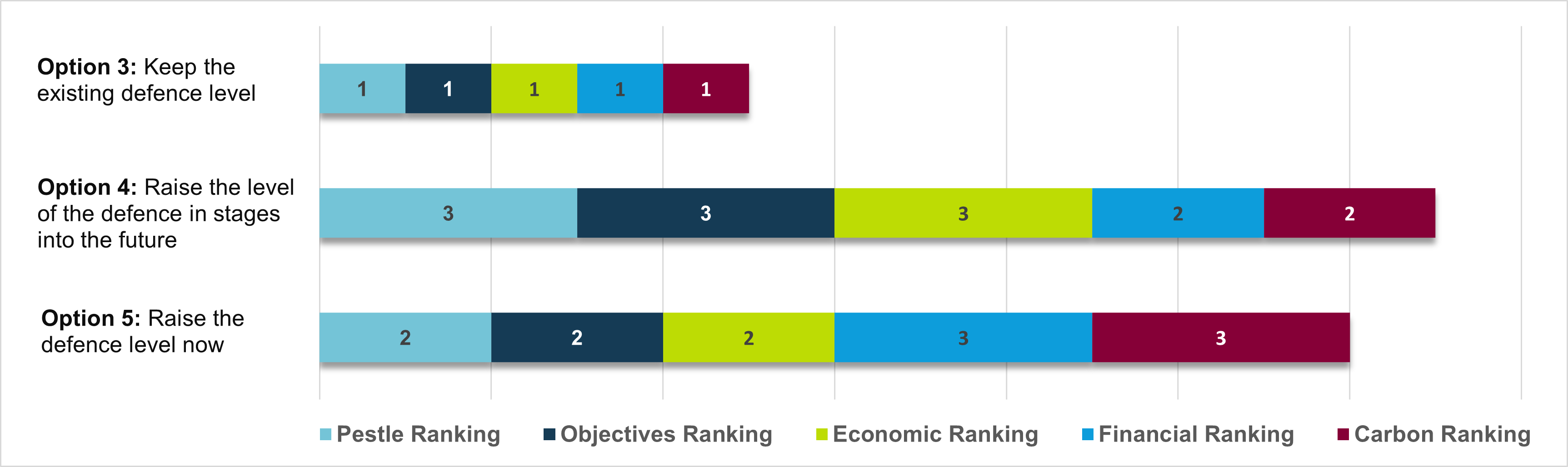
The ranking of the options is based on:
A PESTLE analysis studies the key external factors (Political, Economic, Social, Technal, Legal and Environmental) that influence an organisation or environment. It can be used in a range of different scenarios, and can guide people and professionals in strategic decision-making.
Option 3 meets all project objectives, scores highly for PESTLE criteria and scores highly for economic, financial and carbon ranking.
Option 3 also has the longest duration of benefits (50 years) when compared to the other options (20 years). Other than the usual maintenance for Isle of Wight Council and the Environment Agency, no interim works are expected in the 50 years of the scheme.
Why is the height of the sea wall not being increased?
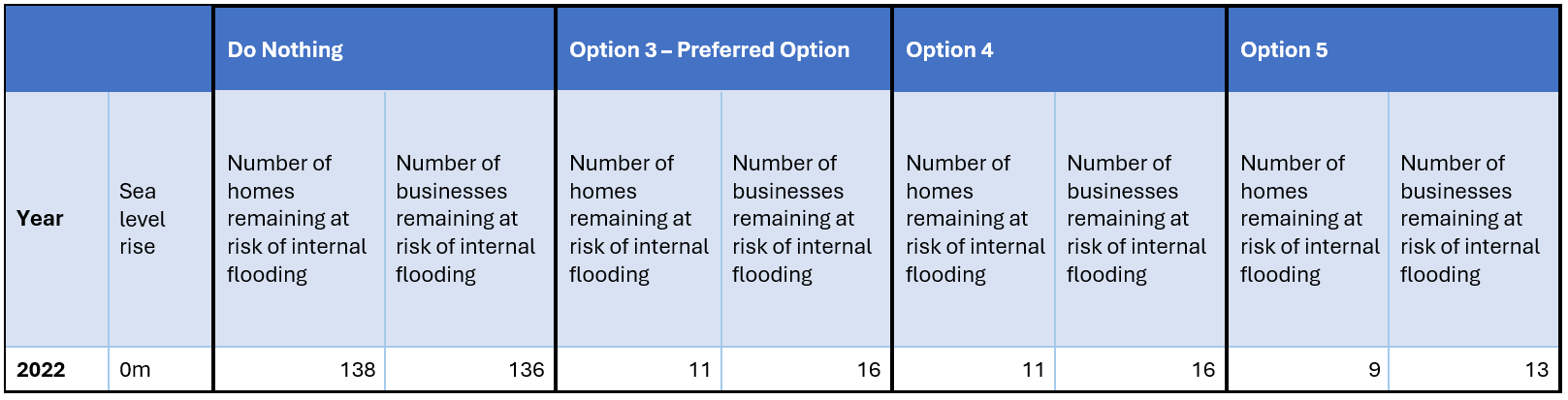
The flood risk assessment shows that the risk of internal property flooding from waves overtopping the existing sea wall is low given the height of the existing wall and raised floor levels of properties. Only a small number of properties would remain at risk of internal flooding from waves overtopping the sea wall after the refurbishment work is complete. Our modelling estimates that 11 homes and 16 businesses would remain at risk of internal property flooding from a tidal flooding event with a 0.5% annual probability (1 in 200 chance each year). This is compared to 138 homes and 136 businesses at risk of internal flooding from the sea if we did nothing.
The financial analysis suggests that other measures such as Property Flood Resilience (PFR) measures are a more cost-effective method of reducing the risk of internal flooding to the 11 homes and 16 businesses which remain at risk after the scheme is constructed. This opportunity will be explored as part of the next phase of work on the scheme. PFR measures can include flood boards, air brick covers, non-return valves and pumps, as well as work to ensure that the fabric of the property is sound. More information about PFR can be found here: https://bluepages.org.uk/
We can never remove the risk of flooding entirely. Our flood risk assessment shows that if the height of the sea wall was to be increased, there would still be a risk of wave overtopping and associated internal property flooding. The number of properties that would remain at risk of internal flooding today if Option 4 and Option 5 were to be implemented are shown in the table below.
The results of the financial analysis have shown that the additional scheme benefits from raising the height of the sea wall do not outweigh the additional scheme costs. Increasing the height of the sea wall almost doubles the cost of the scheme. The shortfall in funding makes the option to raise the height of the sea wall an unviable option for Isle of Wight Council to take forward.
What will happen with future sea level rise if we do not raise the height of the sea wall?
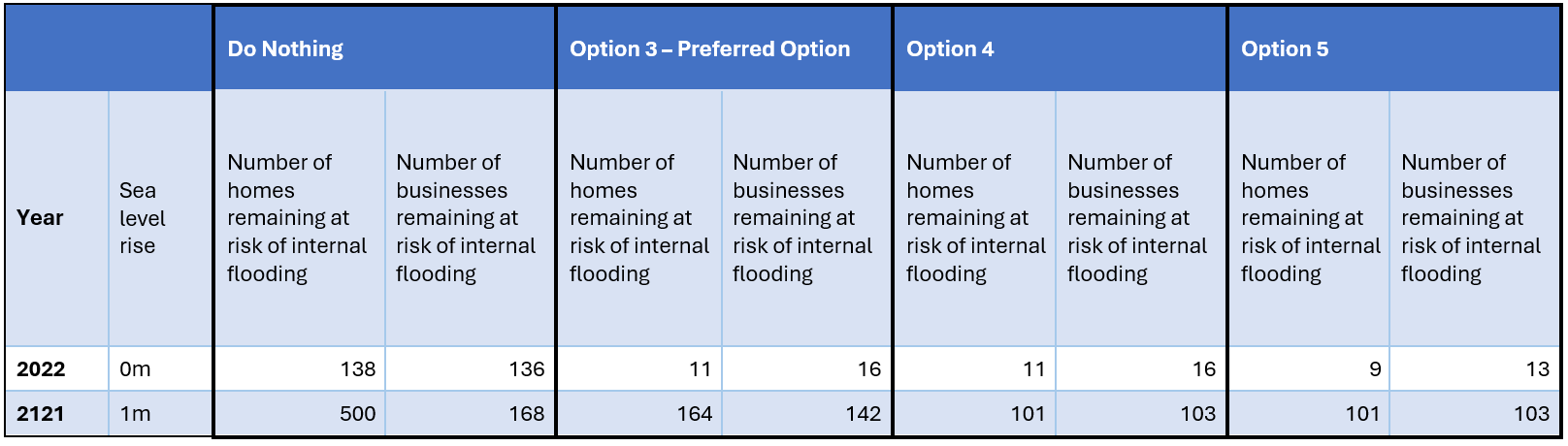
The risk of flooding from the sea over the next 100 years with 1 metre of sea level rise was modelled to improve our understanding of how the risk of flooding in the area may change in the future. It is estimated that without increasing the height of the sea wall, 164 homes and 142 businesses would be at risk of internal flooding from the sea by the year 2121. Raising the height of the sea wall would still leave 101 homes and 103 businesses at risk of internal property flooding from the sea by the year 2121.
 As part of the refurbishment project, we will include works which strengthen the foundations of the seawall with the foresight that a decision to raise the height of the seawall may be a viable option in 50 years’ time.