We use cookies to ensure our site functions properly and to store limited information about your usage. You may give or withdraw consent at any time. To find out more, read our privacy policy and cookie policy.
Manage Cookies
A cookie is information stored on your computer by a website you visit. Cookies often store your settings for a website, such as your preferred language or location. This allows the site to present you with information customized to fit your needs. As per the GDPR law, companies need to get your explicit approval to collect your data. Some of these cookies are ‘strictly necessary’ to provide the basic functions of the website and can not be turned off, while others if present, have the option of being turned off. Learn more about our Privacy and Cookie policies. These can be managed also from our cookie policy page.
Strictly necessary cookies(always on):
Necessary for enabling core functionality. The website cannot function properly without these cookies. This cannot be turned off. e.g. Sign in, Language
Analytics cookies:
Analytical cookies help us to analyse user behaviour, mainly to see if the users are able to find and act on things that they are looking for. They allow us to recognise and count the number of visitors and to see how visitors move around our website when they are using it. Tools used: Google Analytics
Limiting the spread of Invasive Non-Native Species (INNS) through biosecurity measures and partnership working in the Wessex Water region
The Water Industry National Environment Programme (WINEP) is a cornerstone of environmental regulation in England, setting out the actions water companies must deliver to meet statutory obligations and contribute to wider environmental goals. AMP7, which covered 1 April 2020 to 31 March 2025, represented one of the most ambitious WINEP cycles to date, with over 11,900 actions aimed at improving water quality, protecting biodiversity, and supporting sustainable water resources. The case study below provides an example of one of the completed AMP7 projects.
There are currently around 2,000 Invasive non-native species in the UK with 10-12 new species establishing themselves every year. INNS can have negative social and economic impacts with a study by the Centre for Agriculture and Biosciences International (CABI) estimating that INNS costs the UK economy £4 billion a year. Invasive zebra and quagga mussels attach themselves to the insides of water pipes resulting in blockages, with removal representing a cost to water companies.
To control the spread of INNS to and from their operational sites Wessex Water worked with partner organisations to implement biosecurity measures. The measures taken at different sites depended on whether there was existing INNS presence and the risk of spread by operations and recreation. Measures implemented included:
General awareness signage at 12 sites
Dry boot scrubs for walkers at seven sites
Wet boot scrubs for anglers at four sites
An angler dip tank at five sites
One bespoke washdown facility for cleaning wetsuits
Washdown for boats at three sites.
Wessex Water was also among nine water companies that funded the Aquatic Biodiversity Partnership managed by the Animal and Plant Health Agency (APHA). This aimed to strengthen aquatic biosecurity at a more regional/international level e.g. through border control campaigns, such as Check, Clean, Dry.
Wessex Water contributed towards a biological control trial run by CABI to tackle Crassula helmsii (Australian swamp stonecrop) an invasive weed that negatively impacts on water industry assets. Though the trial was unsuccessful at the Wessex Water site, results were promising at other wetland sites. The results will inform further research on bio controls for Crassula.
Wessex Water has an active monitoring programme for INNS and is developing a Rapid Response Plan through AMP8 that will enable the company to respond quickly to any such occurrence.
Invasive Australian swamp stonecrop at Blashford Lakes July 2021
Limiting the spread of Invasive Non-Native Species (INNS) through biosecurity measures and partnership working in the Wessex Water region
The Water Industry National Environment Programme (WINEP) is a cornerstone of environmental regulation in England, setting out the actions water companies must deliver to meet statutory obligations and contribute to wider environmental goals. AMP7, which covered 1 April 2020 to 31 March 2025, represented one of the most ambitious WINEP cycles to date, with over 11,900 actions aimed at improving water quality, protecting biodiversity, and supporting sustainable water resources. The case study below provides an example of one of the completed AMP7 projects.
There are currently around 2,000 Invasive non-native species in the UK with 10-12 new species establishing themselves every year. INNS can have negative social and economic impacts with a study by the Centre for Agriculture and Biosciences International (CABI) estimating that INNS costs the UK economy £4 billion a year. Invasive zebra and quagga mussels attach themselves to the insides of water pipes resulting in blockages, with removal representing a cost to water companies.
To control the spread of INNS to and from their operational sites Wessex Water worked with partner organisations to implement biosecurity measures. The measures taken at different sites depended on whether there was existing INNS presence and the risk of spread by operations and recreation. Measures implemented included:
General awareness signage at 12 sites
Dry boot scrubs for walkers at seven sites
Wet boot scrubs for anglers at four sites
An angler dip tank at five sites
One bespoke washdown facility for cleaning wetsuits
Washdown for boats at three sites.
Wessex Water was also among nine water companies that funded the Aquatic Biodiversity Partnership managed by the Animal and Plant Health Agency (APHA). This aimed to strengthen aquatic biosecurity at a more regional/international level e.g. through border control campaigns, such as Check, Clean, Dry.
Wessex Water contributed towards a biological control trial run by CABI to tackle Crassula helmsii (Australian swamp stonecrop) an invasive weed that negatively impacts on water industry assets. Though the trial was unsuccessful at the Wessex Water site, results were promising at other wetland sites. The results will inform further research on bio controls for Crassula.
Wessex Water has an active monitoring programme for INNS and is developing a Rapid Response Plan through AMP8 that will enable the company to respond quickly to any such occurrence.
Invasive Australian swamp stonecrop at Blashford Lakes July 2021

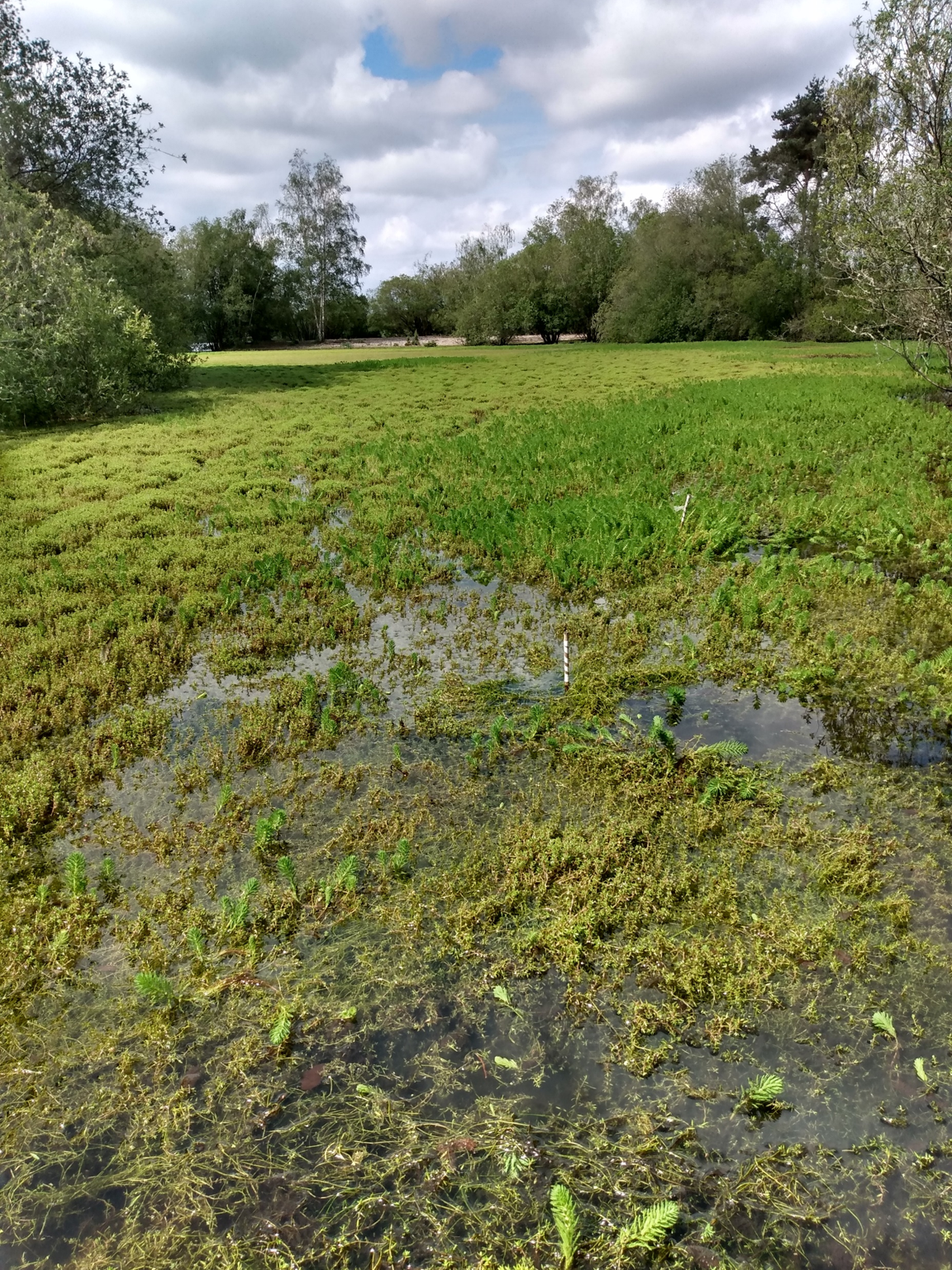 Invasive Australian swamp stonecrop at Blashford Lakes July 2021