We use cookies to ensure our site functions properly and to store limited information about your usage. You may give or withdraw consent at any time. To find out more, read our privacy policy and cookie policy.
Manage Cookies
A cookie is information stored on your computer by a website you visit. Cookies often store your settings for a website, such as your preferred language or location. This allows the site to present you with information customized to fit your needs. As per the GDPR law, companies need to get your explicit approval to collect your data. Some of these cookies are ‘strictly necessary’ to provide the basic functions of the website and can not be turned off, while others if present, have the option of being turned off. Learn more about our Privacy and Cookie policies. These can be managed also from our cookie policy page.
Strictly necessary cookies(always on):
Necessary for enabling core functionality. The website cannot function properly without these cookies. This cannot be turned off. e.g. Sign in, Language
Analytics cookies:
Analytical cookies help us to analyse user behaviour, mainly to see if the users are able to find and act on things that they are looking for. They allow us to recognise and count the number of visitors and to see how visitors move around our website when they are using it. Tools used: Google Analytics
Increasing biodiversity through wetland restoration and woodland creation at Park Pit, Bodmin Moor
South West Water have carried out several improvement measures at Park Pit to enhance biodiversity. Park Pit which was previously worked and mined for clay and tin was sold to South West Water in 2007 and then flooded to provide a drinking water resource. Since taking the site over, alongside working groups, South West Water has managed the adjacent land for biodiversity. Previous restoration work established key priority habitats on the site, with wetland, heathland, woodland and open water now effectively restored as functioning habitats.Results of peatland restoration works on Bodmin Moor, comparing the site in October 2023 and April 2024
During the AMP7 management period additional measures were carried out. Wetland function was restored to an area of peatland to the north-west of the site by the South West Peatland Partnership. Heathland management and willow coppicing were also carried out in the restored wetland area, in accordance with a recommendation by the Park and Stannon management groups. Non-native tree species were felled and replaced with appropriate natives with 14.55 ha of woodland achieved. Innovative techniques like horse logging were used to remove non-native conifers. An eel passage was created under the access road in the form of a stone ramp and spat rope.
Bird and invertebrate surveys commissioned by South West Water suggest that the measures have resulted in increased biodiversity. The diversity of bird species at Park increased by 57% and at Stannon by 40%. 255 species of invertebrate were recorded including 28 species that are of conservation concern.
Significant funding for the management of the site came from the WINEP programme. The work was supported by the stakeholder group made up of Natural England, Forestry Commission, Environment Agency, Fowey Rivers Association, Liskeard Angling Association, English Heritage, Cornwall Council and Cornwall AONB (Area of Outstanding Natural Beauty). The Environment Agency provided advice on wetland restoration, eel and fishery management and invasive management principles as part of the stakeholder group.
The site provides a key water resource for public supply and is an exemplar of sustainable development through the delivery of ecosystem benefits. Such sites are becoming increasingly important for climate resilience to wetter winters and drier summers, providing public water supply and enhancing local biodiversity.
Park horse logging- removal of non-native conifers
Stannon drone seeding trials for temperate rainforest establishment, with the Woodland Trust
Species highlights: Dartford Warbler, devil’s bit scabious, bloody nose beetle, bog asphodel, harvest mouse nest, marsh clubmoss.
Increasing biodiversity through wetland restoration and woodland creation at Park Pit, Bodmin Moor
South West Water have carried out several improvement measures at Park Pit to enhance biodiversity. Park Pit which was previously worked and mined for clay and tin was sold to South West Water in 2007 and then flooded to provide a drinking water resource. Since taking the site over, alongside working groups, South West Water has managed the adjacent land for biodiversity. Previous restoration work established key priority habitats on the site, with wetland, heathland, woodland and open water now effectively restored as functioning habitats.Results of peatland restoration works on Bodmin Moor, comparing the site in October 2023 and April 2024
During the AMP7 management period additional measures were carried out. Wetland function was restored to an area of peatland to the north-west of the site by the South West Peatland Partnership. Heathland management and willow coppicing were also carried out in the restored wetland area, in accordance with a recommendation by the Park and Stannon management groups. Non-native tree species were felled and replaced with appropriate natives with 14.55 ha of woodland achieved. Innovative techniques like horse logging were used to remove non-native conifers. An eel passage was created under the access road in the form of a stone ramp and spat rope.
Bird and invertebrate surveys commissioned by South West Water suggest that the measures have resulted in increased biodiversity. The diversity of bird species at Park increased by 57% and at Stannon by 40%. 255 species of invertebrate were recorded including 28 species that are of conservation concern.
Significant funding for the management of the site came from the WINEP programme. The work was supported by the stakeholder group made up of Natural England, Forestry Commission, Environment Agency, Fowey Rivers Association, Liskeard Angling Association, English Heritage, Cornwall Council and Cornwall AONB (Area of Outstanding Natural Beauty). The Environment Agency provided advice on wetland restoration, eel and fishery management and invasive management principles as part of the stakeholder group.
The site provides a key water resource for public supply and is an exemplar of sustainable development through the delivery of ecosystem benefits. Such sites are becoming increasingly important for climate resilience to wetter winters and drier summers, providing public water supply and enhancing local biodiversity.
Park horse logging- removal of non-native conifers
Stannon drone seeding trials for temperate rainforest establishment, with the Woodland Trust
Species highlights: Dartford Warbler, devil’s bit scabious, bloody nose beetle, bog asphodel, harvest mouse nest, marsh clubmoss.

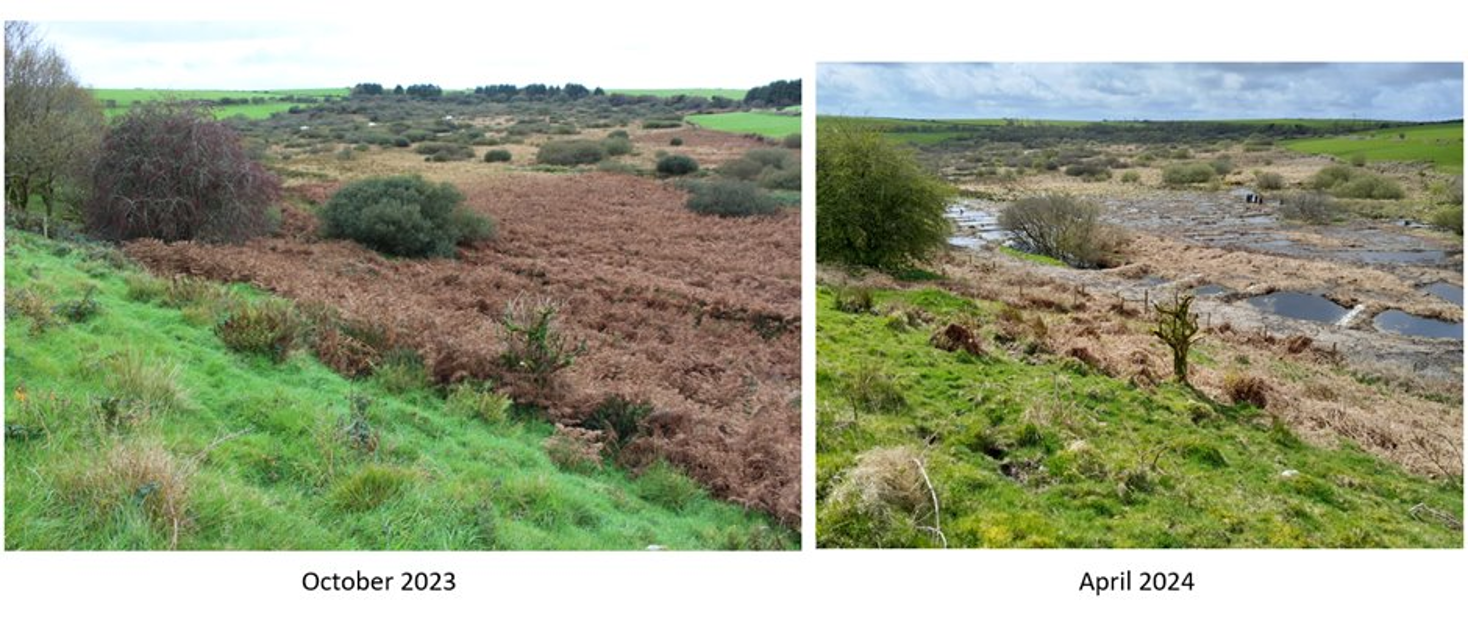 Results of peatland restoration works on Bodmin Moor, comparing the site in October 2023 and April 2024
 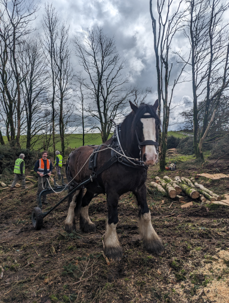 Park horse logging- removal of non-native conifers
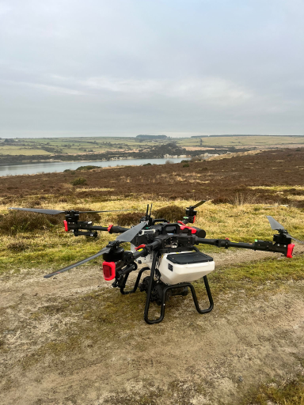 Stannon drone seeding trials for temperate rainforest establishment, with the Woodland Trust
 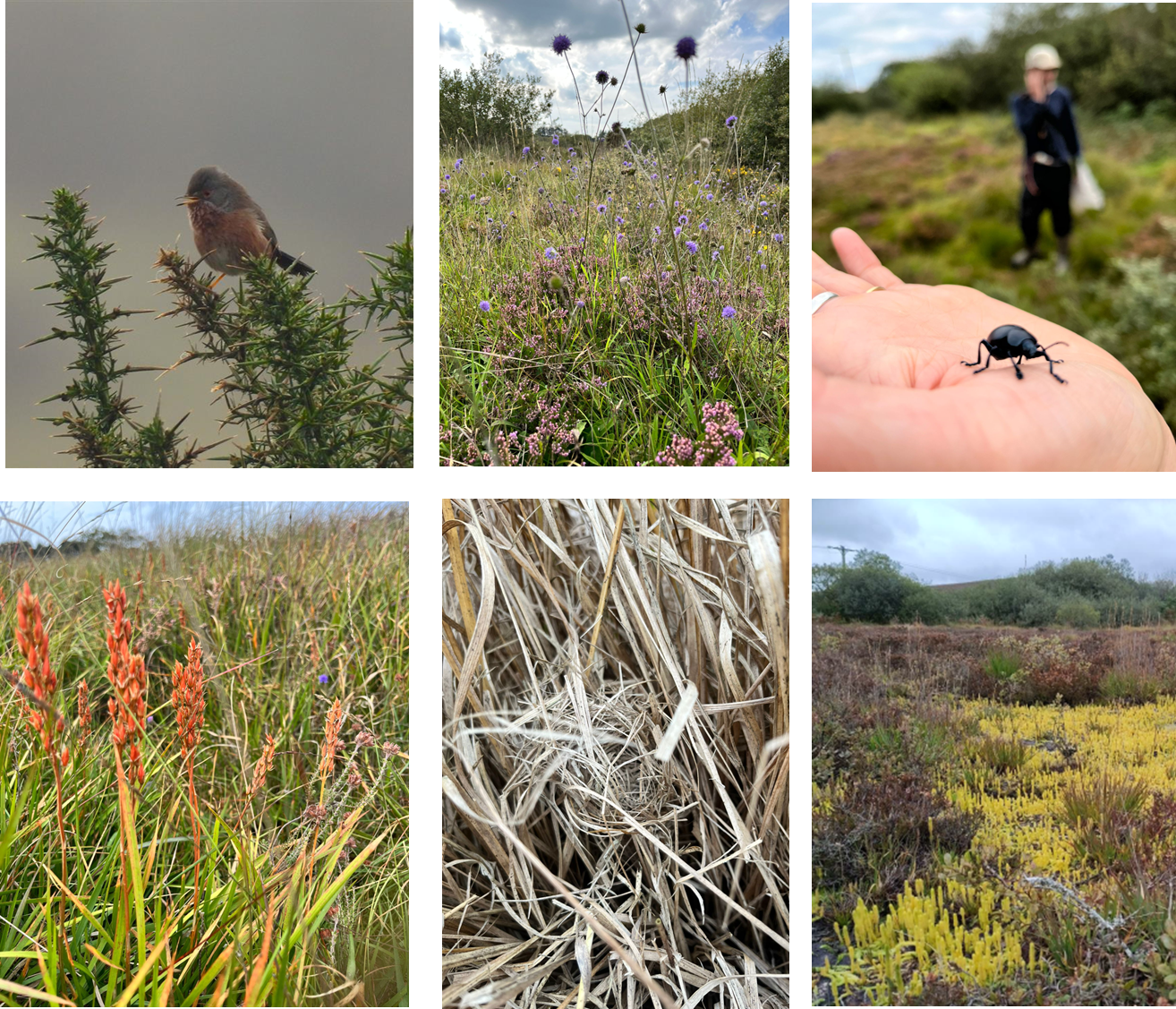 Species highlights: Dartford Warbler, devil’s bit scabious, bloody nose beetle, bog asphodel, harvest mouse nest, marsh clubmoss.