We use cookies to ensure our site functions properly and to store limited information about your usage. You may give or withdraw consent at any time. To find out more, read our privacy policy and cookie policy.
Manage Cookies
A cookie is information stored on your computer by a website you visit. Cookies often store your settings for a website, such as your preferred language or location. This allows the site to present you with information customized to fit your needs. As per the GDPR law, companies need to get your explicit approval to collect your data. Some of these cookies are ‘strictly necessary’ to provide the basic functions of the website and can not be turned off, while others if present, have the option of being turned off. Learn more about our Privacy and Cookie policies. These can be managed also from our cookie policy page.
Strictly necessary cookies(always on):
Necessary for enabling core functionality. The website cannot function properly without these cookies. This cannot be turned off. e.g. Sign in, Language
Analytics cookies:
Analytical cookies help us to analyse user behaviour, mainly to see if the users are able to find and act on things that they are looking for. They allow us to recognise and count the number of visitors and to see how visitors move around our website when they are using it. Tools used: Google Analytics
Establishing a catchment partnership to reduce fine sediment inputs into the South Tyne Catchment
The Water Industry National Environment Programme (WINEP) is a cornerstone of environmental regulation in England, setting out the actions water companies must deliver to meet statutory obligations and contribute to wider environmental goals. AMP7, which covered 1 April 2020 to 31 March 2025, represented one of the most ambitious WINEP cycles to date, with over 11,900 actions aimed at improving water quality, protecting biodiversity, and supporting sustainable water resources. The case study below provides an example of one of the completed AMP7 projects.
To address the issue of fine sediment clogging abstraction at Ovingham on the River Tyne, Northumbrian Water led the development of a catchment partnership in the South Tyne Catchment. The partnership offered grants to organisations to deliver interventions which addressed sediment inputs to rivers and delivered biodiversity and climate benefits. Grants were also provided to farm businesses to reduce pollution risks. Notably, funding was made available for feasibility and project development work, which can be difficult for organisations to secure. Many of the interventions were co-funded by the Environment Agency through the Water Environment Improvement Fund (WEIF) and by the Mine Remediation Authority. The Environment Agency also supported partners to develop their applications for permits. So far, £510,765 of Northumbrian Water customers’ money has been matched by contributions from other sources of £799,691.
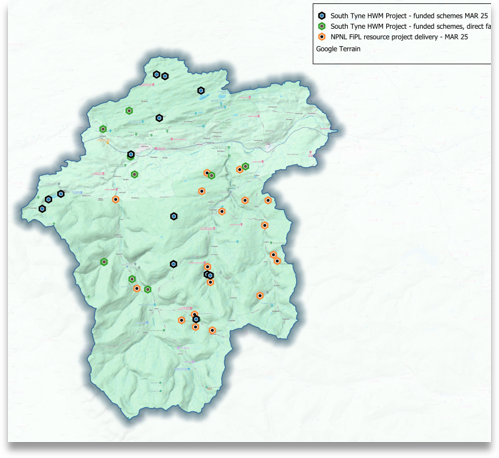
The grant scheme supported 23 individual projects, 10 directly on farms. One grant enabled the creation of a new Farming in Protected Landscapes (FiPL) Officer post with the North Pennines National Landscape Partnership. This led to a further 17 FiPL grant-funded projects.
The interventions have already started to improve water quality and biodiversity, slow the flow and build climate resilience into the river systems.
Locations of the 40 interventions delivered under the banner of the South Tyne Holistic Water Management project.
Establishing a catchment partnership to reduce fine sediment inputs into the South Tyne Catchment
The Water Industry National Environment Programme (WINEP) is a cornerstone of environmental regulation in England, setting out the actions water companies must deliver to meet statutory obligations and contribute to wider environmental goals. AMP7, which covered 1 April 2020 to 31 March 2025, represented one of the most ambitious WINEP cycles to date, with over 11,900 actions aimed at improving water quality, protecting biodiversity, and supporting sustainable water resources. The case study below provides an example of one of the completed AMP7 projects.
To address the issue of fine sediment clogging abstraction at Ovingham on the River Tyne, Northumbrian Water led the development of a catchment partnership in the South Tyne Catchment. The partnership offered grants to organisations to deliver interventions which addressed sediment inputs to rivers and delivered biodiversity and climate benefits. Grants were also provided to farm businesses to reduce pollution risks. Notably, funding was made available for feasibility and project development work, which can be difficult for organisations to secure. Many of the interventions were co-funded by the Environment Agency through the Water Environment Improvement Fund (WEIF) and by the Mine Remediation Authority. The Environment Agency also supported partners to develop their applications for permits. So far, £510,765 of Northumbrian Water customers’ money has been matched by contributions from other sources of £799,691.
The grant scheme supported 23 individual projects, 10 directly on farms. One grant enabled the creation of a new Farming in Protected Landscapes (FiPL) Officer post with the North Pennines National Landscape Partnership. This led to a further 17 FiPL grant-funded projects.
The interventions have already started to improve water quality and biodiversity, slow the flow and build climate resilience into the river systems.
Locations of the 40 interventions delivered under the banner of the South Tyne Holistic Water Management project.

 Locations of the 40 interventions delivered under the banner of the South Tyne Holistic Water Management project.