We use cookies to ensure our site functions properly and to store limited information about your usage. You may give or withdraw consent at any time. To find out more, read our privacy policy and cookie policy.
Manage Cookies
A cookie is information stored on your computer by a website you visit. Cookies often store your settings for a website, such as your preferred language or location. This allows the site to present you with information customized to fit your needs. As per the GDPR law, companies need to get your explicit approval to collect your data. Some of these cookies are ‘strictly necessary’ to provide the basic functions of the website and can not be turned off, while others if present, have the option of being turned off. Learn more about our Privacy and Cookie policies. These can be managed also from our cookie policy page.
Strictly necessary cookies(always on):
Necessary for enabling core functionality. The website cannot function properly without these cookies. This cannot be turned off. e.g. Sign in, Language
Analytics cookies:
Analytical cookies help us to analyse user behaviour, mainly to see if the users are able to find and act on things that they are looking for. They allow us to recognise and count the number of visitors and to see how visitors move around our website when they are using it. Tools used: Google Analytics
WINEP case study: Essex and Suffolk Water (AMP7) Ex.2
Enabling fish and eel passage by installing a pass at Langford Sluice
The Water Industry National Environment Programme (WINEP) is a cornerstone of environmental regulation in England, setting out the actions water companies must deliver to meet statutory obligations and contribute to wider environmental goals. AMP7, which covered 1 April 2020 to 31 March 2025, represented one of the most ambitious WINEP cycles to date, with over 11,900 actions aimed at improving water quality, protecting biodiversity, and supporting sustainable water resources. The case study below provides an example of one of the completed AMP7 projects.
Langford Sluice on the River Blackwater holds the upstream river back to prevent it from flowing too rapidly downstream and out to sea. This maximises available freshwater but prevents the upstream movement of fish and eels. The Eel (England and Wales) Regulations 2009 require provision of free passage for eel migration and the Water Framework Directive (WFD) has targets for ecological condition include fish passage. Therefore, the sluice could prevent this water body from achieving good ecological potential.
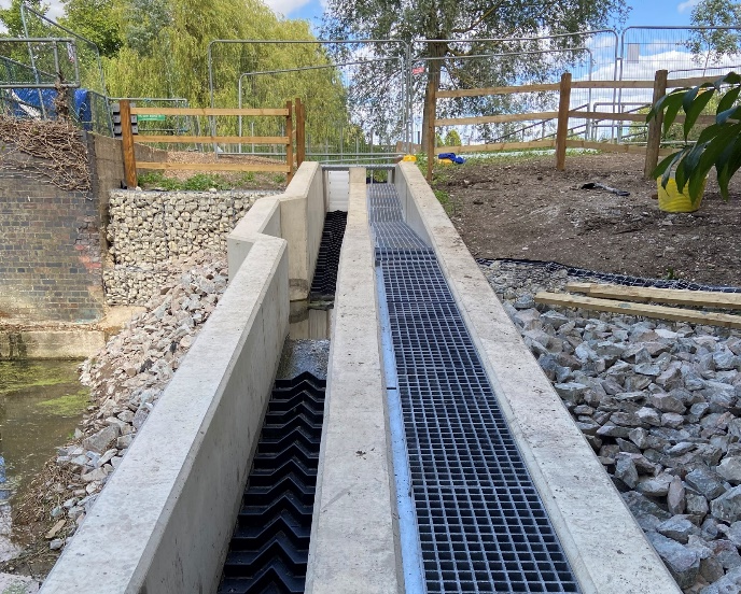
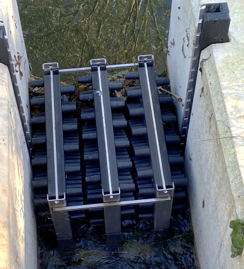
To enable passage, two artificial channels were constructed to support the movement of both fish and eels. These were built using low-carbon concrete. The fish channel was fitted with Larinier tiles to slow water flow, alongside a resting pool to allow fish to recover as they move upstream. The eel channel was installed with peg tiles to enable eels to ascend upstream. These tiles were arranged in a cassette-type system, turned on their sides and slotted into racks. The cassette arrangement represents an innovative design approach never been trialed before, developed to make it easier for eels to exit upstream while also improving access for cleaning and maintenance. A monitoring camera has been installed, which the Environment Agency is using to observe fish and eel movements through the pass and quantify its success.
The pass was designed by Stantec and installed by Stonbury and GMP. The local EA fisheries team supported the development of the design, seeking advice and approval from experts on the National Fish Pass Advisory Panel.
Significant benefits are expected by encouraging the free movement of fish and eels up and downstream, allowing all migratory species to complete their lifecycles while contributing to WFD objectives for the water body. The EA are now using the camera to record the number of fish and eels using the pass to quantify its success.
A view of the pass looking upstream, with the fish pass on the left showing the Larinier tiles and the eel pass on the right, covered by a walkway for maintenance access.
The eel pass cassette formed from the peg tiles turned on the side and slotted into racks.
Enabling fish and eel passage by installing a pass at Langford Sluice
The Water Industry National Environment Programme (WINEP) is a cornerstone of environmental regulation in England, setting out the actions water companies must deliver to meet statutory obligations and contribute to wider environmental goals. AMP7, which covered 1 April 2020 to 31 March 2025, represented one of the most ambitious WINEP cycles to date, with over 11,900 actions aimed at improving water quality, protecting biodiversity, and supporting sustainable water resources. The case study below provides an example of one of the completed AMP7 projects.
Langford Sluice on the River Blackwater holds the upstream river back to prevent it from flowing too rapidly downstream and out to sea. This maximises available freshwater but prevents the upstream movement of fish and eels. The Eel (England and Wales) Regulations 2009 require provision of free passage for eel migration and the Water Framework Directive (WFD) has targets for ecological condition include fish passage. Therefore, the sluice could prevent this water body from achieving good ecological potential.
To enable passage, two artificial channels were constructed to support the movement of both fish and eels. These were built using low-carbon concrete. The fish channel was fitted with Larinier tiles to slow water flow, alongside a resting pool to allow fish to recover as they move upstream. The eel channel was installed with peg tiles to enable eels to ascend upstream. These tiles were arranged in a cassette-type system, turned on their sides and slotted into racks. The cassette arrangement represents an innovative design approach never been trialed before, developed to make it easier for eels to exit upstream while also improving access for cleaning and maintenance. A monitoring camera has been installed, which the Environment Agency is using to observe fish and eel movements through the pass and quantify its success.
The pass was designed by Stantec and installed by Stonbury and GMP. The local EA fisheries team supported the development of the design, seeking advice and approval from experts on the National Fish Pass Advisory Panel.
Significant benefits are expected by encouraging the free movement of fish and eels up and downstream, allowing all migratory species to complete their lifecycles while contributing to WFD objectives for the water body. The EA are now using the camera to record the number of fish and eels using the pass to quantify its success.
A view of the pass looking upstream, with the fish pass on the left showing the Larinier tiles and the eel pass on the right, covered by a walkway for maintenance access.
The eel pass cassette formed from the peg tiles turned on the side and slotted into racks.

 A view of the pass looking upstream, with the fish pass on the left showing the Larinier tiles and the eel pass on the right, covered by a walkway for maintenance access.
 The eel pass cassette formed from the peg tiles turned on the side and slotted into racks.