We use cookies to ensure our site functions properly and to store limited information about your usage. You may give or withdraw consent at any time. To find out more, read our privacy policy and cookie policy.
Manage Cookies
A cookie is information stored on your computer by a website you visit. Cookies often store your settings for a website, such as your preferred language or location. This allows the site to present you with information customized to fit your needs. As per the GDPR law, companies need to get your explicit approval to collect your data. Some of these cookies are ‘strictly necessary’ to provide the basic functions of the website and can not be turned off, while others if present, have the option of being turned off. Learn more about our Privacy and Cookie policies. These can be managed also from our cookie policy page.
Strictly necessary cookies(always on):
Necessary for enabling core functionality. The website cannot function properly without these cookies. This cannot be turned off. e.g. Sign in, Language
Analytics cookies:
Analytical cookies help us to analyse user behaviour, mainly to see if the users are able to find and act on things that they are looking for. They allow us to recognise and count the number of visitors and to see how visitors move around our website when they are using it. Tools used: Google Analytics
WINEP case study: Essex and Suffolk Water (AMP7) Ex.1
Working in partnership to address risks to water quality within the Blackwater catchment area
The Water Industry National Environment Programme (WINEP) is a cornerstone of environmental regulation in England, setting out the actions water companies must deliver to meet statutory obligations and contribute to wider environmental goals. AMP7, which covered 1 April 2020 to 31 March 2025, represented one of the most ambitious WINEP cycles to date, with over 11,900 actions aimed at improving water quality, protecting biodiversity, and supporting sustainable water resources. The case study below provides an example of one of the completed AMP7 projects.
To reduce concentrations of pesticides in watercourses in the Blackwater Safeguard Zone and deliver habitat and biodiversity improvements, Essex and Suffolk Water worked with and through partner organisations. They supported and expanded the Chelmer and Blackwater Catchment Partnership and worked more closely with the Combined Essex Management Catchment.
They co-funded six delivery schemes including feasibility and project development, which is typically difficult to secure funding for, and pollution prevention activity on ten farms. The Environment Agency co-funded many of the interventions through the Water Environment Improvement Fund (WEIF) and supported applications for permits. Several organisations supported delivery of the scheme, alongside farmers who made improvements directly to their land and farm steadings.
The scheme has supported the ongoing development of ambitious and successful initiatives across the catchment, including the North Essex Farm Cluster. Essex and Suffolk Water, working with partners, provided funding for cluster coordinators, who have harnessed the enthusiasm of farmers across the catchment to deliver meaningful change through peer support. Another notable initiative was support for the Essex and Suffolk Rivers Trust, which received advice and funding to undertake a fluvial audit. This audit will provide a foundation for the future delivery of river restoration projects across the catchment. A restoration plan has also been developed by the Essex and Suffolk Rivers Trust, led by a Project Officer funded through the scheme.
Essex and Suffolk Water’s financial contribution of £330,800 has been matched by at least £640,000 of funding from other sources, meaning that for every £1 they have invested a total of £2.93 has been spent on environmental improvement in the Blackwater catchment.
Essex and Suffolk Water Catchment Advisor talking at North Essex Farm Cluster farm walk (Oct 2022)
Sealed bund built prior to installation of liquid fertiliser tanks, reducing the risk of spills to local watercourse
Working in partnership to address risks to water quality within the Blackwater catchment area
The Water Industry National Environment Programme (WINEP) is a cornerstone of environmental regulation in England, setting out the actions water companies must deliver to meet statutory obligations and contribute to wider environmental goals. AMP7, which covered 1 April 2020 to 31 March 2025, represented one of the most ambitious WINEP cycles to date, with over 11,900 actions aimed at improving water quality, protecting biodiversity, and supporting sustainable water resources. The case study below provides an example of one of the completed AMP7 projects.
To reduce concentrations of pesticides in watercourses in the Blackwater Safeguard Zone and deliver habitat and biodiversity improvements, Essex and Suffolk Water worked with and through partner organisations. They supported and expanded the Chelmer and Blackwater Catchment Partnership and worked more closely with the Combined Essex Management Catchment.
They co-funded six delivery schemes including feasibility and project development, which is typically difficult to secure funding for, and pollution prevention activity on ten farms. The Environment Agency co-funded many of the interventions through the Water Environment Improvement Fund (WEIF) and supported applications for permits. Several organisations supported delivery of the scheme, alongside farmers who made improvements directly to their land and farm steadings.
The scheme has supported the ongoing development of ambitious and successful initiatives across the catchment, including the North Essex Farm Cluster. Essex and Suffolk Water, working with partners, provided funding for cluster coordinators, who have harnessed the enthusiasm of farmers across the catchment to deliver meaningful change through peer support. Another notable initiative was support for the Essex and Suffolk Rivers Trust, which received advice and funding to undertake a fluvial audit. This audit will provide a foundation for the future delivery of river restoration projects across the catchment. A restoration plan has also been developed by the Essex and Suffolk Rivers Trust, led by a Project Officer funded through the scheme.
Essex and Suffolk Water’s financial contribution of £330,800 has been matched by at least £640,000 of funding from other sources, meaning that for every £1 they have invested a total of £2.93 has been spent on environmental improvement in the Blackwater catchment.
Essex and Suffolk Water Catchment Advisor talking at North Essex Farm Cluster farm walk (Oct 2022)
Sealed bund built prior to installation of liquid fertiliser tanks, reducing the risk of spills to local watercourse

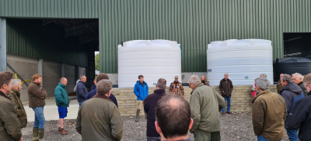 Essex and Suffolk Water Catchment Advisor talking at North Essex Farm Cluster farm walk (Oct 2022)
 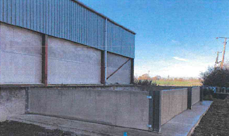 Sealed bund built prior to installation of liquid fertiliser tanks, reducing the risk of spills to local watercourse