We use cookies to ensure our site functions properly and to store limited information about your usage. You may give or withdraw consent at any time. To find out more, read our privacy policy and cookie policy.
Manage Cookies
A cookie is information stored on your computer by a website you visit. Cookies often store your settings for a website, such as your preferred language or location. This allows the site to present you with information customized to fit your needs. As per the GDPR law, companies need to get your explicit approval to collect your data. Some of these cookies are ‘strictly necessary’ to provide the basic functions of the website and can not be turned off, while others if present, have the option of being turned off. Learn more about our Privacy and Cookie policies. These can be managed also from our cookie policy page.
Strictly necessary cookies(always on):
Necessary for enabling core functionality. The website cannot function properly without these cookies. This cannot be turned off. e.g. Sign in, Language
Analytics cookies:
Analytical cookies help us to analyse user behaviour, mainly to see if the users are able to find and act on things that they are looking for. They allow us to recognise and count the number of visitors and to see how visitors move around our website when they are using it. Tools used: Google Analytics
Preventing introduction and spread of invasive species through partnership projects
The Water Industry National Environment Programme (WINEP) is a cornerstone of environmental regulation in England, setting out the actions water companies must deliver to meet statutory obligations and contribute to wider environmental goals. AMP7, which covered 1 April 2020 to 31 March 2025, represented one of the most ambitious WINEP cycles to date, with over 11,900 actions aimed at improving water quality, protecting biodiversity, and supporting sustainable water resources. The case study below provides an example of one of the completed AMP7 projects.
Affinity Water's 'INNS Out Scheme' supports partnerships projects in the Affinity Water catchment area that aim to prevent introduction and spread of invasive non-native species (INNS). Especially in protected sites such as those of Special Scientific Interest (SSSI).
The scheme has provided both financial and volunteer support to people and organisations in the catchment to carry out INNS prevention projects. Affinity Water's Biodiversity team, alongside other colleagues and contractors have volunteered at numerous events.
Since the launch in 2021, over 80% of applications to the INNS Out scheme have been successful and £350,000 funding has been awarded. Volunteer events have included floating pennywort removal and himalayan balsam days, along with projects tackling over 30 different species at 25 different water spaces.
The Environment Agency aims to build on the successes and continue to enhance relationships with local stakeholders and communities to reduce the impact of INNS in the Affinity Water catchment areas.
Affinity Water and Browne Volunteers pulling out himalayan balsam on the River Rib
Preventing introduction and spread of invasive species through partnership projects
The Water Industry National Environment Programme (WINEP) is a cornerstone of environmental regulation in England, setting out the actions water companies must deliver to meet statutory obligations and contribute to wider environmental goals. AMP7, which covered 1 April 2020 to 31 March 2025, represented one of the most ambitious WINEP cycles to date, with over 11,900 actions aimed at improving water quality, protecting biodiversity, and supporting sustainable water resources. The case study below provides an example of one of the completed AMP7 projects.
Affinity Water's 'INNS Out Scheme' supports partnerships projects in the Affinity Water catchment area that aim to prevent introduction and spread of invasive non-native species (INNS). Especially in protected sites such as those of Special Scientific Interest (SSSI).
The scheme has provided both financial and volunteer support to people and organisations in the catchment to carry out INNS prevention projects. Affinity Water's Biodiversity team, alongside other colleagues and contractors have volunteered at numerous events.
Since the launch in 2021, over 80% of applications to the INNS Out scheme have been successful and £350,000 funding has been awarded. Volunteer events have included floating pennywort removal and himalayan balsam days, along with projects tackling over 30 different species at 25 different water spaces.
The Environment Agency aims to build on the successes and continue to enhance relationships with local stakeholders and communities to reduce the impact of INNS in the Affinity Water catchment areas.
Affinity Water and Browne Volunteers pulling out himalayan balsam on the River Rib

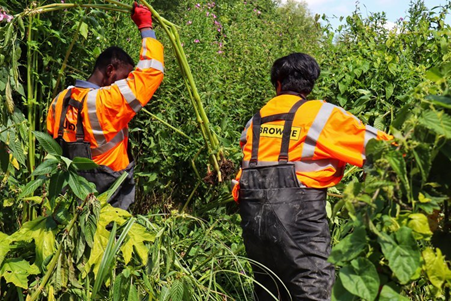 Affinity Water and Browne Volunteers pulling out himalayan balsam on the River Rib