
FAQs
General
- Set up a site compound and car park
- Installed access off Shonks Mill Road
- Constructed of an Artificial Badger Set
- Diverted the Public Right of Way across the site
- Excavated a cofferdam (dry working area) to enable construction of the control structure
- Completed construction of the new control structure
- Excavated a new channel which has now become the new course of the River Roding
- Diverted the river through the new channel and control structure
- Put in two temporary river crossings (over the old River Roding channel and the new diverted channel)
- Completed construction of the earth embankment to its full height
- Completed work to an embankment adjacent to the River Roding behind Broadmead Baptist Church, Woodford
What is the River Roding Project?
We are building a flood storage area on the River Roding just North of the M25 at Shonks Mill Bridge. This will reduce the risk of flooding to over 1,400 residential properties in Woodford and Ilford, as well as reducing the risk to commercial properties and infrastructure (including the M11).
The project has also refurbished an existing flood embankment in Woodford to make sure it can withstand the estimated impacts of climate change.
What stage is the project currently at?
On 21 March 2024 we formally entered the construction contract for The River Roding Project (TRRP) with our delivery partners, BAM Nuttall. Site mobilisation and setup started on 22 April 2024, with the permanent construction works starting on 10 June 2024.
Since June 2024, BAM have undertaken the following key activities:
What approvals does the project have in place?
In July/August 2023, Epping Forest District Council and Brentwood Borough Council granted planning permission for the project.
In November 2023, we received final internal approval for the project through sign-off of the Full Business Case.
How long will the project take to deliver?
Construction started on site in June 2024 and should be complete in 2027. We will update these FAQs and our webpage if the timeframes change.
Flood Risk
Where is at risk of flooding from the River Roding?
There are communities at risk of flooding all along the River Roding, from above where the flood storage area is being built to where it joins the River Thames in Barking. The most serious flood in recent decades occurred in October and November 2000. Over 400 homes in Woodford were flooded, there was widespread disruption to local infrastructure and major roads (including Charlie Browns roundabout) were closed for over a week.
Why is this area at risk of flooding?
During heavy rainfall, the River Roding can exceed its channel capacity and water can spill out into the floodplain. As the river continues to rise, it will start to impact communities by flooding homes, businesses, and infrastructure. The flooding in 2000 was caused by a long, wet winter which saturated the ground. Multiple storms on top of this resulted in the river overtopping its banks.
Will flooding get worse in the future?
Climate change is one of the biggest risks we face – the most recent climate change predictions confirm we will experience wetter winters and drier summers, with an increased likelihood of more intense rainfall likely to lead to flooding. The flood storage area has been designed taking these latest climate change projections into account so that it will mitigate against this risk and make flooding less likely to impact communities in the future.
Project history
- making changes to our river management and maintenance activities
- improving surface water management in Woodford
- reducing the flood risk of the catchment and protecting against climate change related increase in river flows, by creating a large flood storage area near Shonks Mill
How did the project team decide which options to take forward?
The River Roding Strategy was completed in 2012. This strategy identified long-term recommendations for managing flood risk across the whole of the River Roding catchment. The strategy covered the river from its source at Molehill Green in Essex to its tidal limit in Wanstead. It included the major tributaries of the Cripsey Brook and the Loughton Brook. For more information on the strategy recommendations, please see this document: Update_to_the_Roding_Flood_Risk_Management_Strategy_June_2015.pdf (publishing.service.gov.uk).
The strategy split the catchment into 18 flood cells, dependant on their characteristics. We identified options for each cell and carried out a cost-benefit analysis to determine preferred options. The recommendations from the strategy fell into three categories:
The first two recommendations have already been delivered through other projects and initiatives. This project is taking forward the third, to construct the flood storage area near Shonks Mill.
Since approval of the strategy, the scope of this project to construct the flood storage area has increased to include refurbishment of the existing flood defences in Woodford. This is because the continued operation of the existing defences is critical to the successful implementation of the flood storage area. This embankment work was completed in October 2024.
Flood Storage Area
- directing suppliers to access via London Road from the east, rather than the west, to distribute traffic more evenly
- providing suppliers with a route map to guide them effectively
- installing temporary road signs to provide information on alternative routes and ongoing construction activities
What is a flood storage area?
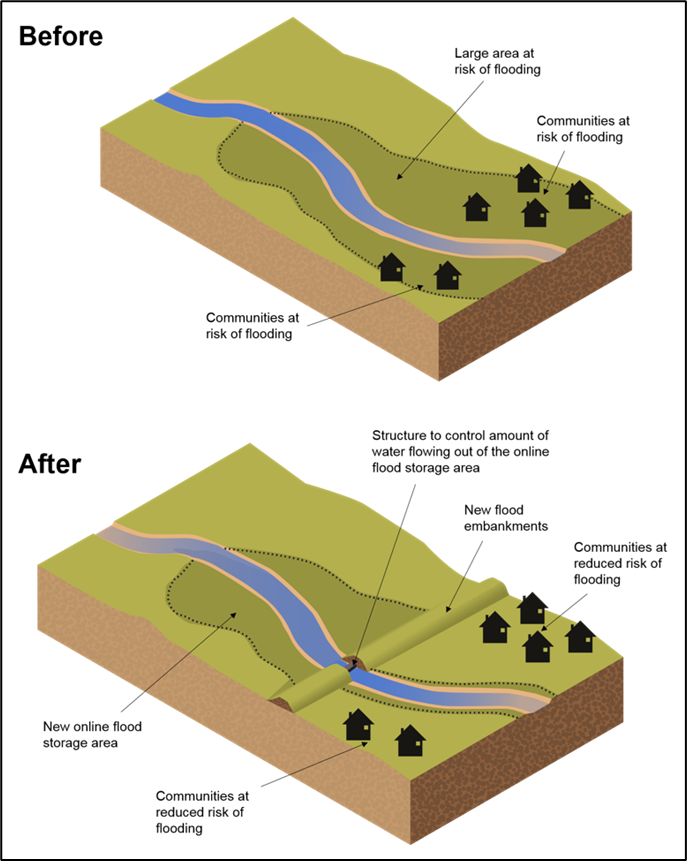
The flood storage area is designed to fill with and hold water at times of heavy rainfall when river levels are high. Flood water will be held behind the impoundment structure (earth embankment) while a controlled flow will be able to pass through the structure reducing the flow downstream. The storage area will consist of an earth embankment to hold back water and a structure to control the flow rate out into the river. By controlling the flow, water is stored upstream to prevent flooding downstream in Woodford and Ilford.
The before and after diagrams below show how a flood storage area works. In times of high flows, flood water is held behind the earth embankment while a controlled flow will be able to pass through the structure, reducing the flow, and extent of flooding downstream.
Where is the site for the flood storage area?
The storage area will be located to the north of Shonks Mill Road in Chipping Ongar, Essex.
How long will construction take?
The construction works for the storage area started in June 2024 and are expected to be completed in 2027. The existing embankment refurbishment works in Woodford took about 4 weeks and were completed in October 2024.
How will the local community be affected by the works?
We will endeavour to limit disruption to the local community in the construction phase. We are using temporary off-road haul roads where possible to minimise traffic impacts to residents. There was a need for temporary road closures at the start of the construction programme so that permanent access to the site could be instated. Now that this access is in place we do not anticipate needing any further road closures.
What is in place to mitigate heavy traffic on side roads?
To alleviate heavy traffic on side roads, we have implemented several measures, including:
Approximately 12,000 vehicle movements are anticipated over the course of the project. This equates to an approximate average of 20 vehicle movements per day, with roughly 30% of these being larger than 3.5 tonnes and 20% larger than 7.5 tonnes (i.e. HGV vehicles). Due to the sequencing of works, the vehicle movements will be distributed over the project, with quiet periods expected during the winter months.
How often will the flood storage area operate?
We expect it to hold water on average once every other year, sometimes more. On these more frequent occasions the storage area will hold back small quantities of water which may only flood a small area. During the less frequent, heavy rainfall events, the amount of water stored will be greater, as will the area covered by flood water.
How big will the waterbody be when it is full?
The flood storage area is designed to hold more than 1,400,000m³ of water during a high-risk flood event, flooding an area of 1,016,260m² behind the embankment. That’s the equivalent of 560 Olympic swimming pools of water covering 94 full sized football pitches in area.
How long will water be held in the flood storage area for?
This will vary depending on the volume of water held (impounded) behind the embankment. For a small, lower size flood event this will only be a few hours, but it could be up to as much as 48 hours for a larger size flood event. Once the river levels drop downstream, water will drain from the storage area into the river below the embankment.
Where is the access route into the flood storage area?
There are 2 access points created to the site. Primary access is from the west, off Shonks Mill Road. There is a secondary access, from the east through a field gate from Shonks Mill Road, but this will only be utilised if the primary access is blocked. Both access routes are shared access with the landowners.
Where will you get the material to create the embankment?
The material for the embankment will be excavated and brought in from a nearby field so that it doesn’t need to be transported by road from another location.
How big will the embankment be?
The earth embankment will be 570 metres long and approximately 4 metres high at its highest point.
What impacts will the flood storage area have upstream?
The area upstream of Shonks Mill Bridge is prone to regular flooding in the existing situation. The fields that flood currently will become the formal flood storage area and be flooded in a controlled manor through use of the embankment and associated control structure. The route of the River Roding has been altered as a part of the project (it was diverted on 11 September 2025). Instead of it being a very straight channel, a section has been improved to a more natural channel and a wetland area has been created in the fields upstream of Shonks Mill Road.
There are two properties on London Road that will be at increased flood risk because of the flood storage area. To comply with government policy, we need to mitigate this increased risk. We have worked with the impacted landowner to agree a preferred option. Outline planning permission is in place to demolish and rebuild these two properties 'like for like' in an area that is not at increased risk within the same land ownership off London Road.
How much will flood risk be reduced downstream?
The flood storage area will reduce the risk of flooding to over 1,400 residential properties in Woodford and Ilford. It will also reduce the risk of flooding to businesses and infrastructure, including the M11. The storage area will also help the area be more resilient to any increased flood risk resulting from future climate change.
Why is type 1 aggregate chosen over grasscrete for the haul roads?
The decision to use type 1 aggregate over grasscrete for the haul roads was primarily driven by cost considerations and sustainability. Type 1 aggregate offers a cost-effective solution while also minimising carbon footprint compared to grasscrete.
Will there be downstream impacts during the works?
We are committed to monitoring downstream areas to prevent the release of silt or other materials resulting from our construction activities. Compliance with our Flood Risk Activity Permit requires monitoring to safeguard watercourses and ecosystems downstream.
Environment and Wildlife
- Badgers - relocating the site haul road, closing set entrances and installing an artificial badger set
- Kingfishers - working outside of an exclusion zone and clearing vegetation to encourage the birds to nest elsewhere ahead of the following nesting seasons
- Sky Larks - relocating the site haul road, use of acoustic barriers to avoid disturbance and clearing vegetation to encourage the birds to nest away from the works ahead of the following nesting seasons
- Great Crested Newts: undertook additional surveys, worked outside of an exclusion zone and secured a District Level Licence from Natural England
- Hobby: sourced material offsite in 2024 due to the location of a nest and exclusion zone, continued monitoring, specific advice from Natural England for this species, installing artificial nests ahead of the following nesting seasons
- Little Ringed Plover: adjusted the scheduled work to avoid disturbance to nests and working around an exclusion zone
How will we take current wildlife into account?
We have undertaken ecological surveys of the site as part of the environmental work for the project. We have prepared suitable protection and mitigation measures within the design and throughout our construction programme. This includes ecological surveys for protected and invasive non-native species.
Qualified ecologists have carried out all the surveys. The results helped to inform and shape the design process and were submitted as part of our planning application. In particular, the landscape plans include the creation of new wetland features and habitats within the site.
We have an Environmental Action Plan in place which will be updated throughout the works, with an Ecological Clerk of Works (ECoW) appointed to ensure that work on site does not harm the environment or local wildlife.
Throughout the first two years of the construction programme, the ECoW has been present on site and as a result the project has been able to identify and work closely with the ecology on site. This has included:
Will there be any environmental improvements?
The River Roding in the Shonks Mill area was an artificially straightened channel. Our project has created a more natural channel running through the flood storage area including river features such as riffles, pools and backwater areas, which will enhance and diversify the habitat types here.
The project has also created a wetland area comprised of ponds and scrapes connected to the new river channel along with marginal shelves and lower lying areas to be colonised by reeds and marginal plants. Additionally, a large area of arable land will be converted to grassland habitat.
Engagement and consultation
How have you communicated with others?
The project team have carried out engagement and consultation with local communities and stakeholders throughout the project, from development of the strategy in 2012 through to the current work to specifically engage on delivery of the flood storage area.
This has been through a mixture of local drop-ins, newsletters, virtual meetings, community events and specific meetings with key stakeholders. We engaged thoroughly with the local councils who granted planning permission and we continue to have conversations regularly with local landowners who will be affected by construction of the flood storage area.
We held a virtual meeting in early 2024 with the communities who will be most affected by the construction to introduce them to our contractors and answer any questions they had about the works.
Where can I go to find out more information?
We have had a project webpage available since before construction began and this gets updated every 3-4 months. In July 2025 we launched this updated webpage on a new platform, and this is where we will provide updates going forwards. General queries should be directed to the project team using the contact details on this webpage.
How can I ask questions during construction?
There are site signs at the access points to the construction site, with specific contact details for any questions about the construction site specifically.
General queries about the project should be directed to the project team using the contact details on our webpage.
Will you be holding any more engagement events?
Yes. We will provide details of these on our project webpage and inform our mailing list once they have been arranged. We will also provide briefing notes for events which others organise (the London Borough of Redbridge, for example).
If you would like to receive direct invites to relevant events and project updates and aren’t already on our mailing list please contact us through this webpage, or via the contact details on the front page.
Maintenance
What existing maintenance work is carried out in the area to reduce flood risk?
Environment Agency maintained structures are regularly inspected, tested and repaired where required. We also do routine maintenance here.
We inspect all flood defence assets and contact 3rd party owners if required.
We do some vegetation removal to maintain the river flow in key areas where we can. If something poses an immediate flood risk we will take action where possible and if resource allows.
Who will look after the storage area?
The Environment Agency will maintain the embankment and flow control structure. We will carry out routine maintenance such as blockage clearance and grass cutting and carry out regular inspections on all parts of the structure by ourselves and 3rd party engineers. Either us or our contractors will complete any maintenance or repairs required.
Who will be responsible for looking after the watercourse?
The landowner will be responsible for maintaining their section of watercourse.
The Water Resources Act 1991 grants statutory powers to the Environment Agency to maintain Main Rivers for reduction of flood risk (sections 169 to 172), irrespective of channel ownership. These powers are discretionary and are exercised according to resources available and the flood risk pertaining in any locality. The legal duty to maintain a watercourse rests with the Riparian Owner (normally the owner of the land adjacent to the watercourse) irrespective of whether the Environment Agency chooses to undertake works.
The following link has information about owning a watercourse - Owning a watercourse - GOV.UK (www.gov.uk).
Why don’t you dredge the river?
We do not currently schedule any regular dredging maintenance on the River Roding or its tributaries and there are currently no plans for this position to change. We will always consider using our powers to complete maintenance on main rivers, but we exercise these powers according to resources available and the flood risk in any locality. Dredging is a complex maintenance activity that is difficult to evidence from a flood risk perspective. It is also usually very resource/cost intensive, not to mention the negative environmental impacts.
Dredging can, and does, contribute to reducing flooding in some locations and we assess each situation individually. Where there is evidence that dredging will reduce flood risk to local properties without increasing flooding downstream, it meets government criteria, and is cost effective, we will do it.
In some locations and circumstances, dredging would not be an efficient or effective way to manage flood risk and therefore not the best long term or economic solution compared with other flood risk measures such as building walls or providing storage upstream. Any structures in the river such as bridges and natural features need to be considered, as these pinch points can make dredging ineffective. We also need to consider the potential of any flood management activity to transfer flood risk to other communities, which our schemes and activities should not do.
Funding
How is the project being funded?
There is information available about how our projects to manage flood risk are funded, and how we seek contributions from different sources to ensure that a project can go ahead: Partnership funding for FCERM projects - GOV.UK (www.gov.uk)
The River Roding project is funded through a combination of the following:
Flood and Coastal Erosion Risk Management Grant in Aid (FCERM GiA)
Any project to manage flooding, where the benefits are greater than costs can qualify for a contribution from FCERM GiA funding. The amount depends on the benefits and the outcomes of the project. The River Roding project has a set amount of FCERM GiA funding and then the rest of the costs are funded through other contributions as outlined below.
Local Levy
Regional Flood and Coastal Committees (RFCC), in this case the Thames RFCC are responsible for administering Local Levy funding across the capital programme. The River Roding project is supported by the Thames RFCC and Local Levy is being utilised to help fund the project.
National Highways
National Highways are a partner in the project, and putting a financial contribution towards its delivery due to the benefit it is providing to their infrastructure – the M11 in Woodford.
London Borough of Redbridge
The London Borough of Redbridge are a partner in the project, and putting a financial contribution towards its delivery due to the benefit it is providing to communities, businesses, and infrastructure in the borough (Woodford and Ilford).
Department for Education
Where benefit can be demonstrated to school infrastructure from projects to reduce flood risk, the DfE are able to financially contribute. The River Roding project has been able to demonstrate this benefit, and the DfE are therefore contributing towards its delivery.
Deprived Communities Fund
There is an inequality in terms of social deprivation and flood risk exposure from all sources of flooding. When developing our projects to manage flood risk, the level of deprivation in an area is therefore one of the indicators which is considered. This specific fund has provided a contribution towards the project due to the levels of deprivation in some of the benefiting areas of Woodford and Ilford.
Other FAQs
Are public routes/cycleways to be maintained in the same position? Through the build? On completion?
We have diverted the public right of way which runs across the site to its new route. This is because it needed to be re-routed around the embankment to accommodate the flood storage area. Access to the public right of way will be maintained through the construction phase wherever possible and appropriate signage is in place.
General flooding advice
Who should I contact in an emergency if my property is about to be flooded or is flooded?
If you or your family are in immediate danger, then you should dial 999.
If there is no immediate danger to life, but your property is flooding and you need help then you should call Redbridge Council on 0208 554 5000, Epping Forest District Council on 01992 564000 or Essex County Council on 0345 603 7631.
If the flooding is as a result of an overflowing sewer then you should call Thames Water on 0800 316 9800.
If the flooding is as a result of flooding from a river, then you should report it to the Environment Agency’s incident hotline number on 0800 80 70 60.
There is also some useful information available at the following links:
Environment Agency: https://www.gov.uk/help-during-flood
National Flood Forum: https://www.nationalfloodforum.org.uk/site-pages/during-a-flood
Epping Forest: Flooding - Epping Forest District Council (eppingforestdc.gov.uk)
Brentwood: Flooding | Brentwood Council
Essex County Council: Essex Flood and Water Management
Redbridge: https://www.redbridge.gov.uk/crime-and-public-safety/crime-prevention-advice/flooding/flood-advice
How do I sign up for flood warnings?
To sign up for flood warnings please visit the Environment Agency website: https://www.gov.uk/sign-up-for-flood-warnings or call Floodline on 0345 988 1188.
If I’m affected by flooding, will I still be able to get insurance?
The provision of insurance is a matter for the insurance industry, so we cannot confirm this.
We provide the best available information on flood risk to the insurance industry in line with Government requirements. The insurance companies should not use our information alone to decide insurance premiums, they use it as a first stage to assess the flood risk at a particular location. They also use their own tools to assess flood risk. Although we provide them with our National Flood Risk Assessment (NaFRA) data, they use this in conjunction with their own information to assess flood risk, and thus determine insurance premiums for an area.
You may consider contacting the Association of British Insurers for further information regarding insurance and possible methods of reducing your flood risk online at https://www.abi.org.uk/products-and-issues/topics-and-issues/flooding/
Flood Re is an organisation set up by the Government and the Insurance industry dedicated to helping insurers help householders at risk of flooding have access to affordable cover- visit www.floodre.co.uk for more information.
If you are finding it difficult to get your property insured, you can get advice from the National Flood Forum www.nationalfloodforum.org.uk.
How do I report flooding?
Please use the contact details above to contact the relevant organisation in an emergency. However, it is important that flooding is reported to the relevant organisations after it has happened so that it can be properly recorded and action taken where relevant.
For river flooding please contact the Environment Agency’s 24 hour Freephone Incident Hotline on 0800 80 70 60.
After an event where there has been significant flooding (internal property flooding), the Lead Local Flood Authority have a duty to undertake a Flood Investigation so please report it to them. This will be either Redbridge Council, or Essex County Council depending on your location:
Redbridge Council: Redbridge: Flooding/blocked drain
Essex County Council: Report a flood (essex.gov.uk)
There is also some useful information on Epping Forest Council’s website: Flooding - Epping Forest District Council (eppingforestdc.gov.uk) and Brentwood Council’s website: Flooding | Brentwood Council
It is also important, if you have been flooded from a public sewer to complete Thames Water's sewer flooding questionnaire on their website and return it to them at the address on the form: Sewer flooding questionnaire