Important Consultation Information
Workshops and research projects involving stakeholders and specialist groups.
Research led by JBA on hazard classification and safety management practices.
Further development by Mott MacDonald focusing on reservoir safety management practices.
Approval required by leads of the four organisations leading the programme
Submission to Defra and Welsh Government Ministers
Cabinet Committee approval
Final timing for public consultation agreed by Number 10 (subject to government priorities).
Background information
Detailed proposals
Specific questions for public feedback
Summarise the responses received
Highlight the main issues raised
Set out any decisions made and the next steps
- Reservoir owners and operators are responsible for the safety of their reservoirs. They must appoint engineers from the reservoir engineer panels to inspect their reservoirs and they must act on the engineer’s recommendations.
- Reservoir panel engineers are appointed to supervise and inspect the construction and operation of reservoirs.
- The Environment Agency manages and enforces reservoir safety regulation in England.
Consultation Process
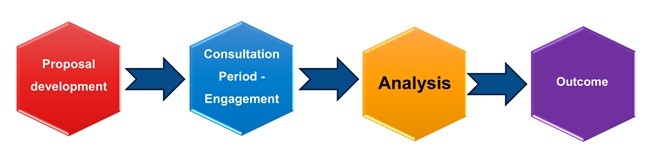
Public Consultation 1 Process
Developing these reservoir safety reform proposals has been a complex and challenging process, requiring significant effort and careful consideration. This reflects the importance of the reforms.
Stage 1 - Proposal Development
This began with the Independent Reservoir Safety Review, which set out a series of recommendations to strengthen reservoir safety standards.
Over the past two to three years, we carried out extensive work to develop these recommendations into practical proposals, including:
Stage 2 - Consultation Period/Document Approvals
We put together the proposals into a draft document for public consultation. This document then goes through an approvals process.
Stage 2 - Engagement
Once approved, the consultation document will be published online and will include:
The consultation will be hosted on Defra’s Citizen Space page where a Welsh translation will also be available.
Everyone with an interest will be invited to respond. The consultation will remain open for 8 weeks.
During the consultation period we will offer webinars to help support and facilitate people’s consultation responses. These will provide an opportunity to ask questions around the consultation content.
Stage 3 - Analysis
After the consultation closes, all responses will be carefully reviewed and considered before any decisions are made. Key themes, concerns and suggestions will also be identified.
This stage may take several weeks and is subject to wider government priorities, such as restrictions during local and Welsh government elections.
Stage 4 - Outcome
Within 12 weeks of the consultation closing, a summary report will be published on the consultation page. This report will:
Looking ahead
It is difficult to predict how long it will be before any changes are implemented. There will be further work after this consultation to revise and develop the proposals further, draft new legislation and make plans for transition and implementation. The further into the future we look, the more assumptions we have to make. There are also factors outside of our control, such as the Cunliffe Report and wider government priorities, which may affect progress.
In the meantime, it’s important to note that the current reservoir safety regulatory system will continue to apply for some time to come.
Any reforms will only come into effect once consultations are complete, new legislation has passed through Parliament and been brought into force. These changes will be phased in gradually, with notice provided.
Roles and Responsibilities for Reservoir Safety Regulation in England
Responsibilities for reservoir safety regulation are divided between the following three groups:
The proposed reforms will not change this overall three-way approach, but they will introduce some changes that will affect all three groups if implemented.
Research Studies
Check out the report for Improving Probable Maximum Precipitation and Probable Maximum Flood for Reservoir Safety on GOV.UK by the Flood and Coastal Erosion Risk Management Research and Development Programme
The Environment Agency has published the refreshed Reservoir safety research strategy - 2026 - GOV.UK along with a supporting evidence report. The strategy sets out the strategic direction for reservoir safety research and explains the evidence used to identify priority research areas. It will help focus research on the topics that can have the greatest impact on improving reservoir safety, informing guidance and advancing understanding of key topics, strengthening the evidence base for future decision-making.
The agency encourages any organisation looking to undertake reservoir safety research, to use the strategy to support an industry-wide approach to improving the evidence to better understand, manage, operate and make decisions on dams and reservoirs