
Background information and the need for the Strategy
View FAQs
South Bridge in Far Cotton where the ‘Northampton Arm’ of the Grand Union Canal joins the river, and where ‘Lock 17’ is located (indicated by the red square); and
Downstream of Peterborough, where the river splits into two courses;
up to Stanground Lock and Stanground Sluice on the original course (indicated by the red circle); and
up to the last structure on the new course which is the Dog in a Doublet Lock (indicated by the red triangle).
3: good health and wellbeing;
6: clean water and sanitation;
11: sustainable cities and communities;
13: climate action – carbon reduction;
14: life below water – biodiversity net gain; and
15: life on land – biodiversity net gain.
Farmers - to support environmentally friendly farming.
The Government - to develop future laws and policy that will drive better water quality.
Non-governmental organisations - to protect and restore water environments under threat.
Improve river channels, and therefore facilitate greater access to blue spaces which support physical, psychological and social health.
Encourage more active travel, which will improve individuals’ physical and mental health, and reduce demand on the healthcare system.
Create a sense of social belonging through encouraging community use of outdoor spaces.
Develop safer access to green spaces, which help to mitigate noise pollution and poor air quality1, and encourage communities to connect with nature.
Increase the quantity of recreational activities such as boat clubs and paddle sports, as well as angling which provide therapeutic benefits and positive impacts on physical and mental health
What is the catchment area of the Nene Water Management Strategy?
The scope of the Strategy is an 88km stretch, running from Northampton to the Whittlesey Washes, as shown on the diagram below.
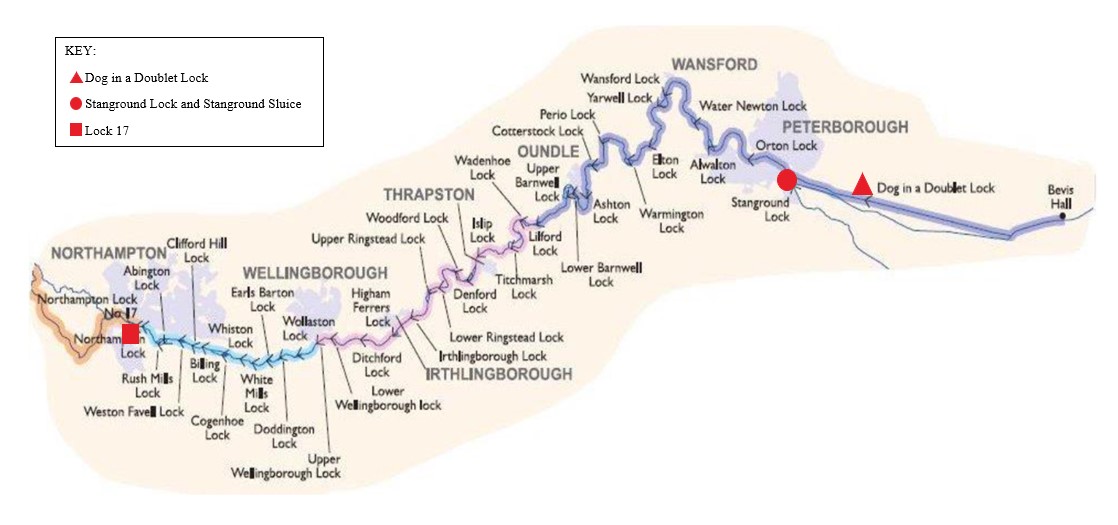
The Environment Agency is the statutory navigation authority for the stretch of the River Nene between:
What flood resilience benefits will the Nene Water Management Strategy deliver?
We have a long-term commitment to developing flood resilience in the River Nene catchment area. As part of this, we operate structures across the River Nene catchment which provide flood risk management benefits. Some of the most critical structures are those in and around the Northampton Washlands and the Whittlesey Washes.
One aim of the Strategy is to ensure that flood resilience is managed in accordance with the latest Government policy and guidance. The benefits that the Strategy will have on flood resilience in the catchment will be explored through a benefits assessment, stakeholder consultation, and through building on earlier reports and work with our partners.
What environment and biodiversity benefits will the Nene Water Management Strategy aim to bring?
The Environment Agency has a duty to protect and enhance the environment and biodiversity, which we will fulfil as part of the Strategy.
The benefits that the Strategy will have on the environment and biodiversity will be explored through a benefits assessment, stakeholder consultation, and through building on earlier reports and existing work with our environmental partners.
How will the Nene Water Management Strategy consider sustainability?
The Strategy will contribute to multiple United Nations’ Sustainable Development Goals (SDGs), including the following:
In due course, we will develop a Sustainability Plan for the Strategy which will outline our commitments, how we will achieve them, and monitor our progress. Delivery of the Sustainability Plan will contribute to the Environment Agency’s target to reach net zero by 2045 to 2050, and in doing so, will benefit the community and environment, and support the Government’s ambition for a net zero nation by 2050.
What impact will the Nene Water Management Strategy have on navigation channels?
We, as the Navigation Authority, have a duty to maintain water levels for navigation purposes, to allow boaters and other waterway users to use the waterways safely. This is currently achieved by using locks (which also allow for the passage of boats), and wider collections of structures that manage water levels (i.e., locks, sluices, and weirs). The Strategy will therefore maintain navigation capabilities along the River Nene.
What benefits will the Nene Water Management Strategy have on the abstraction of drinking water, and water for business, industry, and agriculture?
The Strategy seeks to ensure there is clean and plentiful water available in the catchment, both now and in the future. To do this, the Strategy will involve collaboration with the following stakeholders:
The benefits that the Strategy will have on water resources in the catchment will be explored through a benefits assessment, stakeholder consultation, and through building on earlier reports.
How are you considering individuals’ health and wellbeing within the Nene Water Management Strategy?
The River Nene already supports the health and wellbeing of local people and tourists, who use it for travel and recreation. Our Public Health and Wellbeing team will be involved in development of the Strategy and will work with stakeholders to inform how it can further support health and wellbeing.
The Strategy could identify new opportunities to deliver the following benefits:
How will the Nene Water Management Strategy impact the local economy and businesses?
A significant amount of economic growth is envisaged in the Strategy’s catchment area in the coming years. There will be a particular focus on key industries, including: logistics, tourism, renewable, low carbon energy and sustainable technologies, and high-performance technologies. There is also an aspiration to significantly increase the number of jobs within the catchment area, and provision for 76 hectares of employment land in the eastern area.
The Strategy will seek to support these growth aspirations through making important contributions to water resources, amenity and tourism levels.
What flooding has occurred within the River Nene catchment in the past?
There is a history of flooding associated with the River Nene. This includes a significant flood in April 1998. In Northampton this affected more than 2,000 homes and businesses, and sadly, resulted in two deaths. Other towns, including Thrapston and Wellingborough were also badly affected along with isolated properties and mills in the Nene valley.
Significant surface water flooding occurred in the Far Cotton area of Northampton in May 2018 following an intense rain and thunderstorm.
Widespread flooding occurred across Northamptonshire in December 2020.This event saw river levels in Northampton reach record highs, affecting 170 homes and businesses.
In November 2024 significant heavy rainfall (associated with Storm Bert) caused water levels in the River Nene to rise. At its peak, the flow through Northampton was comparable to the flood of 1998. This resulted in flooding to some homes and impacts to transport networks across Northamptonshire.
How do the existing structures along the River Nene protect the area from flooding?
Structures such as locks, sluice gates and tilting weirs, are used to help to manage water levels, and therefore, can reduce the risk of flooding.
However, once flood water exceeds a certain threshold (i.e. when water flows out of the bank, which may vary depending on the location), unfortunately, structures can no longer have a significant effect on reducing the risk of flooding.