
Lower Witham Flood Resilience Project background
What area does the Lower Witham Flood Resilience Project cover?
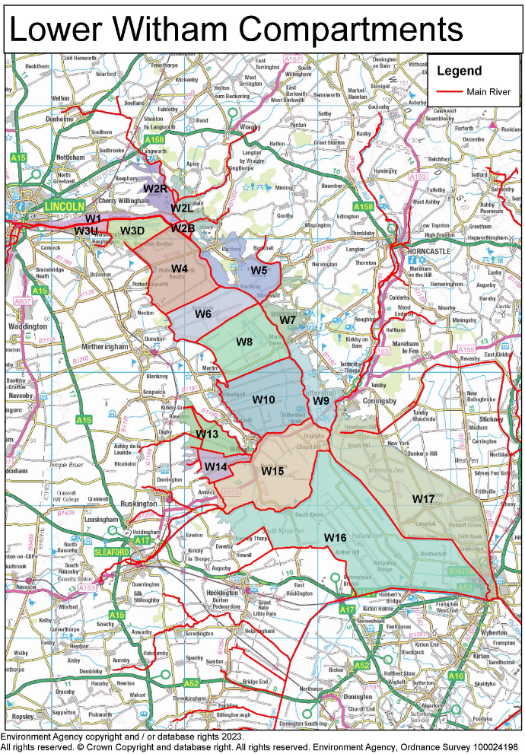
This project runs from Stamp End in Lincoln to Grand Sluice in Boston including tributaries of the Witham like the Carr Dyke and Delphs, the Barlings Eau, Snakeholme Drain, Duckpool Catchwater, Billinghay Skirth, and the Kyme Eau. For us to understand the flood risk on the Lower Witham, the area has been divided into a series of flood compartments. These are areas that will flood independently of each other due to the presence of the embanked watercourses or higher ground. Breaking down the catchment allows us to look at what is at risk in each compartment and understand which structures work together to protect the compartments. |
 |
Why is the project needed?
The Lower River Witham Fens is a large area of drained fenland between Lincoln and Boston. Throughout history embankments have been created alongside watercourses, and drainage works undertaken. These works have made the surrounding land highly productive for farming and allowed communities to develop.
Some of these embankments are now over 200 years old. The extent and frequency of flood incidents is putting these structures under increased pressure, and the local community and economy at risk.
In 1997, the Lower Witham Strategy recommended reinforcement of key embankments, whilst allowing some areas to flood, to relieve the pressure on the system. Since then, 30km of embankments have been reinforced, but repeated high flows have damaged more. The recommended storage options have not been implemented, due to availability of suitable sites and difficulties in meeting HM Treasury funding rules of the time.
Flooding in 2019, and again during Storms Babet and Henk in the winter of 2023/24, has highlighted the need to update the long-term plan to manage flood risk in the area.
Project phases
The project is taking a parallel approach. This is to repair and reinforce the most critical structures in the short term, sustaining the current arrangements for managing flood risk. At the same time, we're working on a longer-term plan to help the area adapt to the challenges of a changing climate. It is recognised that changes to the way that we currently manage flood risk will take longer to agree and implement, and we want to ensure that structures will last until new arrangements are in place.
The timeline below shows the different project phases. You can find out more about the background of each project on the side bar of the main page. We'll keep you up to date on the latest project news and progress in Project Updates section.
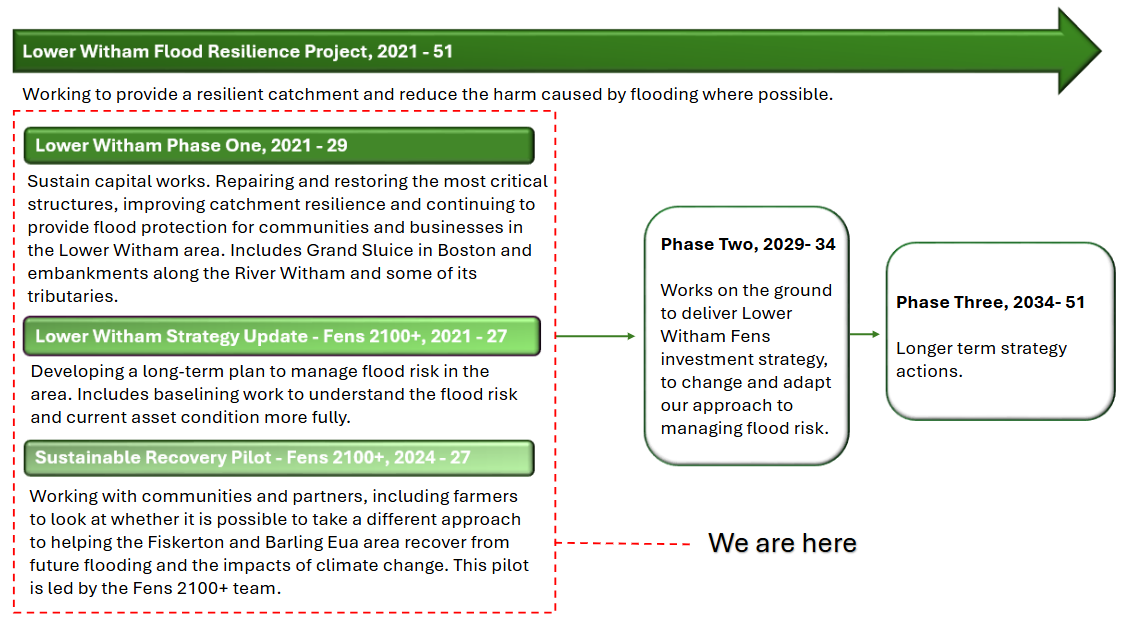
An accessible version of this timeline can be found in our Photos section on the side bar of the main page.
What have we been doing?
The project has undertaken an intensive collection, review and analysis of technical data such as hydraulic modelling, structure assessments of current banks, environmental and benefits assessments.
What's coming up?
Works have now started on repairing and reinforcing critical structures. Grand Sluice in Boston and embankments along the River Witham and some of its tributaries are flood defences currently included in Phase One.
Who is involved in the project?
The Environment Agency are working with Arup and Jackson Civil Engineering Ltd. to deliver this project. Working with local stakeholders, we aim to utilise the community’s local knowledge and aspirations for the area to develop a sustainable flood management plan with the long-term goal of improving resilience to future flooding.
What environment and biodiversity benefits will the Lower Flood Resilience Flood Project aim to bring?
The Environment Agency is required by law to mitigate for any habitat loss that occurs because of our works to provide flood defences. As well as replacing what is lost, where our works involve us applying for planning permission, we must now also provide an additional 10% more biodiversity. This means a development will result in more or better-quality natural habitat than there was before the development.
We have recently been able to purchase and complete on two land holdings that had come to the market within the Lower Witham Fens. These two sites have been purchased primarily to provide habitat mitigation for the capital works taking place under the 'Lower Witham Flood Resilience Project - Phase One'. They may also provide statutory biodiversity net gain for future phases of the Lower Witham Flood Resilience Project.