
Flood Defence Assets (Environment Agency)
Our Flood Defences - how do they affect flooding?
- Flood storage reservoirs: The Environment Agency is responsible for six flood storage reservoirs in Leicestershire which are located on tributaries that feed into the River Soar.
- Dakyn Road (Willowbrook Park, Thurnby). Which holds 123,000m3 (cubic metres) of water = 49 Olympic swimming pools, at full capacity. Granting flood protection to 2,372 properties.
- Knighton Park. It holds a combined total of 77,400m3 of water = 31 Olympic swimming pools, at full capacity across it's 4 separate storage cells. Helping to protect 397 properties.
- Braunstone Park. This holds up to 55,100m3 of water = 20 Olympic swimming pools, when full. Providing protection to 572 properties.
- Tilting Gate (Knighton Fields Road West): The structure was designed and constructed by Leicester City Council Engineers between 1970 & 71 to reduce the risk of flooding to properties from the Saffron (or Wash) Brook. Since 2008 it has been operated and maintained by the Environment Agency. Under normal conditions the gate is closed (up).
Just prior to the onset of flood conditions a displacer system lowers the tilting gate open (down) allowing flood water to flow through the additional and culverted flood relief channel, thereby lowering water levels downstream of the gate structure in the main channel and preventing property and infrastructure flooding. - Other gates:
- saturated or frozen ground preventing infiltration
- rain falling on snow (this typically also melts the snow vastly increasing water levels)
- intense rainfall exceeding soil infiltration rates etc.
- droughts - perhaps counterintuitively, during droughts soils become hard and compact and cannot absorb water. It can take a long time after a drought for soils to return to their usual absorption rates.
- wildfires - these can cause soils to become hydrophobic (water-repellent) by heating and burning the organic matter on the soil's surface, which releases waxy, organic compounds that coat the soil particles as the area cools. Preventing water from infiltrating.
- the addition of man-made impermeable surfaces - concrete/tarmac, buildings etc., as well as an increase in drainage pipes, that carry rainwater to stream/river channels much more quickly.
Flood Defence Map
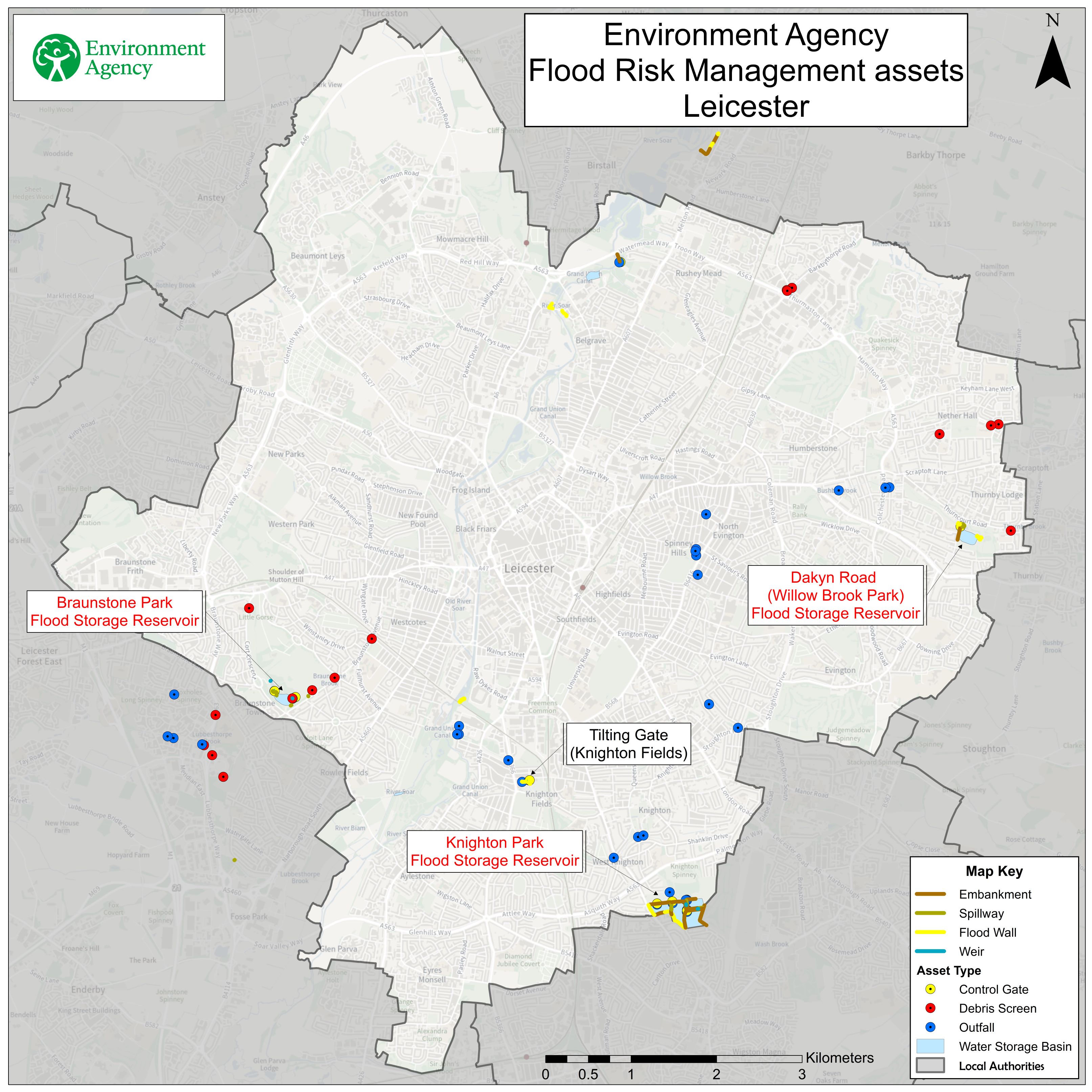
Map of EA flood defences
You can also visit Asset Information and Maintenance Programme to see an interactive map. Once you've zoomed in to Leicester, the assets should appear (they're all in blue and look like a river map). You can then click on them to see what they are, and filter in the top right between all assets and EA maintained assets.
To see the Leicester City Council flood defence assets, visit Aurora, and on the panel on the left, tick the 'flood risk assets' box and the '+' symbol box. You can click on the assets on the map to see their details.
Flood Defence assets that alter river flow
These reservoirs store flood water during flood events until they are full, at which point they will continue to hold water until river levels are low enough for it to be released safely. If river levels are very high for a long duration, the reservoirs may exceed their capacity (as some did during January 2025). Under these circumstances, they will overtop and this excess floodwater will flow downstream, which would have occurred naturally if the reservoirs were not present. They therefore only alleviate flooding and do not contribute to flooding downstream.
Three of these are located on tributaries/sub-tributaries of the River Soar downstream of Leicester City and therefore have no impact on river levels in the city.
The other three are located within Leicester City, also on tributaries of the Soar. These were built following the extensive flooding of Leicester in July 1968. The EA took over responsibility for their maintenance in 2006/2007. They are:
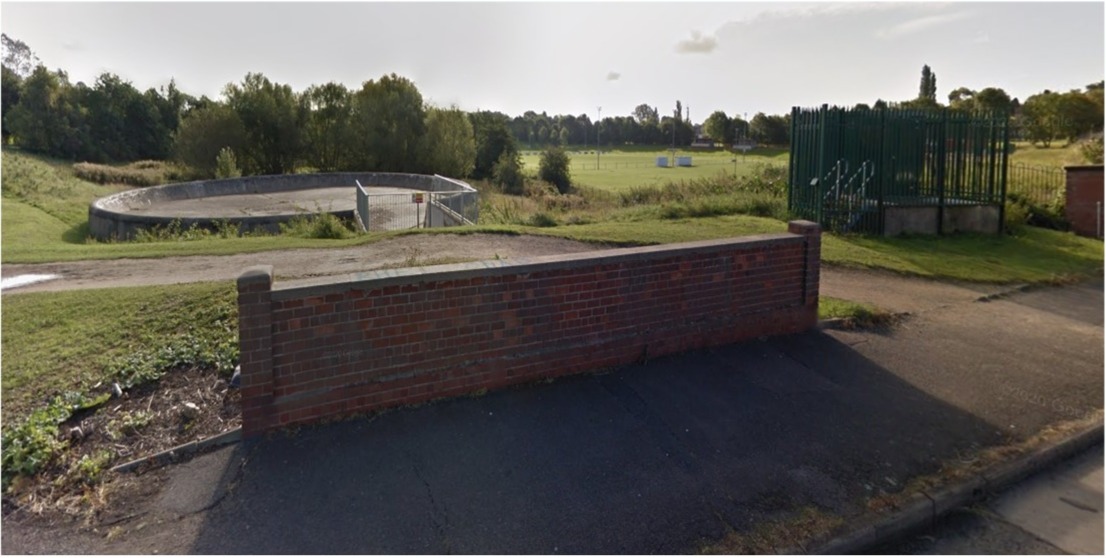 | 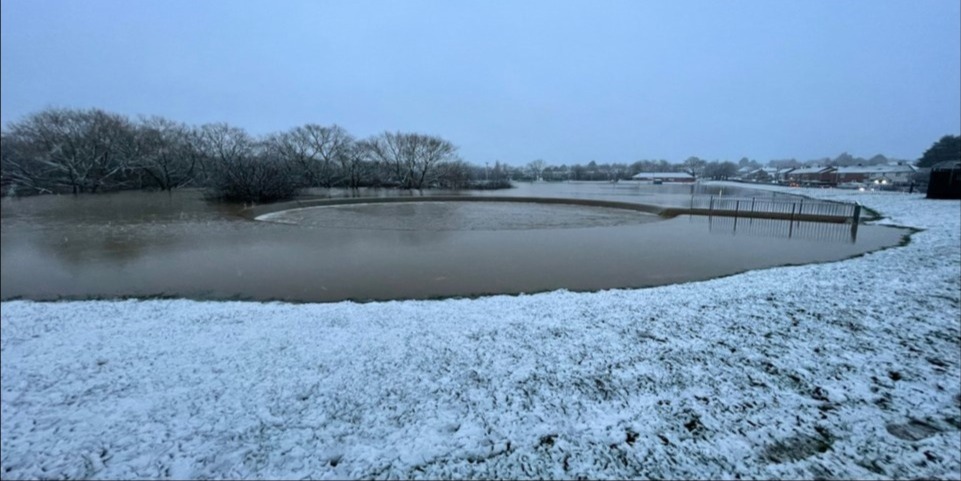 |
| Dakyn Road (Willowbrook Park) Flood Storage Reservoir - Empty, with circular spillway visible. | Dakyn Road (Willowbrook Park) Flood Storage Reservoir - Full, with water flowing into circular spillway (Monday 6th January 2025, 08:20hrs) |
The amount the gate lowers is dictated by the flow immediately upstream in the main channel, if these levels begin to rise above a set threshold the gate will lower further to allow more water through the additional flood relief channel, thereby modulating water levels in the main channel to keep them within safe bounds.
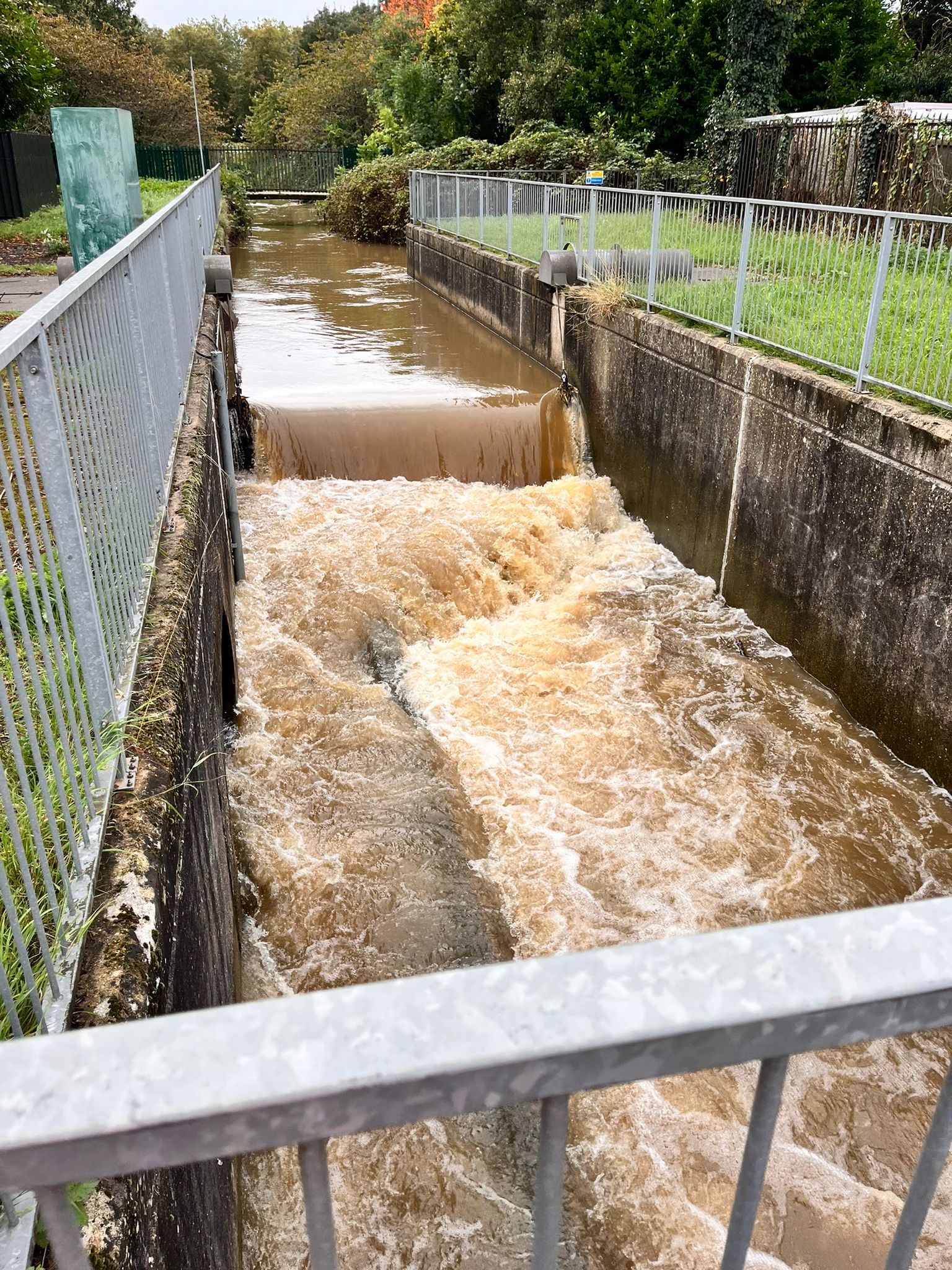
Tilting Gate at Knighton Fields, partially lowered during a high flow event to allow water through the flood relief channel. The main channel itself veers off at 90° just upstream of the gate, at the end of the concrete channel wall.
The Environment Agency is responsible for a number of other gates downstream of Leicester City on the Soar/Trent. These also only serve to alleviate flooding but unfortunately are too far downstream to provide any benefit to Leicester City.
Canal Lock Gates. There are many canal locks located in and up/downstream of Leicester on the interconnected River Soar and Grand Union Canal. By design, both pairs of gates in a lock cannot be open simultaneously as any flow would force them shut. These are owned and maintained by the Canal and River Trust.
The Environment Agency and the Canal and River Trust are also responsible for several small manual penstocks and/or stop logs on the River Soar within Leicester. These are located adjacent to weirs and are only ever opened (or in the case of stoplogs removed/installed) on rare occasions during low levels in summer, for the purpose of weir maintenance/repair.
Flood Gates - are they responsible for flooding?
It is extremely common for Risk Management Authorities to be asked about the possible opening/closing of gates as a cause of flooding, and this is equally prevalent in areas where no gates exist. These questions are considered to be a natural response to what is often the rapid rise and fall of river levels during flood events - "as if someone pulled a plug out or opened a gate"
The flooding of January 2025 was no exception, as the saturated and frozen ground led to rainfall and snowmelt running off normally permeable surfaces and rapidly entering the watercourses, leading to levels rising very quickly.
We have included the above map and descriptions of all our assets that alter river flow, gates or otherwise, to hopefully make it clear that none of our assets are responsible for causing flooding, but rather only serve to reduce it.
To further this point, when the EA designs a new Flood Defence asset, it is not allowed to worsen the flooding at even one property, regardless if it protects hundreds or thousands of others.
To our knowledge there are no gates or flood risk management assets owned by us (or anyone else), present in or near Leicester, that cause or contribute to flooding.
Why do river levels sometimes rise and/or fall rapidly?
Causes of rapid changes in river levels:
1. The majority of rainfall runs off the ground surface during a rainfall event
This results in water entering watercourses very quickly, causing levels to rise rapidly. Once the rain stops, levels drop very quickly, as the taps have essentially been turned off.
By contrast if the majority of rainfall is absorbed by the ground/soil to become groundwater/through-flow it will take much longer - typically hours to days, depending on where it fell, to enter the channel. Therefore water levels rise and fall much more gradually, rather than in a short sharp spike.
High amounts of run-off can result from the following factors:
2. High water levels in a nearby larger watercourse.
Water from a larger water course tends to back up its smaller tributaries while simultaneously preventing water that is flowing down the smaller tributaries from escaping. Water levels may or may not rise quickly in this scenario, but will likely plateau (remain high) for a period of time. Then as soon as the water levels in the larger watercourse start falling, they will rapidly drop in the smaller watercourses, as the water is no longer held back.
3. Bottlenecks (a narrowing of a watercourse channel, restricting flow) and/or flat floodplains.
The former are very common under bridges, but come in many different forms (it would be unusual if a watercourse maintained the exact same dimensions along it's whole length).
During a large event the flow within a watercourse may exceed the channel capacity, and spill out of the channel onto the surrounding land (a flood). This can be exacerbated by the presence of a bottleneck which results in a greater amount of water building up on the upstream side of the restriction both in the channel and on the flood plain. As the land on the flood plain is often flatter, water will spread out horizontally much more than it would in the channel, meaning it rises and falls vertically much more gradually.
Once flow coming down the channel decreases to below the restriction's (/channel's) capacity, water levels will begin to fall. However, due to the large volumes of water out of the channel bounds, levels initially may fall very gradually, before dropping very quickly once only the water in the channel remains. This, combined with the previous factors (1. & 2.) can lead to levels dropping extremely quickly across many watercourses.
4. The shape of a watercourse catchment and location of confluences.
All large watercourses are fed by many smaller ones. During a rainfall event, each of these smaller watercourses will experience a period of greatest flow that travels down their length. The occurrence of this is primarily dictated by the size and shape of the watercourse and its catchment, but also the location, timing, and intensity of rainfall, and the speed it enters the watercourse.
This, combined with the relative locations that these smaller watercourses converge on / feed into a larger one, determine the timing/s of the peak flow/s of said larger watercourse.
If the periods of greatest flow from multiple smaller watercourses coincide/merge with each other within the larger water course, levels can rise and fall much more quickly. Often with river levels peaking far higher than they otherwise would.
Certain watercourses are very prone to this phenomenon due to the shape of their tributaries/catchment and the locations of their confluences.