
FAQs from our engagement event - 10 September
- There is no evidence or context for the calculations of future spill performance in the documents. There are three versions in the documents two of which show identical percentage reductions for Phear Park and Maer Road which is unlikely and seem to indicate the outcome figure of 7.5 spills was a fixed rule and would not naturally occur with unlinked overflows. How are reductions achieved at Phear Park where no additional work is undertaken between the baseline and AMP 7 column?
- Maer road – 109 >700 l/s
- Phear park – 120 > 200 l/s
- The Baseline spills for Maer Road and Maer Lane are under reported. The five-year average for Maer Road is 62.5 and Maer Lane is 57.6 (EDM return). Is the volume derived from these spill numbers? If so, the actual volume will be considerably more. The Maer Road figures may be incorrect because of the EDM reporting error rectified in 2022 but was not corrected historically.
- A further document has been provided to ESCAPE (attached). As this document is more up to date should it be included in the Consultation Pack? (SWW has asked that we do not share this document further but has given me permission to discuss with yourselves.)
- As with Doc 30 Bacterial Reductions this new modelling seems to be based on the historic flow rates up to 2025 and therefore does not include the large increase of storm water flow from Maer Road pumping station to Maer Lane. Is the additional flow included in the modelling?
I do not agree with any untreated sewage being released into the sea. Will all the waste have gone through the processing plant?
If granted, the permits will allow South West Water to discharge treated effluent through the new outfall. This is wastewater that has gone through the wastewater treatment works and is safe to release into the environment.
It will also allow South West Water to discharge settled storm sewage in the event of heavy rain. Whilst settlement provides a degree of treatment, settled storm sewage has not undergone full treatment and ultra violet disinfection, however in this situation, the untreated sewage would be heavily diluted by the rainwater, reducing the negative impact on the environment. The UK has, for the most part, combined sewerage systems which collect sewage and rainwater. Without storm overflows, sewage would back up in the network causing flooding from manholes or into homes.
We know that sometimes untreated sewage is released into the environment when there has not been any heavy rain. This is not ok and it is a breach of permit conditions.
We assess storm overflows annually against spill thresholds using the Storm Overflow Assessment Framework (SOAF); this can then lead to a SOAF investigation by the Water and Sewerage Company. In addition to this, intelligence is used to identify sites where more in-depth, site-based investigations are needed to assess compliance against permit conditions and potentially take enforcement action.
The changes to the outfall pipe from the sewage treatment works (STW) are part of SWW's plans to reduce the number of spills from storm overflows in the Exmouth Catchment. These plans will ultimately lead to upgrading the wastewater treatment works on Maer Road to increase its treatment capacity, and separate their sewage infrastructure from surface water drains. You can read more about their proposed improvements on their website.
We are working with Ofwat and doing everything in our regulatory power to hold water and sewerage companies to account and keep the pressure on, to deliver these upgrades as soon as possible. South West Water have committed to upgrade the wastewater treatment works at Exmouth by the end of 2028.
When will the Maer Lane Sewage Treatment Works be upgraded?
South West Water have promised the upgrades by the end of 2028. We have seen a timeline for this and are feeling more reassured this is a priority for them.
South West Water are legally required to upgrade the works by 2030, under the agreed Asset Management Plan (AMP) 8 in the PR24 Water Industry National Environment Programme (WINEP). As the regulator, we can only hold them to the legal deadline and cannot take action if they miss their earlier 2028 deadline.
We are currently working with Ofwat, ensuring they are kept up to date and exploring other options that will keep the pressure on SWW to deliver to their 2028 deadline.
Have they met WINEP requirements? Will this affect their performance rating?
Even with the replacement outfall, we do not agree that SWW have met their WINEP requirements until the Maer Lane sewage treatment works have been upgraded. This will be reflected in their Environmental Performance Rating (EPR) every year until the upgrades are completed.
Could the replacement outfall have an impact on other bathing waters?
The modelling results that South West Water have submitted as part of their permit applications show no impact to other bathing waters.
Our marine modelling experts have checked the modelling data as part of the Local Enforcement Position (LEP) agreement and have concluded that it shows no impact on the bathing waters at Sandy Bay and Budleigh Salterton. The 2022 Coastal Modelling Assessment concluded that the effluent plume would not reach Exmouth bathing water, so Exmouth was screened out from the permit application modelling.
The LEP also requires monitoring to be undertaken to verify the modelling. The modelling will be further scrutinised as part of the permit determination process to check the results are correct.
By enabling higher flows to be conveyed to the STW, the new outfall pipe will move spills from Maer Road and Phear Park SPSs away from Exmouth Beach Bathing Water and the Exe Estuary Shellfish Waters.
For information:
To maintain a 'Good' bathing water status, E. coli thresholds must be below 500cfu*/100ml and Intestinal enterococci thresholds below 200cfu*/100ml (95th percentile).
*cfu = Colony Forming Units, which estimates the number of viable bacteria present.
Are we really going to issue the permit when the upgrades aren't there yet? and is there a risk that the LEP will remain in place for longer?
We can't predetermine our decision - we need your consultation responses first.
It has been agreed that the LEP will remain in place for a maximum of 6 months. If the outcome of the consultation is not determined by that time, any extension of the LEP will only be considered following a review of the monitoring data collected during the initial LEP period.
How does the process for Sandy Bay shellfish harvesting work?
A licence from the Port Health team at the Local Authority is required to harvest a shellfishery bed. The area will then be prepared and shellfish laid to grow. Once ready to harvest, Port Health will take monthly samples of the shellfish flesh to monitor bacteria levels. These levels will ascertain the shellfish beds classification (A, B or C) - which controls where and how the shellfish are sold. This is controlled by the Food Standards Agency (FSA). The EA has no direct involvement in this process.
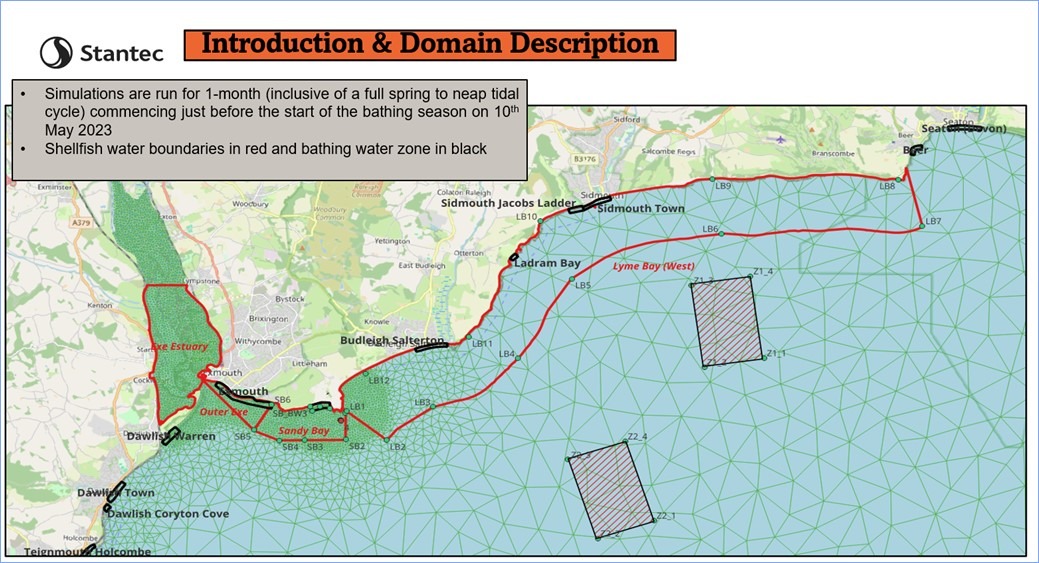
The map below shows the Water Framework Directive (WFD) Shellfish Water Protected Areas (red outlined areas). The shellfish monitoring points marked on the offshore shellfish harvesting beds are shown by the green rectangles. Harvesting could potentially take place anywhere within the green polygons, so we need to protect the whole of these areas.
Could the replacement outfall have an impact on the shellfish waters?
When South West Water modelled the impacts on the shellfish waters, they assessed the values at the shellfish water boundary and at the four compass points 60m and 120m from the outfall.
They have identified that, in the worst-case scenario, the impact at the shellfish waters would be greater.
The model suggests the water quality is generally good enough to meet the current standard, but some locations still contain more E. coli than would be allowed under a tougher standard. As a result, the stricter target is not consistently achieved across all areas.
For information:
The modelling indicates compliance with the 5.25 log-reduction standard overall. However, predicted E. coli concentrations at several locations within Sandy Bay and Lyme Bay West remain above the level associated with the more stringent 6.6 log-reduction standard, indicating that this higher standard would not be achieved consistently across the study area.
Since Sandy Bay shellfish waters are not currently harvested, the 5.25 log reduction applies.
Lyme Bay shellfish waters are classified as Class A and should be assessed against the stricter 6.6 log reductions. While the shellfish harvesting beds are located further offshore, the area we can protect under the Water Framework Directive is limited to the designated Shellfish Water area, which extends one nautical mile off the coast.
Log-reduction describes how much the treatment reduces bacteria. A 6.6 log reduction removes far more bacteria than a 5.25 log reduction, so it is a much tougher requirement.
What happens if they decide to start harvesting the Sandy Bay shellfish before they complete the WWTW upgrades?
We will need to take this eventuality into account when we determine the application. We need to be comfortable that the risk to the shellfishery can be managed. The decision about whether harvesting is permitted will be made by the Food Standards Agency.
For background:
Shellfish Water Protected Areas usually overlay the harvesting areas but the WFD remit only extends to one nautical mile, so this was not possible for the offshore beds shown on the map. An inshore strip has been designated instead to pick up any land-based influences.
WFD microbial compliance is based on shellfish flesh, not water quality. We use data collected for the FSA and use it for WFD compliance (so the same set of data is used for two different purposes by the two organisations).
There are a lot of new housing developments in Exmouth. Does South West Water's infrastructure have capacity to cope with this demand?
It is South West Water’s responsibility to decide if their sewerage infrastructure has sufficient capacity to accept foul effluent arising from new housing. East Devon District Council, as the Local Planning Authority (LPA), are responsible for determining planning applications for housing developments. The LPA will consult SWW during the planning application process and SWW will advise on sewerage capacity. The LPA considers the capacity of sewerage infrastructure during their determination of an application.
We provided a response to the East Devon District Council Local Plan consultation. In that response, our principal concerns relate to water quality, wastewater infrastructure capacity, flood risk and the cumulative environmental impacts of planned growth across East Devon. For Exmouth specifically, we have identified a number of environmental considerations affecting proposed development sites, including increased flood risk, river health and the need for sustainable drainage systems and green infrastructure. We have also highlighted the importance of protecting bathing waters, shellfish waters and the Exe Estuary from any deterioration in water quality that could arise from increased wastewater discharges associated with growth.
Who did the modelling? Will we be validating the modelling? Who will be doing the validation? How are you doing that? What assumptions are being made?
The hydrodynamic and water quality modelling was undertaken by South West Water's appointed consultants, Stantec. Calibration and validation of the model were completed as part of the model development process and are documented within the supporting technical reports available through the open consultation.
Details of the validation approach, performance statistics, model assumptions and limitations are provided within the consultation documents. In particular, these can be found in Exe Estuary Coastal Modelling Assessment. As this PDF contains two reports, navigation can be slightly confusing. The River Exe Calibration Report begins on page 20 of the PDF.
We have not undertaken separate modelling. Instead, our assessment has involved reviewing the modelling methodology, assumptions, calibration and validation evidence submitted in support of the application to determine whether the evidence is sufficient to inform the permitting decision.
Following this consultation, we will begin determining the permit applications. Your consultation comments will be considered. If we think we will grant the permits, we will produce draft decision documents and draft permits and consult again on these draft documents.
In the draft decision document, we will say whether we agree with South West Water’s risk assessment based on their modelling. If modelling is a key issue in the determination, then we would include more detail about the modelling review and conclusions.
If you refuse these permit applications, or South West Water cannot meet the conditions of the Local Enforcement Position, and can no longer use the replacement outfall off Straight Point, what would be the alternative?
If the replacement outfall off Straight Point cannot be used, South West Water would have to revert to using the old outfall which is permitted to discharge at a single location at SY 0397 7919 into Lyme Bay.
Note that the old outfall does not have as many diffuser ports and is a smaller pipe than the replacement outfall.
We have received the following questions from ESCAPE:
Permit / documentation
Spill calculations are modelled by SWW with the requirement to reach the 10 spill per year target. Cubic meterage of total spills can be provided to us which are reviewed for comment as to whether improvements will achieve the required outcome. Although our marine modelling team review the modelling results submitted to us, we don’t have the facility to carry out additional modelling with the purpose of double checking SWW’s modelling. So, as with all WINEP improvements, we sign off schemes based on provided data, which then become a regulatory focus where enforcement teams monitor asset performance to ensure it matches the modelled outcomes. If an asset is not achieving the requirements, it will be enforced against and OFWAT will penalise SWW for non-delivery of a WINEP scheme, along with the requirement to make the original improvements.
SWW have told us that the 7.5 spill count will be achieved by the increase in pumped flows from Maer Road & Phear Park SPS, by moving the increased flows through the STW:
The Exmouth Shellfish No Deterioration SW_ND AMP7 Projects – South West Water Technical Report June 2022 states that ‘The Water Industry National Environment Programme (WINEP) output for this scheme is to deliver no more than 10 significant (>50m3) spills per annum from the aggregation of Maer Road Sewage Pumping Station (SPS) Combined Sewer Overflow (CSO) and Phear Park SPS CSO.
You will need to confirm with South West Water that the reductions are linked because the 2 overflows are combined at the STW and discharged from the same outfall. Please also speak to SWW for greater detail on the calculations of future spill performance.
The spill figures and volumes are not taken from the EDM report, they are from modelled data. The design for this scheme was being created 2019-2023 so EDM data for asset spills wouldn’t have been available. SWW created a model which included many variables, to predict CSO action. The model used a 10-year rainfall prediction and assumes constant pumping at permitted rate, which may not match real time operations so variances will occur. As schemes are planned for the future predictive modelling has to be used, but once built we expect the asset to perform as the model predicts. If it doesn’t it will be a compliance issue which will be dealt with through regulation.
Answered under Q4 below.
More up to date modelling was shared on Citizen Space on 25 August, and the consultation extended to 6 October to allow more time to review the new documents. Unlike the previous worst-case scenario modelling, this study looks at a 10-year period and reflects more realistic conditions. This gives a more accurate understanding of the outfall's likely performance and potential effects.
You can find the updated documents on Citizen Space(External link) as Documents 95 and 96.
5. Why is there only modelling for Sandy Bay and Budleigh Salterton? Exmouth bathing water is only 2 km to the west compared with 4 km for Budleigh?
Exmouth Bathing Water was screened out based on the earlier Coastal Modelling Assessment, which concluded that the effluent plume would not reach Exmouth Bathing Water.
LEP / Monitoring Plan
6. There is insufficient time to obtain sufficient verification of the modelling before the end of the 2026 bathing season. Given the likelihood of higher-than-normal rainfall in the autumn can the testing be extended?
We will not continue to sample bathing waters or associated freshwaters after the end of the bathing water season.
SWW have also confirmed that they will not resource further Bathing Water monitoring after the season ends. EA modelling specialists are content that the modelling of the plume/tides is based on well-established principles and is sufficient to demonstrate no/very low risk to the bathing waters. The monitoring of storm overflow bacterial load will verify the accuracy of the bacterial load assumed by the modelling and this will inform any decisions regarding enacting the contingency plans.
In addition, any high bathing water results would be very difficult to attribute to the new outfall with any statistical certainty, particularly as the bacterial load of the bathing water will increase over winter with the wetter weather. It would therefore be of limited use in determining if the outfall was the cause. Monitoring over the winter would also come with complications around practicality and health and safety risks as demonstrated by previous trials of year-round monitoring and would require resource that we are unable to provide at present.
7. The auto sampling procedure is predicated on average spill durations of 10 - 12 hours but this is using the 12/24 count method. The average of active spill events in 2025 (to the end of July) for Maer Lane is just 3.18 hours (Min 0.14 - Max 69 hours). Only 12 of 215 activations were more than 12 hours. The sampling process will therefore dilute storm water with treated effluent when operating a six-hour sampling mix. This does not give an accurate representation of bacterial load during a spill event. Should the composite sample be restricted to only when the storm water overflow is active?
We answered this at the meeting on Tuesday 15 September.
The auto sampler will only sample whilst the storm overflow is active. Even if there is a fault in the communication between the overflow monitor and the auto sampler, the sampler is physically unable to collect a sample containing final effluent only, due to the level of the autosampler intake and the maximum final effluent flow level within the chamber. Therefore, there is no need for a short spill exception rule.
There is an action for SWW to contact the ESCAPE group directly about providing their monitoring results to you.
8. As the AMP 7 is an incomplete intermediate fix with no increase to the 273 /s treatment capacity this step is just moving the pollution problem from one location to another. To ensure the completion of the AMP8 phase can the EA approve the permit variation with conditions including a) continuing enhanced water quality monitoring, b) an agreed contingency plan and c) holding SWW to an agreed delivery timetable?
We can’t pre-determine the outcome of the determination process. Therefore, we can’t comment on whether the permit variations will be approved or pre-determine what conditions any permit variations may include.