
How we regulate industrial sites
Landfill sites
- The waste as it is deposited can produce an odour like a household dustbin.
- Gases produced by the degradation of the waste over time.
- Verifying the presence, type and intensity of odour in the vicinity of a permitted site,
- Identifying whether the site is the likely source of the odour, and if proven, going on site to determine the causes of any odours and whether the operator is taking appropriate measures to control the odour.
- Odour due to activities on the site at a level likely to cause pollution outside the site boundary is substantiated by an officer, and
- The operator is not taking all appropriate measures to control that odour.
- No odour
- Very faint odour (need to inhale into the wind to smell anything)
- Faint odour (you can detect an odour when you inhale normally)
- Distinct odour (there is clearly an odour in the air as you leave your car or enter the area)
- Strong odour (a bearable odour but strong, you could stay in the area for some time)
- Very strong odour (unpleasantly strong, you will want to leave the area quickly)
- Extremely strong odour (likely to cause nausea and a strong need to remove yourself from the odour immediately).
Smell from landfill sites
Landfill operations will always have periodic odours but this should not be a sustained event.
There are two main sources of odours at a landfill site:
When waste is disposed of at the site it is done in phases (known as cells). Once a cell is full of waste it is capped off (sealed) with an impermeable covering. This prevents rainwater getting into the cell and aids the collection of the landfill gas which is produced when the waste starts to break down. Landfill gas typically contains methane (approximately 65%) and carbon dioxide (35%) which are not odorous gases. There will typically be a range of other compounds at relatively low concentrations within the landfill gas known as trace gases. These trace gases can contain substances which cause landfill gas to be odorous, such as hydrogen sulphide (H2S).
Hydrogen Sulphide is a trace gas that can cause the 'rotten eggs' smell, it can be smelt at much lower concentrations than the levels that can cause harm. Any gases will have undergone significant dilution by the time they are smelt within the local proximity, and it is very unlikely to impact human health.
Landfill gas odours can be the result of several factors: some of these may be a result of management failures, others are the result of planned and necessary works such as the installation of new gas extraction infrastructure.
Where odours come from
Odours are the result of complex interactions within the site. Whether they can be smelt off-site, and where they will be smelt, is often a result of local weather conditions. If you notice the smell one day but not the next this could be because of a change in temperature, wind speed or direction or a change in atmospheric pressure.
For example, gasses will always move toward an area of lower pressure, as a result we are more likely to experience odours when the atmospheric pressure is low or falling. Similarly, on colder or still days the odours are not dispersed as quickly which means we are more likely to experience odours.
Health impact of landfill odour
We consult with and follow advice and information provided by health professionals such as UK Health and Safety Agency (UKHSA) when making decisions on the risks from landfills we regulate. You can read more about the impact on health from landfill site emissions in "Impact on Health of Emissions from Landfill Sites", which you can view here:
https://www.gov.uk/government/publications/landfill-sites-impact-on-health-from-emissions
Exposure to odours can adversely affect people’s perception of their health and sense of wellbeing. Several studies have demonstrated that odorous chemicals, present at levels not considered toxic or irritant, can lead to symptoms such as headache, nausea, shortness of breath or sore throats.
Whenever people are concerned about their personal health, they should visit their General Practitioner (GP) or contact NHS Direct on 111 or https://www.nhs.uk/
Regulating off-site odour from landfill
The permit includes a condition that requires the operator to prevent odour off site or, where that is not possible, to keep it to a minimum. The operator will describe how it will achieve this in a document called an Odour Management Plan (OMP). The OMP must be kept up to date and each revision is assessed by our officers to ensure it covers all the key areas of operations in relation to odour management.
Officers assess compliance with the odour condition by:
Officers carry out odour investigations (including off-site odour assessments) in accordance with our guidance and by reference to published odour management guidance(External link).
Odour intensity describes the strength of the odour as perceived by an individual officer. We record odour intensity using a scale of 0 to 6, where 0 = no odour, 3 = distinct odour and 6 = extremely strong odour.
A permit breach will only be recorded where:
If the operator is taking appropriate measures, then no breach of the permit has occurred, even if there is some odour. We would expect the operator to identify appropriate measures in its OMP, but we may require additional measures if serious odour pollution occurs.
The operator is informed about any odour reports we receive that relate to the site, but we do not release personal data, so they cannot identify individual reporters. The operator is expected to respond to reports of odour in accordance with its OMP for the site, and to advise us of any resulting changes to operations.
Assessing site compliance
It is our role to assess compliance with the permits and to take appropriate regulatory action if we identify any breaches. We do so by reference to our enforcement and sanctions policy and the Government’s core guidance on environmental permitting, and with appropriate regard to the Regulators' Code.
Our regulatory team assess compliance with the permit conditions at Bletchley Landfill in several ways including site inspection, audit, off-site odour assessments, and review of reports and monitoring data. We charge all permit-holders subsistence fees, which cover the cost of these routine regulatory activities. Subsistence fees do not cover provision of a constant officer presence on any permitted site. This is explained in more detail in the guidance to our charging scheme.
A CAR is used to record the findings of our site inspections, audits and monitoring activities, reviews of monitoring and other data/reports. We use our guidance on assessing and scoring environmental permit compliance to score permit breaches in accordance with our Compliance Classification Scheme (CCS).
The risk category and score we give a non-compliance reflects the potential impact it could have if it were not addressed promptly and adequately. The only exception is for non-compliances relating to amenity conditions - odour, dust, noise and pests. We categorise the risk and score these according to their actual (rather than potential) impact.
There are 4 risk categories of non-compliance. They represent the severity of the reasonably foreseeable impact, or in the case of amenity conditions, the actual impact. Each risk category is scored. The scores are accumulated during the compliance year.
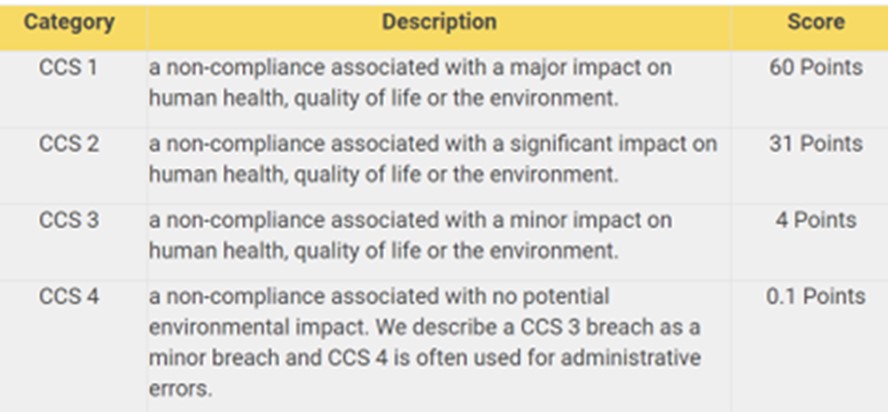
Further Information about how we score permit breaches, and how this impacts on the sites annual subsistence fees is set out in our guidance on assessing and scoring environmental permit compliance.
Use of "sniff tests" for odour assessments
Sniff testing is the name given to the assessment of smells using the human nose. Some people are surprised that the human nose is used rather than monitoring equipment. There are several reasons for this.
The odour condition in environmental permits require odour pollution to be “perceived by an authorised officer” which means that it is necessary for an officer to smell the odour themselves.
Odour intensity describes the strength of the odour as perceived by an individual officer. Our officers record odour intensity using a scale of 0 to 6 as follows:
The human nose is still the best means we have for detecting the full range of gases that cause odour. The concentrations at which these odorous gases are present in outdoor (ambient) air is usually very low beyond site boundaries (even if the smell is intense), and few pieces of equipment are sensitive enough to pick up the full range of these gases, when compared to the nose. In addition, sniff testing is physically versatile and allows us to assess odour at most locations without restrictions relating to external power, weather conditions, terrain etc.
Revoking permits and closing sites due to odour
We only revoke permits where we consider that the operation poses a serious risk to the environment or human health, and all other ways to reduce the odour have been exhausted. We do not believe that the issues at Bletchley landfill pose this kind of risk. We also believe the actions the operator takes will resolve the problem.
Can we close the site down?
We would only do this in the most extreme circumstances. Closing the site down means loss of the business and the employees losing their jobs. It would also mean the service of household, industrial and commercial waste disposal by the landfill would be lost and the waste would have to be directed somewhere else. Closing the site down would not stop the odours, work would still be required to identify and address all odour sources.