
FAQs
1. Why do we need the Butteryhaugh Flood Alleviation Scheme?
Butteryhaugh is a small village located at the confluence of the Kielder Burn and the River North Tyne. The village does currently benefit from seven flood defence assets located on the left bank of the Kielder Burn and North Tyne, which are shown in figure 1 below. Despite these existing assets, the community has a recent history of flooding, with the most recent event being in January 2024. In addition, a number of these assets are unsafe to maintain for our staff due to steep sides and narrow crest widths.
Map of existing main river flood defence assets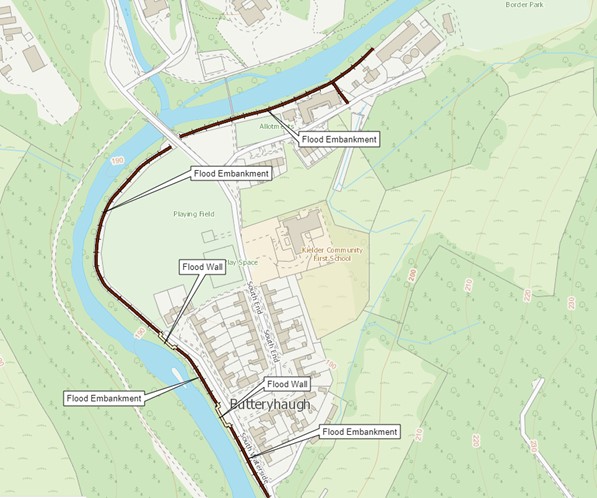
2. What would a flood map of Butteryhaugh look like without flood defences?
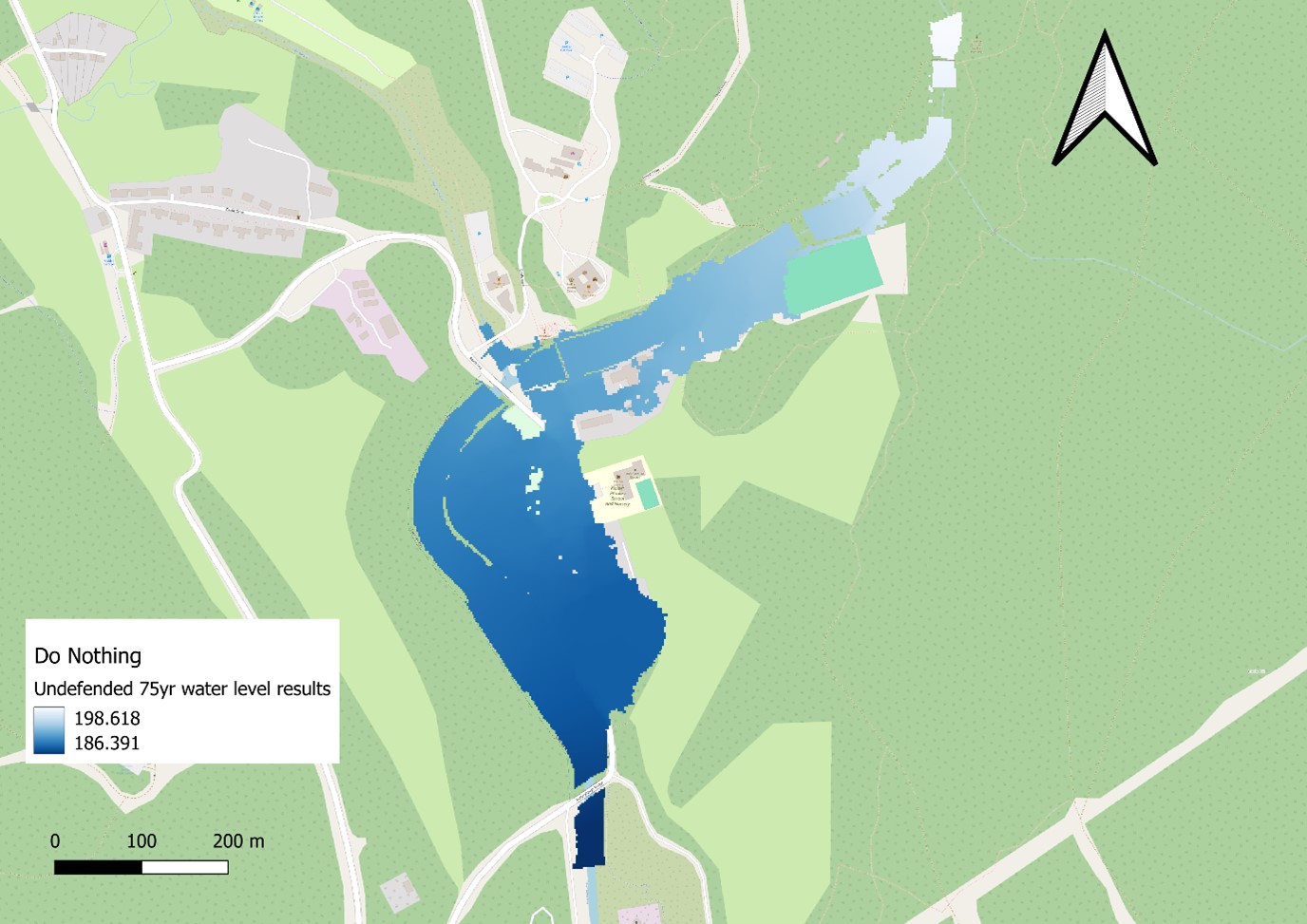
Although there are existing flood defences, it is practical to consider the undefended flood risk scenario because of the inconsistent dimensions of the current flood embankments, our inability to maintain the assets effectively, and in recognition of the upstream flow route. Figure 2 presents the probable flooding expected during an undefended 1 in 75-year return period event.
Figure 2. Undefended 1 in 75-year return period event flood extent and expected water levels
3. What were the probabilities of the flood events that have impacted Butteryhaugh in recent years?
We are unable to calculate a return period at Butteryhaugh gauging station itself as it only records river level and we need flow data to calculate flood return periods.
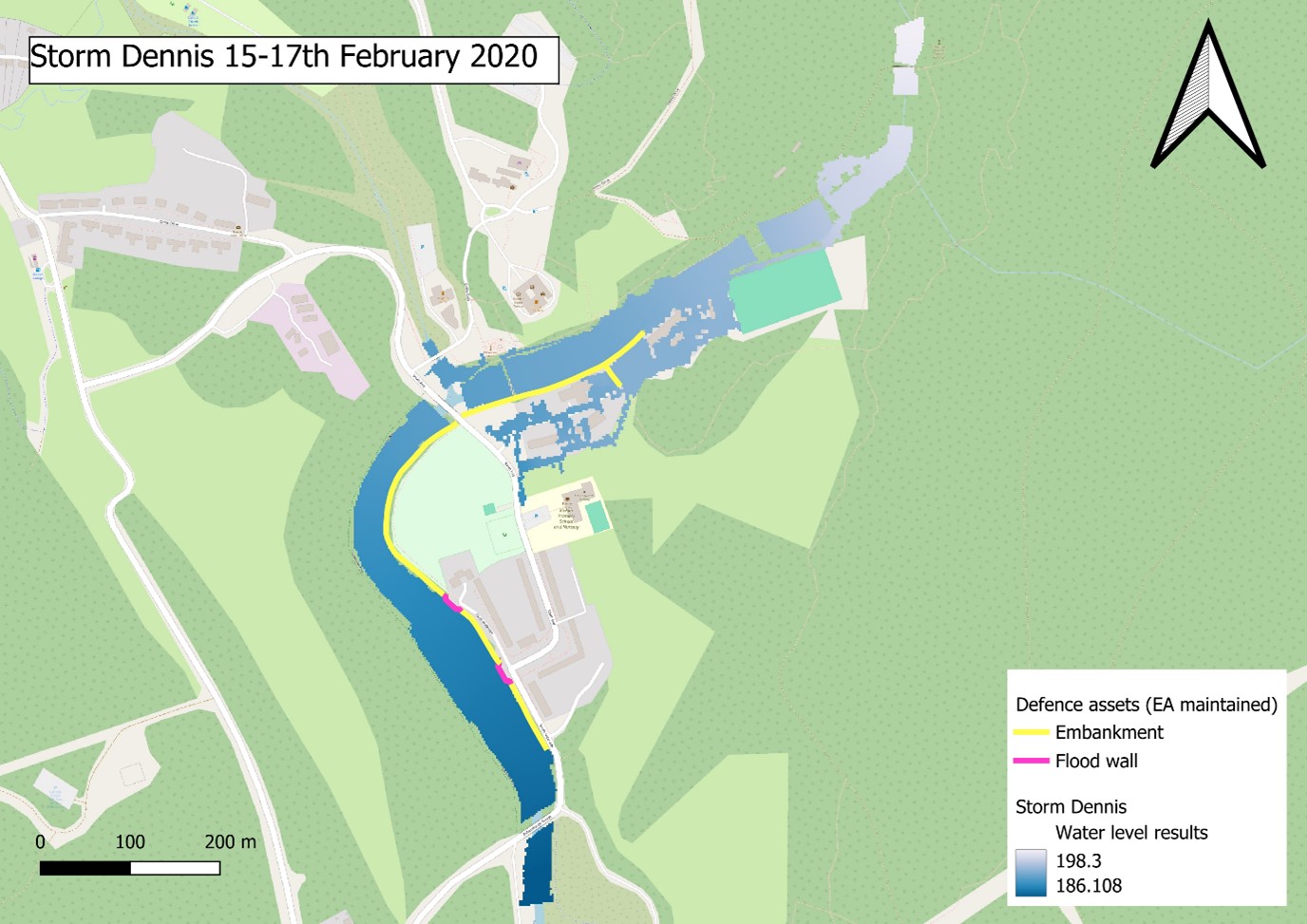
We were able to interpret the rainfall return periods from neighbouring gauging stations and Storm Dennis in February 2020 demonstrated a 1 in 3-year return period. It is worth noting that the flooding during this particular event was also impacted by the antecedent conditions and snow melt. Storm Isha in January 2024 was recorded as a 1 in 8-year rainfall event, with a heavy frost exacerbating the flood risk. Neither of these events demonstrated significant rainfall which reaffirms the need to revisit the flood defences present at Butteryhaugh.
Figure 3 exhibits the flood outline associated with Storm Dennis and highlights the upstream flow route that will look to be addressed as part of the flood alleviation scheme.
Figure 3. Storm Dennis flood outline and water levels
4. What is the expected impact on the Border Park Rugby Club?
It has been established that there is a flow route from the Kielder Burn which makes its way over the rugby pitch and into the village, which we’d like to try and manage to reduce flood risk to the community. The preferred way forward for the scheme will require a new flood embankment to be constructed in front of the club house which will tie into a reinforced concrete wall behind the Salmon Centre.
It is expected that the dimensions of the flood embankment will be up to 1m high and 6m wide. It has been confirmed that these dimensions will still allow games to be observed from the clubhouse. The proposed embankment which cuts across in front of the clubhouse would manage the out of bank flow route effectively and will have no physical impact on the playing area. This embankment can be designed to enable club mowers and equipment to pass over for pitch maintenance purposes. The embankment would meet the requirement of helping to reduce flood risk to the community and also protect the clubhouse and existing infrastructure of the Rugby Club.
5. What is the expected impact on the allotment gardens?
It was originally anticipated that we would be raising and re-profiling the adjacent flood embankment which would encroach into the allotments by approximately 2m along its length plus additional width for access and maintenance.
Through the detailed design process, however, it was determined that extending the flood wall is the preferred way forward given the limited space in this area. Repositioning of the Northern Power Grid (NPG) pole is required as part of the works. We are waiting for NPG marking the pole locations on the ground for further discussion with the Kielder Parish Council (KPC).
6. What is the expected impact on the playing field downstream of the road bridge?
A section of the embankment at the playing field will be re-aligned in order to reduce the throttle affect around the bridge (see Overall General Arrangement Plan document).
A portion of the existing fence will also need to be removed. A public safety risk assessment (PSRA) will be carried out in consultation with the Parish Council to determine future fence requirements. There is an option being considered to not reinstall a fence but to open the wet side of the new embankment for recreation with a path, benches and perennial flower planting. Please see the quick poll question to provide feedback on this.
The playing field will be used for the site compound during the construction phase of the scheme, currently forecast September 2026 to June 2027.
7. What is the expected impact on traffic?
Where there will be disruption or planned works during construction, we will communicate this in advance and minimise disruption as much as possible. A detailed traffic survey will be done to make sure the correct signage and signals are deployed to meet highways standards which the works are being delivered.
8. Are there known risks that could lead to delays or prevent delivery of the scheme?
Affordability / funding eligibility - The Outline Business Case (OBC) approval has unlocked funding to progress the project to the next stage, which included the completion of Ground Investigation, Surveys, the Detailed Design, securing of permissions and completion of the Full Business Case (FBC).
The scheme does currently have a funding gap, however, we will continue to work hard to secure the funds needed to deliver the construction phase of the project.
Planning Permission – An appropriate amount of time has been programmed in for the planning permission, but it is possible for delays to be observed with the Local Planning Authority.
9. What impact will the scheme have on surface water flood risk?
The cross-bank flood embankment on the Border Park Rugby Club land will tie into the line of defences adjacent to the Kielder Burn and will inhibit the existing pathway for a proportion of the overland flows. This, in combination with Forestry England ditch works will provide some surface water benefit. It is worth noting, however, that some surface water impacts will continue to happen in isolation given the localised depressions around several properties.
During the engagement event in January 2025, a resident informed us of blocked road drains around South End / South Waterside. We have raised this with Northumberland County Council and we were asked to share the website fix.northumberland.gov.uk, to increase awareness of this route to inform the council of such matters.
A further relevant issue raised during the engagement event was in relation to the sewer and surface water network. Comments centred around gurgling toilets during heavy rain, concerns of capacity of the sewer system, manholes popping in rainfall events, and pumping station performance concerns. After raising these issues with Northumbrian Water, there is potential for this area to be considered within the Northumbria Integrated Drainage Partnership (NIDP). It is believed that a Kielder Integrated Drainage Study will be carried out but we are awaiting confirmation.
10. What considerations are being made for Bakethin Weir and Reservoir downstream?
During the engagement event in January 2025, it was mentioned by several residents that the weir and reservoir downstream can have an impact on water levels near the Southern extent of Butteryhaugh.
As part of the sensitivity testing for the design, the influence of Bakethin Reservoir and Weir have been considered and will be accounted for when determining the final crest levels for the flood defences.